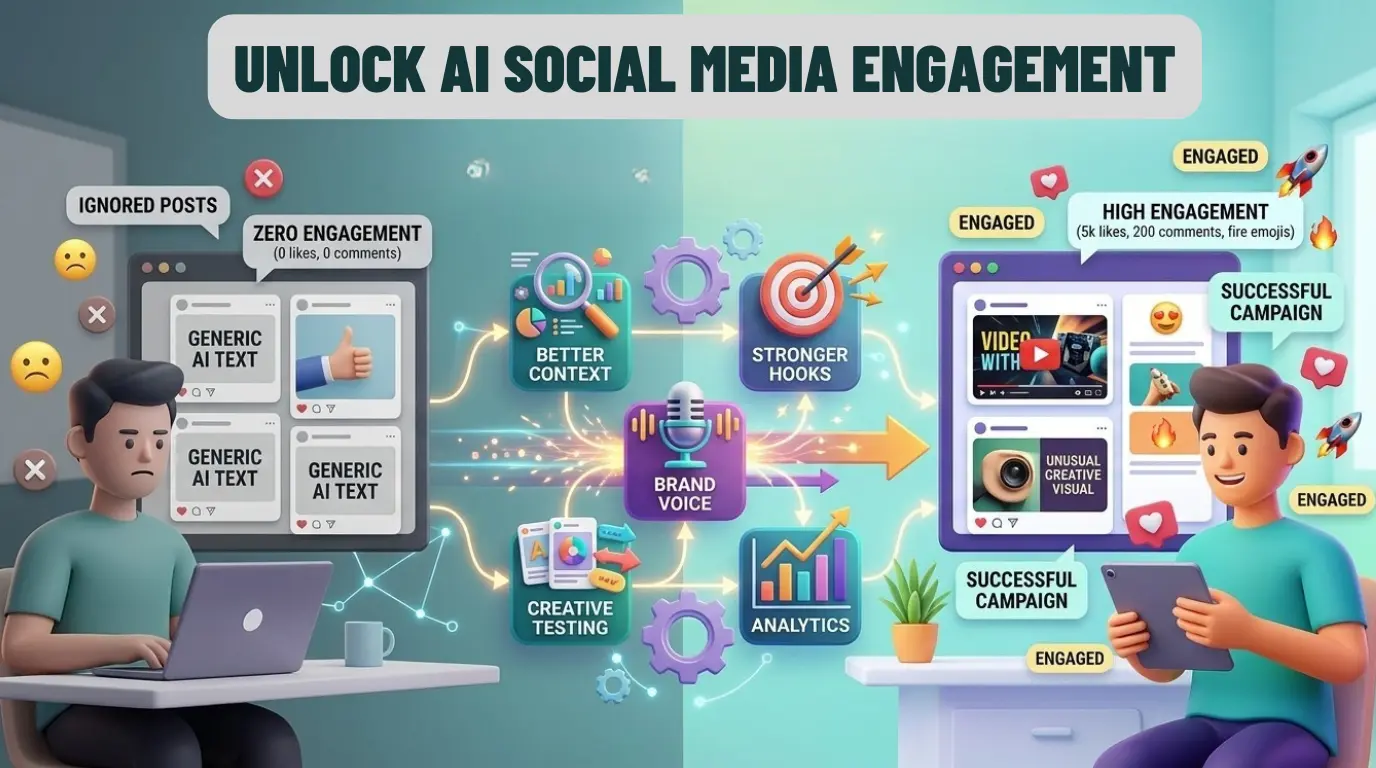
Learn why AI social media content gets ignored and how better context, hooks, brand voice, creative testing, and analytics can improve engagement.
Why AI Social Media Content Gets Ignored
AI can create social media content quickly, but speed does not guarantee engagement. A post can be polished, grammatically correct, and ready in seconds—and still earn few likes, comments, shares, saves, or clicks.
Think of engagement as a chain rather than a single metric: the hook earns attention, the message earns relevance, the creative makes the idea easy to consume, and the CTA gives the audience a clear next action. If one link is weak, publishing more often rarely fixes the underlying problem.
The problem is often the information behind the content. AI does not automatically know what your audience cares about, what makes your brand different, which topics are already overused, or what should make someone stop scrolling.
That is why better AI social media content starts with better inputs: audience context, a clear goal, brand voice, a strong creative angle, and a way to learn from performance.
A practical test is to explain the post without mentioning the technology behind it. If the idea would still be useful, specific, and interesting whether a human or AI drafted it, you are starting from the right place.
A useful way to think about engagement is to work backward from the action you want: stop the scroll, earn attention, deliver value, then give the reader a reason to respond. When those steps are disconnected, even technically strong AI content can feel forgettable.
6 Reasons Your AI Content Isn't Getting Engagement
Before publishing more content, check whether one of these problems is holding your posts back.
1. Your content sounds generic.
AI can produce fluent copy that says very little about your actual business. “Here are 5 powerful tips to grow your business” could belong to almost any account. Make the message specific to your audience, offer, point of view, and experience.
2. You're creating for everyone.
Broad targeting makes relevance harder. Compare “These social media tips will help your business” with “If you run a small e-commerce brand and create every post yourself, start here.” The second version tells the right reader immediately that the post is for them.
3. Your hooks aren't strong enough.
People decide quickly whether to keep reading. Replace safe openings such as “Today we will discuss social media marketing” with a sharper problem, result, contrast, or question that creates a reason to continue.
A useful hook should promise something the post actually delivers. Avoid exaggerated claims that create a click but lose trust; strong social copy makes the value clear early and then follows through.
4. You're repeating the same format.
AI makes repetition easy. Rotate text posts, quote graphics, carousels, product visuals, ad creatives, and UGC-style content so the audience does not see the same content pattern every day.
5. Your visual does not support the message.
A strong caption cannot rescue a confusing creative. The visual should make three things clear quickly: what this is, who it is for, and why it matters.
6. You're not learning from performance.
Publishing is only half the process. Track engagement, shares, saves, comments, clicks, reach, and watch time where relevant, then use the strongest patterns to shape the next variation.
Do not treat every metric as equally important. A post with fewer likes but strong saves or clicks may be more valuable than a highly visible post that produces little action. Measure the signal that matches the goal.

How to Fix Your AI Social Media Content
A stronger workflow is simple:
Audience-->Brand-->Competitor insights-->Content idea-->Hook -->Creative-->Publish-->Analyze
-->Improve
The goal is not to make the prompt longer. It is to give the AI better information before generation starts, then improve the output based on what your audience actually responds to.
You can make this repeatable with a simple brief: audience, objective, topic, angle, platform, format, brand voice, evidence, CTA, and constraints. That gives the AI enough direction without forcing you to write a huge prompt every time.
Before you generate, define the audience, goal, platform, and content angle. After generation, review the result against those same inputs so the workflow stays focused instead of becoming a stream of disconnected AI drafts.
Related: AI Social Media Content: The Complete Guide to Better Content at Scale
Use Brand DNA to Make Content More Relevant
If AI does not know how your brand speaks, it has to guess. That is one reason generic output can feel polished but interchangeable.
Your brand context should include your audience, positioning, offers, communication style, content preferences, and examples of content you already like. The more relevant the context, the easier it is to create posts that feel recognizable rather than generic.
The Post Engine's Brand DNA helps define brand voice, audience, positioning, offers, and content style so AI-assisted content can stay more consistent.
A useful test is simple: could a competitor replace your logo with theirs and publish the same sentence? If yes, the content probably needs more brand context or a stronger point of view.
Brand consistency should make your content recognizable, not repetitive. Keep the core voice and positioning stable while allowing the hook, format, examples, and creative treatment to change from post to post.
This is where Brand DNA becomes practical: instead of describing your brand from scratch for every prompt, you can give AI a reusable foundation for voice, positioning, audience, and content style.
Use Competitor Intelligence to Find Better Content Ideas
Sometimes engagement is low because the topic is not differentiated. Your competitors may already be publishing the same tips, formats, and hooks your audience has seen many times.
Look for patterns rather than copying them:
Repeated topics
Winning formats
Popular hooks
Content gaps
Different positioning
Questions competitors are not answering
The useful question is not “What should we copy?” It is “What does the market keep saying—and what useful angle is missing?”
Look at gaps in questions, not just gaps in topics. If competitors explain what a product does but rarely show how customers use it, the missing demonstration may be a stronger content opportunity than another list of features.
A simple rule helps: borrow the insight, not the wording. The strongest competitor research finds an unmet question or a different point of view that your own brand can answer better.
Explore AI Competitor Analysis for Social Media to turn competitor patterns into original content opportunities.
Create and Test Different Content Variations
Do not assume the first AI-generated version is the best one. Create controlled variations around the same idea so you can learn what actually earns attention.
Change one or more of these elements:
Hook
Headline
Visual
Format
CTA
Content angle
For example, the same topic can become a problem-focused version, a contrarian version, and a result-focused version. Compare the performance instead of choosing a winner by intuition alone.
Testing also becomes more useful when you change one variable at a time. For example, keep the topic and audience the same while testing two different hooks, so the performance signal is easier to interpret.
For larger campaigns, test in layers: first the angle, then the hook, then the creative treatment, and finally the CTA. This reduces guesswork and helps you understand which part of the message is actually driving the response.

Improve Your AI Social Media Strategy With The Post Engine
Low-performing AI content is often a workflow problem, not simply a generation problem. The Post Engine connects the parts that help you move from better inputs to better content decisions:
Brand DNA — Keep content aligned with your brand.
Competitor Intelligence — Understand patterns, gaps, and opportunities in your market.
AI Content Studio — Create posts, visuals, and different content formats.
Creative revisions — Improve ideas without starting over from scratch.
Analytics & Growth — Learn what performs and use that information in the next content cycle.
Together, these capabilities support a repeatable loop: strategy → creation → adaptation → publishing → analysis → improvement.
The benefit is continuity. The insight from one content cycle can inform the next brief, creative variation, and publishing decision instead of disappearing after a single post.
Over time, this creates a compounding advantage: your content process gets faster because your team learns what to repeat, what to change, and what to stop doing. The objective is not more output; it is better decisions at the same or lower effort.

When you are ready to make the workflow more systematic, start creating smarter social media content with The Post Engine →
Use the workflow as a system, not a one-off tool: build the brand context once, create stronger variations, learn from the results, and carry those lessons into the next content cycle.
Frequently Asked Questions
Why isn't my AI content getting engagement?
Common causes include generic messaging, weak hooks, broad targeting, repetitive formats, poor visuals, missing brand context, or a lack of performance-based iteration.
Does AI-generated content get less engagement?
Not automatically. Engagement depends more on relevance, creative quality, audience fit, brand context, and the overall content strategy than on whether AI was involved.
How can I make AI content sound less generic?
Give AI detailed brand context, define the audience and goal, use specific examples, create original angles, and revise the output instead of publishing the first draft.
Should I create more content if engagement is low?
Not necessarily. First identify what is failing. More content with the same problem can simply create more low-performing posts.
How can I improve AI social media engagement?
Focus on stronger hooks, clearer audiences, varied formats, better brand context, competitor insights, and continuous testing and improvement.
Final Takeaway
Low engagement does not necessarily mean AI is the problem. Often, the real issue is that the content lacks context, differentiation, or a strong learning loop.
Use Brand DNA for relevance. Use Competitor Intelligence for better ideas. Create multiple variations for testing. Use analytics to learn. Use AI for speed.
The goal is not to publish more AI content. It is to create content your audience actually wants to stop for, read, watch, save, share, or click.
When engagement is weak, diagnose before producing more. Ask whether the problem is relevance, differentiation, hook strength, creative quality, platform fit, or missing feedback. Fix the weakest link, then test again.
In practice, better AI social media content is the result of better inputs and better decisions—not simply more generation. The aim is content that feels relevant, recognizable, and worth engaging with.
Ready to create smarter social media content?