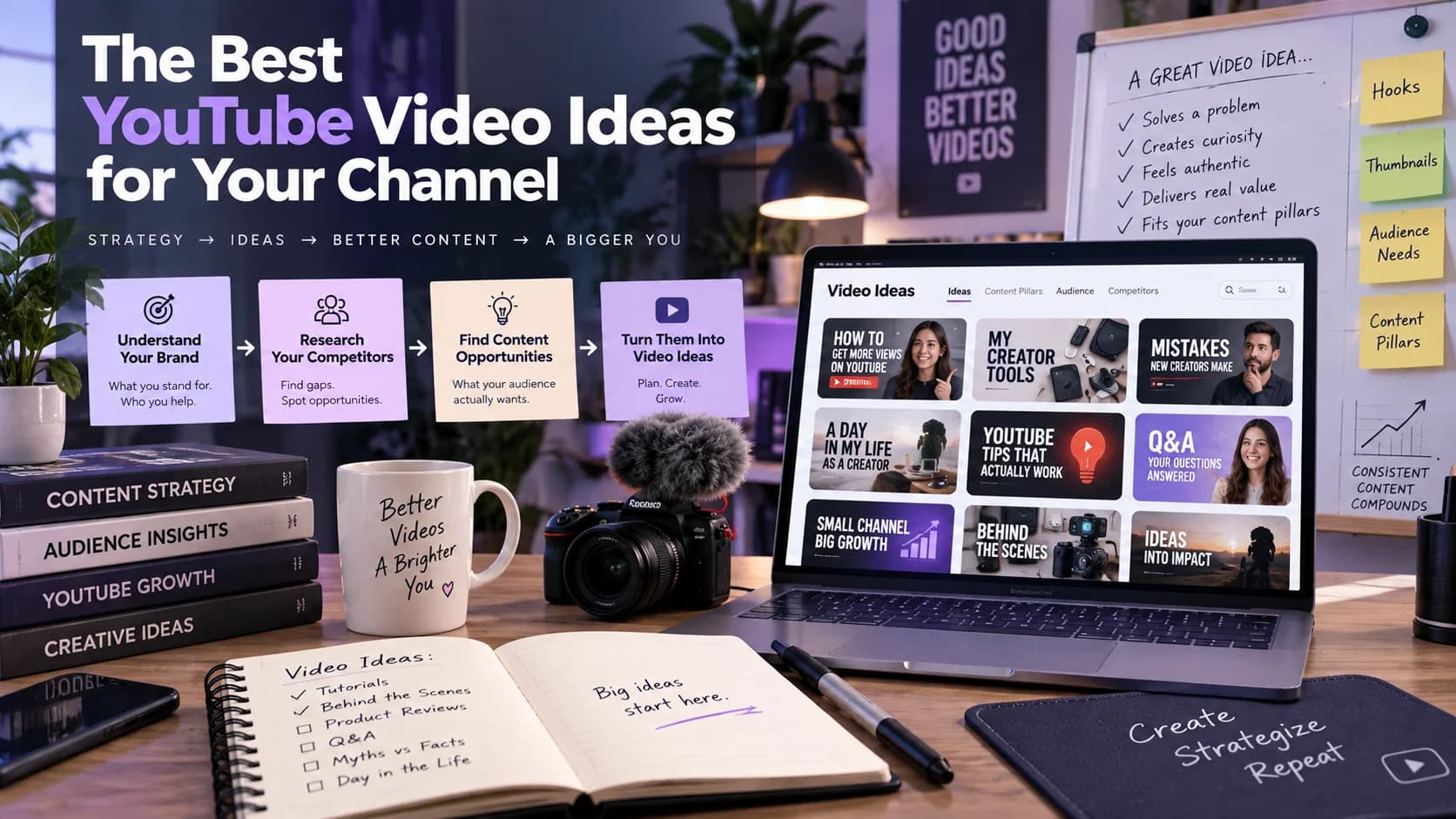
Find better YouTube video ideas using your brand, audience, and competitor insights. Learn how The Post Engine helps you discover winning topics and turn them into original video ideas.
Running out of YouTube video ideas is frustrating.
You know you need to publish consistently, but coming up with topics that are actually worth filming is harder than simply making a list of random ideas.
A better approach is to start with two things:
Your brand — what your channel is about, who you help, and what you want to be known for.
Your competitors — what is already getting attention in your niche, which formats are working, and where viewers still have unanswered questions.
That gives you ideas based on strategy, not guesswork.
With The Post Engine, you can use your Brands and Competitors workflows to build that foundation before deciding what to publish next.
What Makes a Good YouTube Video Idea?
A good YouTube idea should do more than sound interesting.
Before creating a video, ask:
Does my audience care about this?
Does it solve a real problem or satisfy curiosity?
Can I deliver a clear payoff?
Does it fit my channel?
Can I make the idea better or different from existing videos?
A useful idea sits where three things overlap:
Audience demand + Your expertise + A clear content opportunity
This is why copying the most-viewed video in your niche isn't enough.
A competitor's successful topic can be useful evidence, but your version needs its own angle.
10 YouTube Video Ideas That Work Across Niches
These are formats, not random topics. Replace the subject with something relevant to your audience.
1. How-To Tutorials
“How to [achieve a specific result]”
2. Beginner Guides
“The Beginner's Guide to [Topic]”
3. Mistakes Videos
“7 Mistakes to Avoid When [Doing Something]”
4. Comparisons
“X vs. Y: Which One Is Better?”
5. Reviews
“I Tested [Product/Method] — Here's What Happened”
6. Case Studies
“How [Person/Business] Achieved [Result]”
7. List Videos
“10 [Tools/Methods/Ideas] You Should Know”
8. Experiments
“I Tried [Method] for 30 Days”
9. Reactions and Analysis
“Here's What Everyone Gets Wrong About [Topic]”
10. FAQ Videos
“Your Most Asked Questions About [Topic], Answered”
These formats remain useful because they map to recurring viewer needs—learning, comparing, evaluating, discovering, and solving problems. Current 2026 idea guides continue to organize YouTube ideas around tutorials, listicles, reviews, Q&A, challenges, and other repeatable formats.
But there's a bigger question:
Which of these should your channel actually create?
That's where your own brand and competitor research become useful.
Use Your Brand to Find Better Video Ideas
Before researching competitors, define what your channel should be known for.
The Post Engine's Brands workflow can help you build that context around your business or creator brand.
Think about:
Your audience
Who are you creating videos for?
Your expertise
What can you explain better than most people?
Your positioning
What perspective does your channel have?
Your content pillars
What 3–5 subjects should repeatedly appear on your channel?
Your style
Are your videos educational, entertaining, analytical, inspirational, practical, or a mix?
The Post Engine's Brand DNA framework is designed to capture information such as your brand voice, audience, offers, values, content style, and content pillars so content can be generated with more relevant context.
That gives you a simple rule:
Don't start with “What video can I make?” Start with “What should my channel be known for?”

Use Competitors to Discover What to Create Next
Once you understand your own brand, look outward.
Your competitors can show you:
Topics getting attention
Winning video formats
Repeated hooks
Thumbnail patterns
Popular content themes
Content gaps
But don't simply sort a competitor's videos by views and copy the top one.
Instead ask:
Why did this video work?
For example, you might discover that several competitors have successful videos around:
“How to choose the right…”
The topic is useful, but the deeper insight could be:
Comparison-based videos perform well.
Beginner questions attract attention.
Practical examples are common.
Viewers want help making decisions.
Now you can build your own video:
“How to Choose the Right [Product] for Your Situation”
Same audience need.
Different content.
Turn Competitor Insights Into Original Videos
A simple framework is:
↓
Pattern
↓
Audience need
↓
Content gap
↓
Your angle
↓
Video idea
Example
Suppose a competitor's YouTube channel has several successful videos about:
“5 mistakes beginners make…”
You shouldn't simply make:
“7 mistakes beginners make…”
Instead, identify what the format is doing well.
Maybe it:
Targets beginners
Solves a specific problem
Creates curiosity
Uses a numbered structure
You could take that insight and create:
“The 5 Mistakes Experienced [Audience] Still Make”
Now you're using the format insight, not copying the content.
Recent 2026 YouTube competitor-analysis guidance makes this same distinction: effective competitor research looks at patterns, hooks, formats, and content gaps rather than copying individual videos.

Find the Gaps Your Competitors Are Missing
The best video idea isn't always the competitor's biggest video.
Sometimes it's the video they haven't made.
Look for five types of gaps.
Topic gap
Competitors answer:
“How does this work?”
But nobody answers:
“When should you actually use it?”
Audience gap
Competitors target advanced users.
Beginners are underserved.
Create:
“The Beginner's Guide to…”
Format gap
Everyone creates long-form tutorials.
You could test:
Shorts
Demonstrations
Experiments
Case studies
Q&A videos
Question gap
Look at recurring viewer questions.
A popular video can create dozens of follow-up questions.
Those questions are potential videos.
Perspective gap
Everyone says:
“Post consistently.”
Your channel could explore:
“Why posting every day may actually hurt your content.”
A different angle can make a familiar topic feel new.
Build a Repeatable YouTube Idea System With The Post Engine
Instead of researching competitors only when you run out of ideas, make it part of your normal workflow.
Step 1 — Build your Brand DNA
Define:
Audience → Positioning → Content pillars → Style
Step 2 — Analyze competitors
Use YouTube Intelligence to look at:
Winning videos → Hooks → Thumbnails → Formats → Posting patterns → Audience signals
Step 3 — Find the opportunity
Ask:
What is working?
What is missing?
What can we explain better?
Step 4 — Create your video
Turn the insight into:
Long-form video → Short → Thumbnail → Supporting content
Step 5 — Publish and learn
Measure the response and use the results to improve your next ideas.
The Post Engine's wider positioning connects Brand DNA, Competitor Intelligence, AI content creation, and publishing into one workflow.
How to Build a Social Media Workflow From Idea to Published Post

7 Questions to Ask Before Filming
Before committing time to a video, ask:
1. Who is this video for?
2. What problem or desire does it address?
3. What is the promised outcome?
4. Why would someone click this video?
5. What have competitors already covered?
6. What can I explain or demonstrate differently?
7. Can this idea become more than one piece of content?
If you can answer all seven, you have a much stronger starting point than a random AI-generated topic.
Frequently Asked Questions
How do I find good YouTube video ideas?
Start with your audience and content pillars, then analyze competitors to identify winning topics, formats, hooks, and gaps. Combine those insights with your own expertise to create an original angle.
Should I copy successful competitor videos?
No. Study why the video worked—its topic, format, hook, or audience need—and create something original around the insight.
Can AI generate YouTube video ideas?
Yes, but generic prompts can produce repetitive ideas. AI becomes more useful when it understands your brand and has competitor information to work from.
How many competitors should I analyze?
Start with a small group of relevant channels rather than trying to analyze the entire niche. Focus on channels competing for the same audience and subject area.
Can competitor analysis help me find YouTube video ideas?
Yes. Competitor analysis can reveal winning topics, hooks, formats, thumbnails, posting patterns, and content gaps. The Post Engine's YouTube Intelligence is specifically designed around these signals.
Stop Guessing What to Upload Next
The best YouTube video ideas usually aren't completely random.
They come from understanding:
Your audience
Your brand
What is already working
What competitors are missing
What you can explain differently
The Post Engine gives you two particularly useful starting points:
Brand DNA helps you understand your own channel and establish a reusable content foundation.
YouTube Intelligence helps you analyze competitor videos, hooks, thumbnails, formats, posting patterns, and audience signals to discover content opportunities.
Then the process becomes:
Understand your brand → Analyze competitors → Find the gap → Create the video → Publish → Learn
That is a much better way to build a YouTube channel than asking AI for another list of 50 random video ideas.
Find better ideas. Create with more direction. Build your YouTube channel around a strategy.