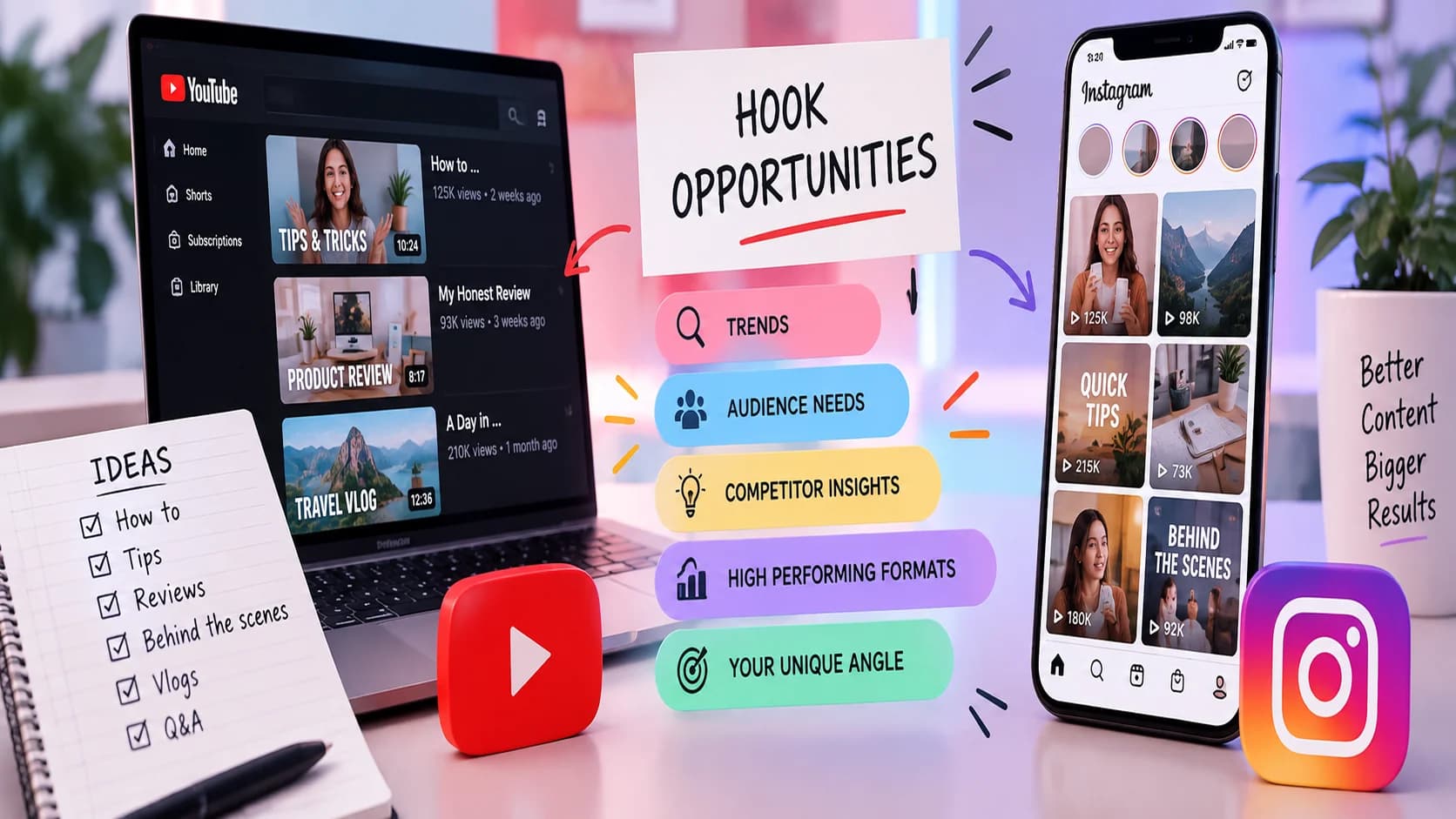
Discover the best hook opportunities for YouTube and Instagram. Learn how to use Brand DNA and competitor analysis to find stronger hooks and create content people want to watch.
You can have a great video and still get ignored.
Often, the problem isn't the topic.
It's the opening.
On YouTube, the title and thumbnail help earn the click, but the opening seconds need to convince the viewer to keep watching. On Instagram, the first frame, spoken line, on-screen text, and visual action compete with an endless feed.
Current 2026 hook research continues to emphasize curiosity, questions, bold claims, problem-solution setups, storytelling, and visual or pattern-interrupt openings.
But there is an even better approach than collecting hundreds of generic hook templates:
Find the hook patterns that fit your brand, audience, and competitors.
That's where The Post Engine's Brand DNA and Competitor Intelligence become useful.
What Is a Social Media Hook?
A hook is the opening element designed to earn the viewer's attention and make them continue.
It can be:
A spoken line
“You are probably making this mistake.”
On-screen text
“Stop doing this.”
A visual
Show the result before explaining how it happened.
A question
“Why are your videos getting views but no subscribers?”
A surprising statement
“Posting more may actually hurt your channel.”
A strong hook creates a reason to continue.
It should not simply sound dramatic.
It needs to promise something the content actually delivers.
YouTube Hooks vs. Instagram Hooks
The two platforms need related—but not identical—hook strategies.
YouTube
YouTube has multiple attention stages.
First, the title and thumbnail have to earn the click.
Then the opening has to confirm that the viewer made the right decision.
A useful YouTube hook usually establishes:
Expectation → Tension → Payoff
For example:
“I tested three AI video tools for 30 days. One looked impressive—but only one was actually useful.”
The viewer immediately knows:
What happened
What is being tested
That there is a result to discover
Current YouTube hook guides emphasize curiosity gaps, questions, bold claims, storytelling, and problem-solution openings while warning against slow introductions that delay the value.
Instagram Reels need to work even faster because the viewer can swipe immediately.
The hook can combine:
Visual + Text + Audio
For example:
Visual: Show the final result.
Text: “We completely changed this product campaign.”
Audio: “Here's what happened.”
Current Instagram hook research highlights curiosity gaps, direct questions, bold claims, storytelling, sensory/visual openings, and pattern interrupts as useful hook structures.
So don't simply copy a YouTube opening onto Instagram.
Adapt the hook to the way people consume the platform.
7 Hook Opportunities to Test
Rather than giving you 100 copy-paste phrases, here are seven hook structures you can adapt to your niche.
1. Curiosity Gap
Create an unanswered question.
“There's one reason this strategy keeps failing.”
Best for:
Educational videos
Explanations
Analysis
Mistakes
2. Problem → Solution
Name the problem immediately.
“If your Reels are getting views but no followers, fix this first.”
Best for:
Tutorials
Business content
How-to videos
Pain-point content
3. Strong Contrarian Claim
Challenge a common belief.
“You don't need to post every day to grow on Instagram.”
Best for:
Expert creators
Educational channels
Opinion content
The important part is being able to prove the claim.
4. Result First
Show the outcome before the explanation.
“This one change doubled the number of people watching past the first few seconds.”
Then explain how.
Best for:
Case studies
Experiments
Tutorials
Product demonstrations
5. Specific Question
Ask a question that immediately qualifies the viewer.
“Are you creating content for everyone—or for the people most likely to buy?”
Best for:
Business
E-commerce
Marketing
Educational content
6. Story Hook
Start inside the story instead of explaining the topic first.
“At 11 p.m., we realized the entire campaign was built around the wrong idea.”
Best for:
Case studies
Personal brands
Behind-the-scenes
Lessons
7. Pattern Interrupt
Break the expected opening.
Instead of beginning with:
“Today we're going to talk about…”
start with:
A visual transformation
A surprising result
A question
A short demonstration
A bold statement
Pattern interrupts are especially useful for short-form video because they immediately break the expected feed experience. Current 2026 hook guides specifically highlight pattern interrupts among effective short-form openings.

Use Brand DNA to Make Hooks Sound Like You
A hook can be technically strong and still feel wrong for your channel.
A luxury brand shouldn't sound like a meme account.
A technical educator shouldn't sound like a hype creator.
A fitness coach shouldn't communicate exactly like a SaaS company.
That's where brand context matters.
The Post Engine's Brand DNA Engine is designed to analyze your existing content to identify your voice, positioning, audience, content pillars, top formats, posting patterns, and growth opportunities.
That gives you a stronger foundation for hook generation.
For example, the same topic:
“How to save time creating social media content”
could become:
Professional B2B:
“Your content workflow is probably costing your team more time than it should.”
Creator:
“I stopped spending my entire day making content. Here's what changed.”
E-commerce:
“Here's how we turn one product into a month of social content.”
Same underlying subject.
Different brand. Different hook.
How to Find Your Brand Voice on Social Media

Use Competitor Intelligence to Find Winning Hook Patterns
This is where hook research becomes much more useful.
Instead of asking:
“What hooks are trending?”
ask:
“Which hook patterns are working in my niche?”
Your competitors can reveal:
Repeated opening structures
Strong title patterns
Thumbnail concepts
Video formats
Content themes
Audience questions
Attention patterns
The Post Engine's Competitor Intelligence is designed to analyze competitors across YouTube, Instagram, and websites, identify their best content, and find the gaps they leave.
For YouTube, the platform's current plans include channel analysis covering videos, hooks, thumbnails, formats, posting rhythm, audience signals, and metadata, with the goal of finding what is working and new content opportunities.
That lets you look beyond:
“This competitor got 500K views.”
and ask:
“What happened in the opening that may have helped the video earn and retain attention?”
Turn Competitor Patterns Into Original Hooks
Suppose you analyze several competitors and discover that strong videos repeatedly use:
Problem + Specific Outcome
For example:
“Why your ads aren't converting—and the 3 things to change.”
Don't copy it.
Extract the pattern:
Problem + Promise + Specificity
Then adapt it to your brand:
“Why your product videos aren't converting—and the first thing I'd change.”
That's the correct way to use competitor intelligence.
The workflow
Competitor videos
↓
Hook patterns
↓
Why they may work
↓
Your audience
↓
Your brand voice
↓
Original hook
The purpose is not to sound like your competitor.
It's to understand what the audience is responding to.
AI Competitor Analysis for Social Media

How to Test and Improve Your Hooks
A hook isn't successful because it sounds clever.
You need to see what happens after the opening.
For YouTube, look at:
Click-through rate
Early audience retention
Where viewers drop
Average view duration
For Instagram, look at:
Views
Watch time
Completion
Shares
Saves
Comments
Then compare different hook structures.
For example:
Version A — Question
“Why aren't your videos getting views?”
Version B — Contrarian
“Stop trying to get more views.”
Version C — Result
“Here's what changed when we stopped chasing views.”
Don't change five things at once.
Test the opening concept.
Then keep the patterns that consistently produce stronger results for your audience.
The Post Engine's Analytics & Growth functionality is designed to help users track what is working, what isn't, and why, creating a feedback loop for future content.
Build a Hook System Instead of a Hook List
The strongest creators don't need a list of 500 hooks every morning.
They need a system.
Build a library around:
Brand
→ Who are we?
Audience
→ What do they care about?
Competitors
→ What patterns are working?
Content pillar
→ What are we talking about?
Hook type
→ How will we open?
Proof
→ Why should viewers believe us?
Payoff
→ What will they get by staying?
This turns hook creation into a repeatable process.
A Simple Hook Formula
Before publishing a YouTube video or Instagram Reel, fill in:
Audience: Who is this for?
Problem: What do they want solved?
Promise: What will they get?
Tension: Why should they keep watching?
Proof: Why should they trust you?
Payoff: What will they learn, see, or achieve?
Then write 3–5 different openings and choose the strongest one.
Don't settle on the first hook.
############IMAGE 5 — HOOK WORKFLOW
Create Better YouTube and Instagram Hooks With The Post Engine
The Post Engine gives you two useful sources of hook intelligence.
1. Your Brand
Use Brand DNA to understand your:
Voice
Audience
Positioning
Content pillars
Formats
Posting patterns
Then generate hooks that actually sound like your channel.
2. Your Competitors
Use Competitor Intelligence to study what competitors are doing across YouTube and Instagram.
The platform's homepage specifically describes Competitor Intelligence as a way to see what works for competitors across YouTube, Instagram, and websites, find their best content, and identify the gaps they leave.
For YouTube, the platform can analyze channels for videos, hooks, thumbnails, formats, posting rhythm, audience signals, and metadata.
Put the two together:
Your brand + Market intelligence = Better hook opportunities
Then use those insights in your wider content workflow.
How to Build a Social Media Workflow From Idea to Published Post
Frequently Asked Questions
What is a hook in social media content?
A hook is the opening element designed to capture attention and encourage someone to continue watching or reading. It can be spoken, written, visual, or a combination of all three.
What makes a good YouTube hook?
A good YouTube hook quickly reinforces the video's promise, creates a reason to continue, and avoids unnecessary introductions. Curiosity, questions, bold claims, storytelling, and problem-solution hooks are common approaches.
What makes a good Instagram Reel hook?
A strong Reel hook needs to work quickly and can combine the first visual, on-screen text, and spoken audio. Curiosity, direct questions, bold claims, visual surprises, and pattern interrupts are common approaches.
Should YouTube and Instagram use the same hook?
Not necessarily. The underlying idea can be the same, but the delivery should match the platform. YouTube often needs to bridge the click into continued viewing, while Instagram Reels need an immediate visual and/or verbal reason not to swipe.
How can competitor analysis help me write better hooks?
Competitor analysis can reveal repeated hook structures, topics, formats, thumbnails, and audience patterns. The goal is to identify why certain approaches may work, then adapt the underlying insight to your own brand.
Final Takeaway
You don't need hundreds of random hooks.
You need the right hook for the right audience, topic, platform, and brand.
Start with:
Your Brand DNA
↓
Your Audience
↓
Competitor Hook Patterns
↓
Content Gap
↓
Your Original Angle
↓
3–5 Hook Variations
↓
Publish
↓
Analyze
The Post Engine brings Brand DNA, Competitor Intelligence, content creation, and analytics into one broader workflow, helping you move from understanding your brand and market to creating and improving content.
The goal isn't to copy the hooks that worked for someone else.
It's to discover the hook opportunities your own audience is most likely to care about.