Compare AI UGC vs real UGC for social media ads in 2026. Learn the differences in cost, speed, authenticity, scalability, testing, and when to use each.
Brands no longer have to choose between traditional UGC production and AI-generated creative.
In 2026, both are becoming important parts of the social media advertising workflow.
AI UGC can help brands produce more creative variations quickly, while real UGC can provide authentic human experiences, genuine product usage, and stronger creator credibility.
Recent 2026 industry comparisons consistently point to the same pattern: AI UGC has major advantages in speed, cost, and testing volume, while real creators can have an advantage when trust, emotion, and authentic product experience are central to the campaign.
So the question isn't simply:
Which one is better?
It's:
Which one is better for each stage of your marketing strategy?
What Is AI UGC?
AI UGC is creator-style advertising content produced or enhanced using artificial intelligence.
Depending on the workflow, it can include:
AI-generated presenters
AI voices
AI-generated scenes
Product demonstrations
AI scripts
Automated editing
Multiple creative variations
The goal is to reproduce the native, informal style of creator content while reducing the time required to produce each variation.
By 2026, AI UGC has moved from experimental creative into practical advertising workflows, particularly where brands need a high volume of variations and fast testing.
What Is Real UGC?
Real UGC is content created by an actual person.
That person could be:
A customer
A UGC creator
An influencer
A micro-creator
A brand ambassador
The content usually shows a real person speaking, demonstrating, reviewing, or using a product.
Its biggest advantage is straightforward:
There is an actual human experience behind the content.
That can make real UGC particularly valuable for testimonials, product demonstrations, emotional storytelling, and trust-driven purchases.
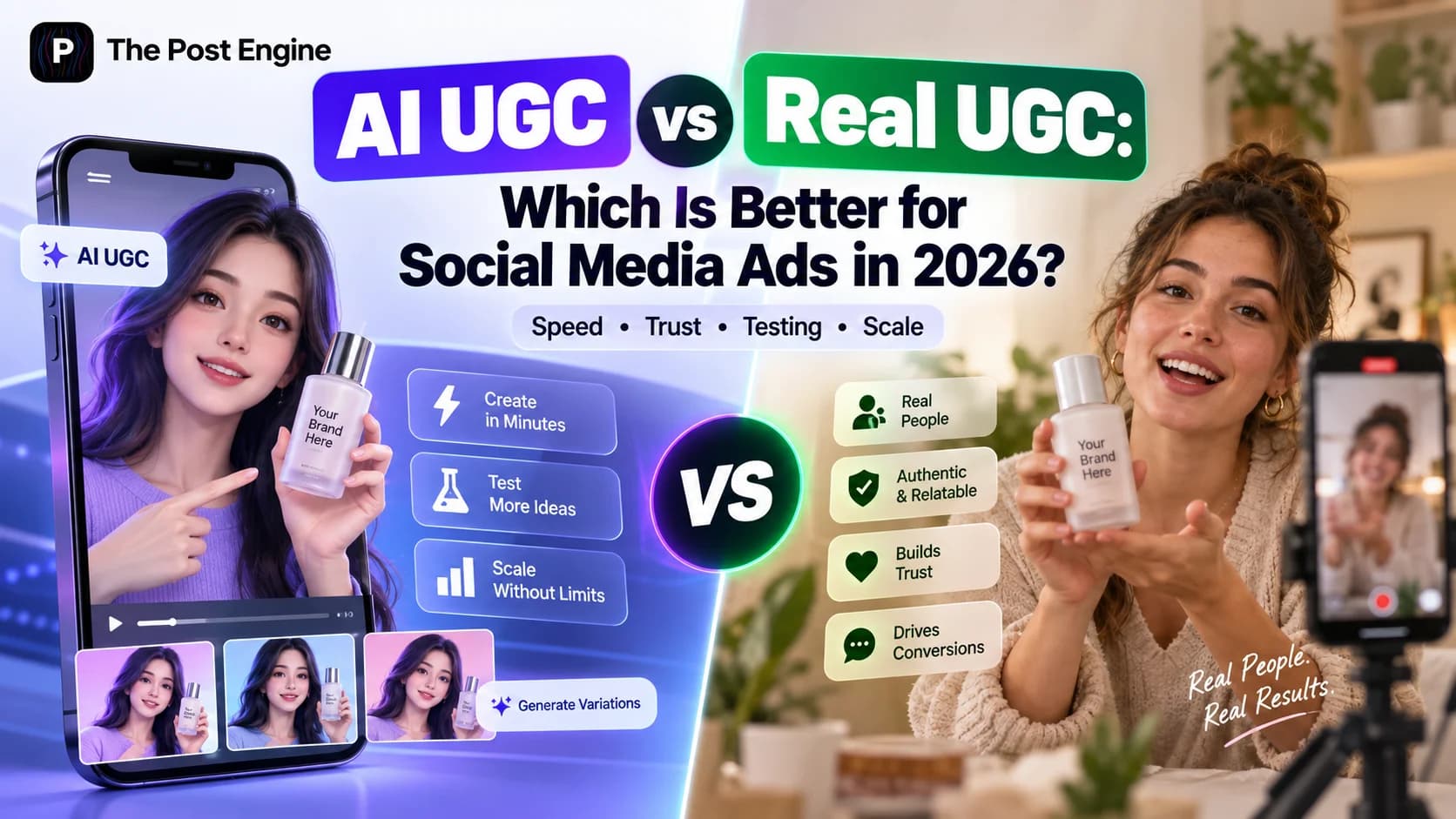
AI UGC vs Real UGC: Key Differences

The important point is that neither format wins every category.
AI UGC is generally strongest where speed and creative volume matter, while real UGC can be stronger where human credibility and authentic experience matter most.
Cost and Production Speed
One of the biggest differences is production.
Traditional UGC can involve:
Creator search → Brief → Product shipment → Filming → Revision → Editing → Delivery
AI UGC can shorten that process dramatically.
You can move from:
Idea → Script → AI generation → Variation
much faster.
That makes AI especially useful when you want to test many hooks or creative directions before investing heavily in production.
Recent 2026 comparisons consistently identify speed and lower production costs as major advantages of AI UGC.
Try it now → Create AI UGC Ads with The Post Engine
Authenticity and Trust
This is where real UGC can have a meaningful advantage.
A real creator can communicate:
Personal experience
Genuine reactions
Natural product use
Emotional connection
Credibility
This can be especially important for products where customers need to trust the person recommending them.
Current 2026 comparisons continue to identify trust and authenticity as areas where real creator content can outperform fully synthetic UGC.
However, that doesn't mean every AI UGC ad performs poorly.
AI UGC can still work well when the creative feels natural, the script is specific, and the advertisement is built around a strong product angle.
Creative Testing and Scalability
This is where AI UGC becomes particularly powerful.
Imagine you have three concepts:
Concept A: Problem-focused
Concept B: Product demonstration
Concept C: Before-and-after result
With AI, you can create multiple versions of each.
For example:
3 concepts × 5 hooks × 3 creators = 45 creative variations
Instead of producing 45 videos with traditional creators, you can use AI to test ideas at much greater volume.
That makes AI UGC useful for creative discovery.
Recent 2026 industry analysis increasingly describes AI UGC as a tool for testing more hooks, angles, and variations before scaling winning concepts.
#################IMAGE 2 — AI VS REAL UGC
When to Use AI UGC
AI UGC can be particularly useful when you need:
Fast creative production
You need new ads quickly.
High creative volume
You want to test multiple hooks and concepts.
Frequent iterations
You want to change messaging without organizing another creator shoot.
Early-stage testing
You want to discover which concepts deserve more investment.
Multiple variations
You want different creators, environments, hooks, or scripts.
AI UGC is therefore especially useful as a creative testing engine.
When to Use Real UGC
Real creators may be a better option when you need:
Strong social proof
The person genuinely used the product.
Emotional storytelling
The campaign depends on a real personal experience.
Trust-heavy purchases
Customers need strong confidence before buying.
Authentic demonstrations
The credibility comes from actually using the product.
Hero creative
You need a small number of high-value videos rather than dozens of variations.
Recent comparisons broadly suggest that real UGC remains especially useful when trust, emotion, or genuine experience is central to the sale.
The Hybrid UGC Strategy
For many brands, the strongest answer isn't AI or real UGC.
It's both.
A practical workflow can look like this:
Step 1: Generate many concepts with AI.
↓
Step 2: Test different hooks and angles.
↓
Step 3: Identify the winning concepts.
↓
Step 4: Recreate the strongest concepts with real creators when authenticity adds value.
↓
Step 5: Scale the winning creative.
This approach combines the speed of AI with the credibility of human creators.
Several 2026 industry analyses are already describing this hybrid approach as a practical model: use AI for volume and testing, then use real creators where deeper trust or storytelling matters.
Use Brand DNA to Keep AI UGC Consistent
One problem with AI-generated content is inconsistency.
Every new video can feel like it came from a different brand.
The Post Engine's Brand DNA can help establish a consistent foundation for your content by understanding your brand's voice, positioning, audience, content pillars, and creative direction.
That means your AI-generated videos can be guided by the same brand principles as your other content.
read more : How to Find Your Brand Voice on Social Media.
Use Competitor Intelligence to Find Better UGC Angles
Before producing another UGC ad, study the market.
Look at:
Competitor hooks
Product angles
Creative formats
Repeated customer problems
Content gaps
Different positioning approaches
The Post Engine's Competitor Intelligence can help you identify patterns and opportunities across competitor content.
Then turn the insight into your own creative angle.
Competitor pattern
↓
Audience problem
↓
Your product
↓
Original UGC concept
read more : AI Competitor Analysis for Social Media.
#############IMAGE 3 — HYBRID UGC WORKFLOW
How The Post Engine Fits Into the Workflow
The Post Engine can support the broader creative workflow around AI UGC.
Use:
Brand DNA
→ Keep the creative aligned with your brand.
Competitor Intelligence
→ Find content gaps and creative opportunities.
→ Create and iterate video concepts.
→ Build supporting campaign visuals.
→ Create additional paid-social creatives.
→ Understand which content deserves more attention.
This creates a workflow where AI UGC is not an isolated tool.
It becomes part of a larger strategy → creation → testing → optimization system.
####################IMAGE 4 — POST ENGINE UGC ECOSYSTEM
Frequently Asked Questions
Is AI UGC better than real UGC?
Not universally. AI UGC is generally stronger for speed, cost efficiency, and creative testing volume, while real UGC can be stronger for trust, emotional storytelling, and authentic product experiences.
Does AI UGC actually work for ads?
Yes, AI UGC can be effective, but performance depends heavily on the hook, offer, script, product fit, creative quality, and testing strategy. Current 2026 sources increasingly describe AI UGC as useful for high-volume creative testing rather than a universal replacement for human creators.
Is real UGC still worth paying for?
Yes. Real creator content can remain valuable when authenticity, trust, lived experience, or emotional storytelling are important to the campaign.
Should I test AI UGC before hiring creators?
For many campaigns, this can be an efficient approach. Test concepts and angles with AI first, then invest in real creators for the ideas that show promise.
Can brands use both AI UGC and real UGC?
Absolutely. A hybrid strategy can use AI for creative volume and testing while using real creators for high-trust or high-value campaigns.
Final Takeaway
The AI UGC vs real UGC debate isn't really about choosing one winner.
It's about using the right format for the right job.
AI UGC
→ Faster production
→ More variations
→ Easier testing
→ Greater scalability
Real UGC
→ Human credibility
→ Authentic experience
→ Emotional storytelling
→ Stronger trust in many contexts
And for many brands, the best strategy is:
AI to test.
Real creators to strengthen the winners.
Analytics to decide what scales.
The Post Engine helps connect those creative decisions with Brand DNA, Competitor Intelligence, content creation, and analytics.