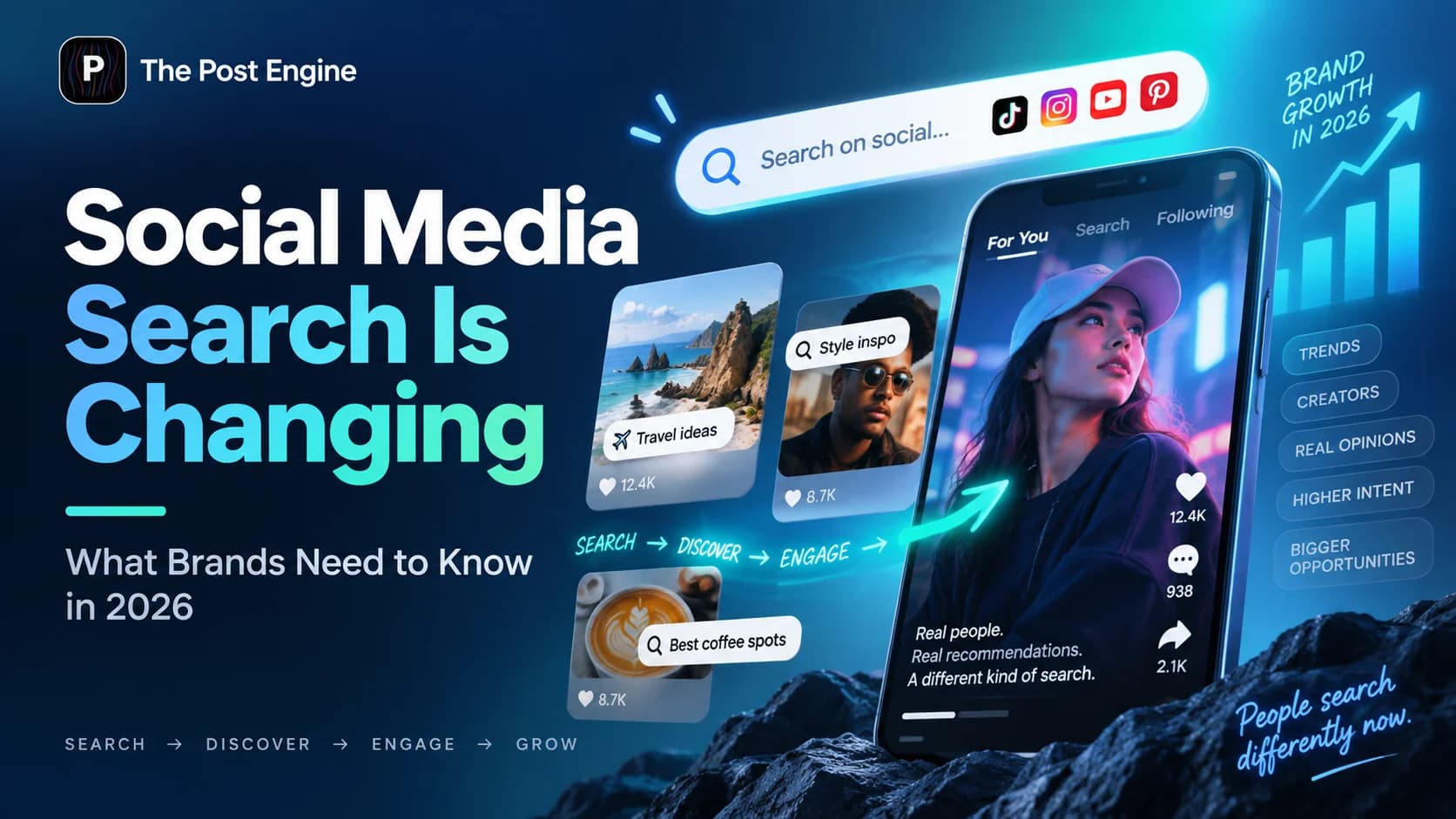
Social media is becoming a search and discovery channel. Learn how Instagram, TikTok, YouTube, and Google are changing how people find brands and content in 2026.
For years, businesses treated social media and search as two separate channels.
Google was where people went to find answers.
Social media was where they went to discover content, follow creators, and interact with brands.
That distinction is becoming less clear.
People increasingly use platforms such as TikTok, Instagram, and YouTube to discover products, places, tutorials, reviews, and recommendations. At the same time, Google is making social and video content more visible and measurable in Search.
In July 2026, Google expanded Search Console platform properties globally, allowing creators and businesses to see which Google Search queries lead people to content on Instagram, TikTok, X, and YouTube.
This creates a bigger opportunity for brands:
Your social content doesn't only need to perform in the feed. It can also be discovered through search.
That changes how businesses should think about social media content in 2026.
Why Social Media Is Becoming a Search Channel
The biggest change isn't that people suddenly stopped using Google.
It's that people now choose the platform based on what kind of answer they want.
Someone might search Google for:
“What is social media SEO?”
But they may search TikTok for:
“Best social media tools for small businesses”
Or Instagram for:
“Minimalist office setup”
Or YouTube for:
“How to use a social media content calendar”
The platform itself has become part of the discovery experience.
Social search can combine information with visual examples, demonstrations, opinions, and real-world experiences.
At the same time, social content is becoming more connected to traditional search. Google's new Search Console platform properties allow creators to see which queries bring people to their Instagram, TikTok, X, and YouTube content from Google Search. Google Search Central: Social and Video Platform Performance in Search
Google has also made these platform properties globally available and added guidance for analyzing the search performance of social and video content.
So brands increasingly have two discovery opportunities:
Platform search
and
External search
Your social content can potentially participate in both.
Social Search Is Different From Traditional Search
Traditional search often starts with a question and produces a page of results.
Social search is more visual, conversational, and experience-driven.
Imagine someone searching:
“Best coffee shops in Marrakech”
They may not only want a list.
They may want to see the location, atmosphere, menu, prices, and experiences from real people.
That is where short videos, carousels, photos, comments, and creator content become valuable.
The difference is important:
Traditional search:Find information.
Social search:Find information + see it + hear opinions + evaluate experiences.
For brands, this means content should not only be designed to appear while someone is scrolling.
It should also be capable of answering a question when someone actively looks for it.
What People Search For on Social Media
The strongest search-driven content usually responds to a specific intent.
Common searches include:
Questions
“How do I create a content calendar?”
Recommendations
“Best AI tools for Instagram”
Comparisons
“Canva vs Photoshop for social media”
Reviews
“Is this social media tool worth it?”
Tutorials
“How to create an Instagram carousel”
Local searches
“Best restaurants in Marrakech”
Product searches
“Best running shoes for beginners”
Inspiration
“Living room design ideas”
These searches are more useful than trying to force a generic keyword into every post.
The goal isn't:
“Where can I put my keyword?”
The better question is:
“What is the person actually trying to find?”
The Signals That Help Content Get Discovered
Searchability isn't created by one magic field.
Platforms use different signals to understand and rank content.
For example, YouTube says its search system prioritizes relevance, engagement, and quality. Relevance includes how well the title, description, tags, and video itself match the search query.
TikTok's Creative Center also provides marketers with keyword and trend insights, alongside examples of high-performing creatives. TikTok Creative Center
This suggests a practical approach for brands:
Use clear language
Make the subject of the content obvious.
Match the audience's wording
Use terms people naturally use when describing their problem.
Explain the topic early
Don't make the first seconds or first lines confusing.
Provide the actual answer
Visibility can earn the click, but useful content is what satisfies the search.
Stay relevant
Don't optimize for a phrase that doesn't match the content.
Search optimization should make your content easier to understand, not less natural.
IMAGE 2 — SEARCH SIGNALS
How Instagram, TikTok, and YouTube Approach Discovery
There isn't one universal social-search algorithm.
Each platform has its own discovery system.
Instagram can recommend eligible public content through Search, Explore, Reels, and Feed recommendations, including to people who don't already follow an account. Instagram Help Center: Recommendation Eligibility
For brands, that makes clear positioning important.
Your profile and posts should make it easy to understand:
Who are you?
What do you talk about?
Who is your content for?
TikTok
TikTok has invested heavily in discovery and keyword-oriented creative research.
Its Creative Center provides insights into high-performing ads, keywords, patterns, products, and trends. TikTok Creative Center
For marketers, that means search behavior and creative trends can be researched together instead of treated as completely separate activities.
YouTube
YouTube Search officially considers relevance, engagement, and quality. Its system looks at how well the title, description, tags, and video content match the query, as well as viewer engagement. How YouTube Search Works
YouTube therefore rewards more than keyword matching.
A video still needs to satisfy the person who searched for it.
Write for Search Intent, Not Just Keywords
One of the easiest mistakes in social search is treating it like keyword stuffing.
Imagine the target phrase is:
“Instagram content ideas for restaurants”
You could simply place that phrase in a caption.
A better approach is to answer the intent behind it:
“Need Instagram content ideas for your restaurant? Here are 10 formats you can use this week.”
Then actually provide useful ideas.
A useful framework is:
Search query → Intent → Answer → Proof → Next step
For example:
Search query:“How to make social media posts faster”
Intent:The person wants a faster production process.
Answer:Explain a practical workflow.
Proof:Show a real example.
Next step:Point the reader toward a relevant resource or tool.
This creates content that is useful to the audience instead of content written only for a keyword.
Make Your Social Profiles Search-Friendly
Search doesn't start with individual posts.
Your profile also communicates what your brand is about.
Make the basics clear.
Profile name
Use a recognizable business or creator name.
Bio
Explain what you do and who you help.
Category
Choose the most relevant category available.
Location
For local businesses, include relevant location information.
Website
Give people a clear destination when they want to learn more.
Main topics
Keep your core subject areas understandable so people can quickly recognize what your account is about.
The goal isn't to fill every field with keywords.
It's to make your profile clear enough for both people and discovery systems to understand.
Think Beyond Hashtags
Hashtags can still help categorize content, but they shouldn't be your entire discovery strategy.
A stronger approach is to make the topic clear through multiple elements:
Title
→ What is this about?
Caption
→ What problem does it solve?
On-screen text
→ What should the viewer understand immediately?
Spoken words
→ What topic is being discussed?
Profile
→ What does this account specialize in?
The important idea is simple:
Make the subject of your content obvious.
Build a Searchable Content Strategy
Once you understand search behavior, your content strategy can become more intentional.
Start with questions your audience is already asking.
Then group them into search themes.
Beginner searches
“How do I start?”
Problem searches
“Why isn't this working?”
Comparison searches
“A vs B”
Product searches
“Best tool for…”
Tutorial searches
“How to…”
Local searches
“Best ___ near me”
Then build content around those themes.
But don't turn every social post into an SEO article.
You still need content for:
Entertainment
Community
Storytelling
Brand personality
Product launches
Relationships
Think of search as one layer of your social strategy, not the entire strategy.
A strong mix can be:
Searchable content + engaging content + brand content + community content
That gives your account opportunities to be discovered, remembered, and followed.
IMAGE 3 — SEARCHABLE CONTENT STRATEGY
How The Post Engine Fits Into the Workflow
Social search changes what brands should create, but the production process still matters.
A simple workflow can be:
Search question
↓
Content angle
↓
Create
↓
Adapt
↓
Publish
↓
Measure
↓
Improve
The Post Engine can support the production side of this system by helping turn content ideas into social media assets while keeping your brand style consistent.
For example:
Search query: “How to create a social media calendar?”
↓
Content angle: “7 steps to build a social media calendar”
↓
Create: Social post, carousel, or video
↓
Publish: Share across relevant channels
↓
Measure: Review performance and search-related results
For creation, see The Post Engine AI Content Studio.
When you want to connect performance data to future content decisions, read How to Turn Social Media Analytics Into Better AI Content.
And when one search-driven topic needs to become different formats, see How to Generate Different Social Media Post Styles in One Place.
Frequently Asked Questions
Is social media replacing Google?
No.
People still use traditional search extensively, but social platforms are increasingly part of the discovery process. Search behavior is becoming more distributed across websites, apps, social networks, and video platforms.
What is social search?
Social search is the process of using social platforms to discover information, products, people, places, recommendations, and answers.
Which platforms matter most for social search?
TikTok, Instagram, and YouTube are particularly important, but discovery also happens across platforms such as Facebook, Pinterest, LinkedIn, and X.
Do hashtags still matter?
They can help categorize content, but they should not be your only discovery strategy. Clear topics, useful content, relevant language, and audience satisfaction are more important.
Does Google index social media content?
Social and video content can appear in Google Search. Google now provides Search Console platform properties for Instagram, TikTok, X, and YouTube so creators can see how their social and video content performs in Google Search. See Google's Social and Video Search Console update
Should every social media post be optimized for search?
No.
Some posts should focus on search intent, while others should focus on community, entertainment, storytelling, product launches, or brand personality.
The strongest strategy combines multiple purposes.
Final Takeaway
Social media is no longer only about being seen while someone scrolls.
It is increasingly about being found when someone is looking.
That changes the way brands should think about social content.
Don't only ask:
“Will this stop the scroll?”
Also ask:
“Could someone find this when they search for the problem we solve?”
Use real search questions.
Write clearly.
Explain the topic early.
Make your profiles understandable.
Create content that genuinely answers the search.
And think beyond individual platforms, because social content can now participate in a broader discovery journey that includes both platform search and Google Search. Google's 2026 Search Console updates make that connection more measurable than before.
The shift is:
Search → Discover → Watch → Trust → Explore → Act
For brands, that means social content can have a life beyond the feed.
The best social content isn't only content people want to scroll past. It's content people can find when they're looking for an answer.