Learn how AI competitor analysis can uncover winning content, strong hooks, positioning, and attention signals—and turn competitor data into original social media content ideas.
What Is AI Competitor Analysis for Social Media?
AI competitor analysis for social media uses artificial intelligence to examine competitor activity and help identify patterns, opportunities, and gaps that can influence your content strategy. Instead of manually reviewing every competitor asset, an AI-powered workflow can help organize the information that matters to content decisions.
Useful signals include:
+Topics and recurring themes
+Content formats
+Hooks and opening structures
+Messaging and positioning
+Attention and engagement signals
+Product focus and calls to action
+Audience themes and conversion opportunities
The important distinction is that not all data answers the same question. Some signals show what content is winning. Others reveal what a competitor is saying, while another layer shows what appears to be attracting audience attention. Keeping those questions separate makes the analysis much more actionable.
Why Competitor Analysis Matters for Social Media
Creating content without looking at your competitive environment can turn into guesswork. You may spend time on topics nobody cares about, formats your audience ignores, or messaging that sounds identical to the rest of your category.
Competitor analysis gives you context. It helps you understand what is already working, what attracts attention, how brands position themselves, what the market is missing, and where your own perspective can be different.
The goal is not to become a better copycat. It is to reduce uncertainty before you create. A competitor can show you that a topic has demand, but your job is to understand the reason behind that demand and build a more useful execution for your audience.
A useful competitor workflow should therefore answer four questions: What is working? Why might it work? What is missing? What can we test differently?

What Competitor Data Should You Analyze?
You do not need to collect every possible metric. Focus on information that can change what you create next.
Topics
Look for themes that keep appearing: tutorials, product education, comparisons, customer problems, trends, launches, reviews, case studies, or promotions. Repetition shows what the market considers important; it does not mean you should repeat the same content.
Formats
Study how ideas are packaged. Look for short videos, carousels, static graphics, product demonstrations, UGC, interviews, tutorials, lists, and long-form video. A familiar topic can become a new opportunity when the format is more useful.
Hooks
Look at how competitors earn the first few seconds—or first few words. Common patterns include problem, curiosity, outcome, contrarian, and list-based openings. Analyze the pattern rather than copying the wording.
Messaging and positioning
Identify the reason a competitor gives people to care: lower price, better quality, speed, convenience, expertise, luxury, simplicity, or performance. Two businesses can sell similar products while creating very different perceptions.
Attention signals
Depending on the platform, these can include views, likes, comments, shares, saves, engagement, and repeated audience reactions. Do not automatically chase the biggest number. Look for the characteristics that appear repeatedly in content that earns attention.
The 3 Types of Competitor Intelligence You Should Look For
A stronger analysis separates competitor research into three practical questions. This prevents you from mixing performance data, positioning data, and social attention signals into one unfocused report.
What content is winning?
Study topics, formats, hooks, and recurring patterns in stronger-performing content. A YouTube channel with a large audience is less useful than understanding which formats and openings consistently perform better.

What is the competitor saying that converts?
Website and brand analysis can reveal headlines, value propositions, product positioning, calls to action, benefits, customer problems, trust messaging, and conversion-focused sections. The goal is to understand the problem the competitor is making important—not rewrite its homepage.

What is getting attention on Instagram?
Look for content themes, post formats, audience response, repeated structures, attention patterns, and engagement signals. The useful question is: “What should our next content experiment look like?”

Related : How to Build a Social Media Workflow From Idea to Published Post
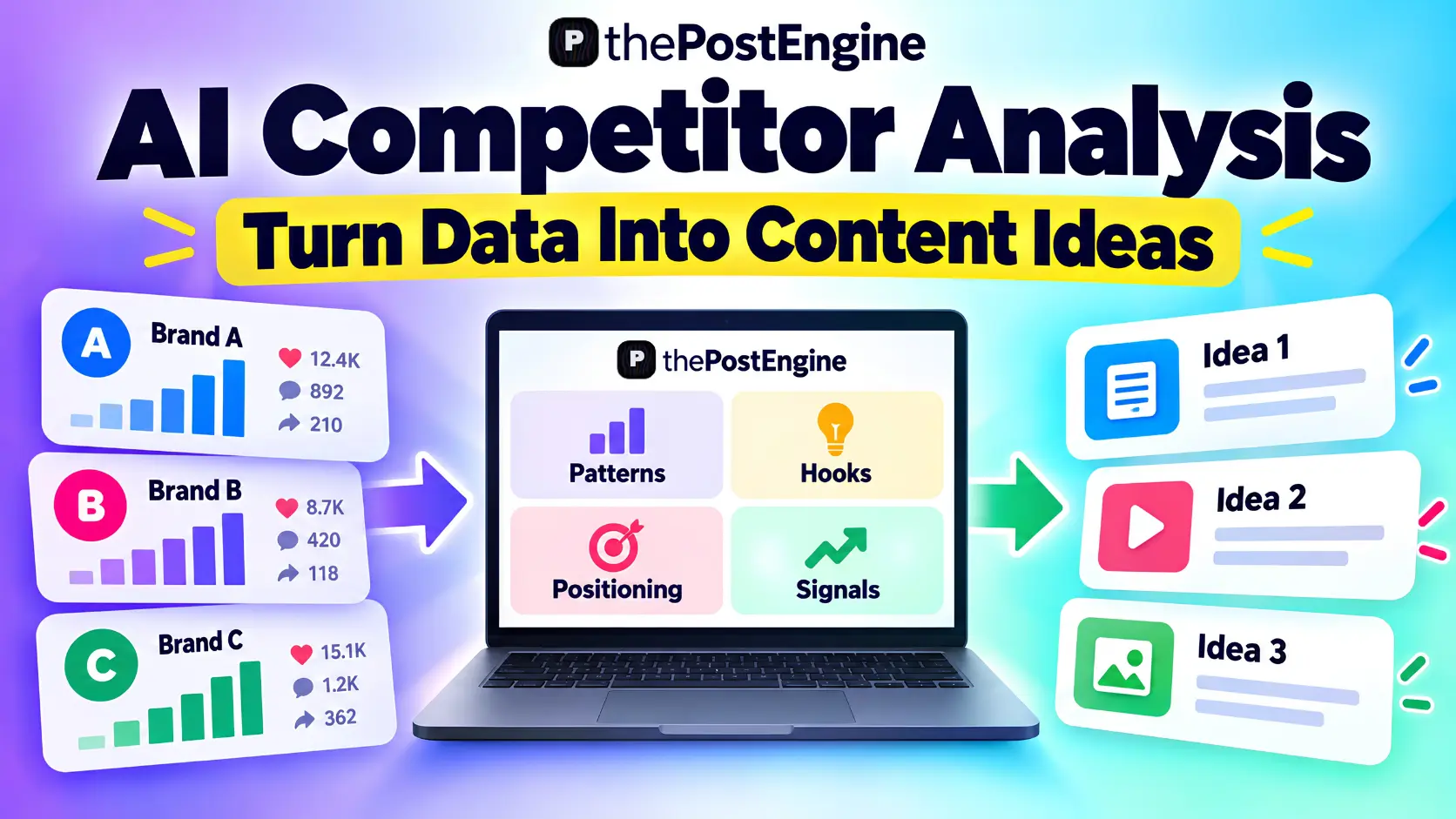
How to Turn Competitor Data Into Content Ideas
Do not jump directly from “competitor post” to “our post.” Use a five-step transformation that turns observation into a testable content decision.
Find the pattern — What keeps appearing?
Understand the reason — Why might the audience care?
Find the gap — What is missing or under-served?
Add your perspective — What can your brand explain, demonstrate, or communicate differently?
Create the content — Turn the insight into an original idea.
For example, imagine you sell running shoes. Your competitor analysis shows that comparison videos attract strong attention, most competitors emphasize technical features, and few explain which shoe type fits different runners. That gap can become a useful idea such as “Trail vs. Road Running Shoes: Which One Should You Actually Buy?”
One insight can then become several assets: an Instagram comparison carousel, a short Reel, a UGC-style explanation, a longer buying guide, and product-page comparison content. This is how competitor intelligence can feed a wider content system instead of ending as a report.
How to Find Social Media Content Gaps
A content gap does not mean a topic has never been published. More often, the opportunity is a missing audience, format, question, or perspective.
Topic gap
Everyone explains how to use the product, but few explain common mistakes after buying it.
Audience gap
Competitors speak mostly to experienced users, leaving beginners with fewer useful explanations.
Format gap
A category may rely heavily on static graphics while underusing UGC, demonstrations, tutorials, or short-form video.
Question gap
Customers ask questions that competitor content rarely answers. Those questions can become practical, high-intent content.
Perspective gap
Everyone discusses a topic from the same angle. You may not need a new subject—you may need a more useful point of view.
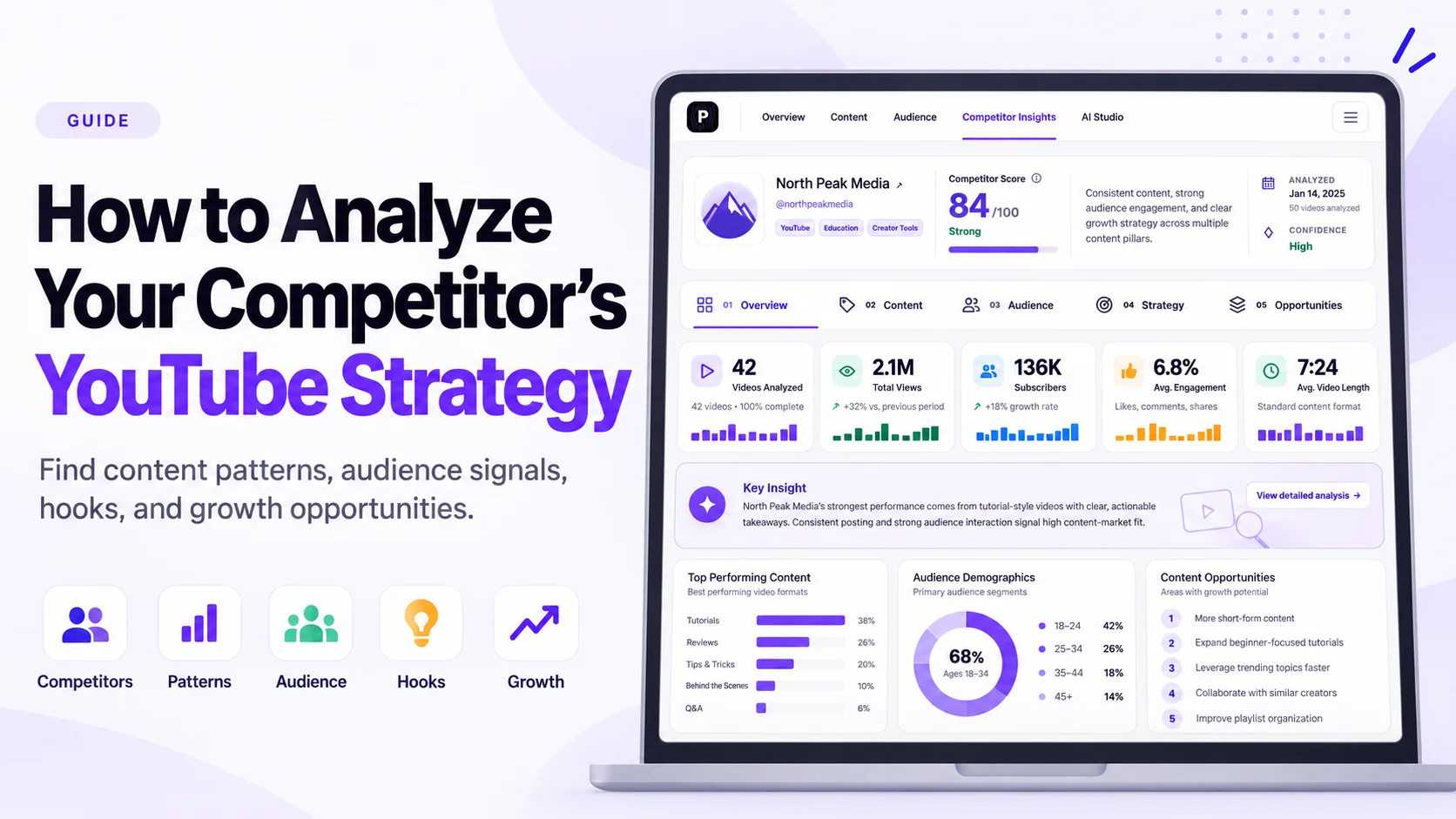
How to Analyze Competitor YouTube Content
For YouTube, focus on the patterns behind strong videos rather than subscriber counts alone. Study top-performing topics, formats, hooks, titles, thumbnails, and recurring content structures.
The strongest insight comes from comparing several videos. If successful videos repeatedly solve beginner confusion, compare options, use demonstrations, or lead with a problem, that pattern can inform your own content concept.
The goal is not to reproduce the same video. It is to understand which audience need the format appears to satisfy and create an original answer from your own expertise.
How to Analyze Competitor Websites and Brands
Social media can show how competitors attract attention. Their websites can show how they position products and try to convert that attention into action.
Review headlines, value propositions, benefits, proof, trust signals, product positioning, customer problems, and calls to action. Then ask what the competitor is making the customer care about.
For example, “Save time managing your social media” is one positioning route. A different brand could address the same audience with a workflow angle such as “Stop managing five separate content tools.” The insight is the customer problem—not the sentence.
How to Analyze Competitor Instagram Content
Instagram analysis is especially useful for understanding attention patterns. Look at recurring themes, visual formats, hooks, content structures, and audience responses.
Suppose a competitor posts many product images, but its strongest response consistently comes from educational carousels. That is a signal worth testing. The competitor has not given you the content; it has shown you something about what the audience may value.
How to Build a Repeatable Competitor Analysis Workflow
The biggest mistake is treating competitor analysis as a one-time research exercise. Make it part of your content process so that each review can improve the next round of ideas.
Select 3–5 relevant competitors
Start with competitors who share your audience, category, product type, and a comparable market position. A smaller relevant set is easier to analyze consistently.
Analyze multiple sources
Do not rely on one platform. Use YouTube for winning content and format patterns, websites for positioning and conversion opportunities, and Instagram for attention and engagement signals.
Save the analysis
Keep findings organized by target, source, date, status, and language so you can compare changes over time rather than rebuilding the research from zero.
Turn reports into opportunities
For each meaningful finding, record what you discovered, why it matters, what competitors are missing, what you could test, and what content should be created.
Test and learn
Treat competitor insights as hypotheses. Test formats and angles such as comparison carousels, Reels, or UGC. Then use your own performance data to validate or reject the assumption.

Related : Why Your AI Social Media Content Isn't Getting Engagement — And How to Fix It
How to Avoid Copying Competitors
AI makes it easy to create content that looks similar to whatever you analyze. That is why the safest rule is simple: copy the insight, not the content.
Do not copy hooks word-for-word, captions, creative concepts, positioning, visual layouts, or scripts. Instead, investigate why a successful format may be working. It may address a clear pain point, create curiosity, offer practical value, or speak to a specific audience.
Then build your own version from your audience, product, expertise, and brand point of view. The objective is differentiated usefulness, not visual similarity.
How to Choose an AI Competitor Analysis Tool
A useful tool should shorten the distance between research and a content decision. Before choosing one, ask whether it can:
Analyze multiple relevant sources
Understand content, not only follower counts
Recognize recurring topics, hooks, formats, and themes
Surface content gaps and opportunities
Explain what the analysis means
Connect competitor insight to your next content idea
That last point matters most. A competitor-analysis tool should not leave you with a large report and the question, “Okay… now what?”
How The Post Engine Turns Competitor Intelligence Into Content
The Post Engine’s Competitors workspace is designed around different intelligence questions rather than one generic report.
Find Winning Content
Analyze a YouTube channel to identify top-performing formats, hooks, and patterns.
Reveal What Converts
Analyze a website or brand to uncover messaging, positioning, and conversion opportunities.
Track Attention Signals
Analyze an Instagram profile to understand what appears to earn attention and engagement.
Move the insight into your content workflow
The wider platform connects competitor intelligence with Brands, Studio, Posts, and UGC, so research can move into creation instead of ending as a static report.
Useful Post Engine workspaces: Competitors • Brand DNA • Studio • Posts • UGC
A Practical Competitor Content Template
After every analysis, capture the answer to these questions:
*What did we discover?
*Which competitor or source?
*What appears to be working?
*Why might it work?
*What gap did we find?
*What could we do differently?
*What content should we create?
*Which platform and format?
*What is the hook?
*What is the CTA?
How Often Should You Analyze Competitors?
You do not need to review every competitor every day. A practical rhythm is:
+Weekly: monitor major campaigns, new formats, launches, and meaningful messaging changes.
+Monthly: review stronger content, new themes, formats, attention patterns, and gaps.
+Quarterly: reassess positioning, audience shifts, platform priorities, and larger opportunities.
Frequently Asked Questions
What is AI competitor analysis for social media?
It is the use of AI to analyze competitor activity across social platforms and other public sources to identify patterns, positioning, attention signals, content gaps, and strategic opportunities.
How can competitor analysis generate content ideas?
It can reveal recurring topics, successful formats, audience questions, positioning patterns, and gaps that can be transformed into original content concepts.
How many competitors should I analyze?
Start with three to five relevant competitors. Expand the set only after you have a process you can repeat consistently.
Should I analyze competitors on Instagram or YouTube?
Analyze the platforms that matter to your business. Instagram can reveal attention and engagement patterns, while YouTube can reveal winning topics, formats, hooks, and structures.
Should I analyze competitor websites too?
Yes. Social media shows how competitors attract attention; websites can reveal how they position products, communicate value, and attempt to convert visitors.
Does competitor analysis mean copying competitors?
No. The objective is to understand the market, identify patterns and gaps, and use those insights to create differentiated content.
How often should I analyze competitors?
Monitor meaningful changes regularly, perform deeper monthly reviews, and reassess broader competitive strategy quarterly.
Final Takeaway
Competitor analysis becomes valuable when you stop treating it as a collection of screenshots, follower counts, and spreadsheets. The real value is what you can do with the information.
Find what is working. Understand why it works. Identify what is missing. Add your own perspective. Turn the insight into content.
The repeatable loop is: Competitor Data → Patterns → Insights → Gaps → Content Ideas → Creation → Publishing → Measurement.
The best competitor-analysis system is not the one that produces the biggest report. It is the one that helps you answer one practical question: “What should we create next?”