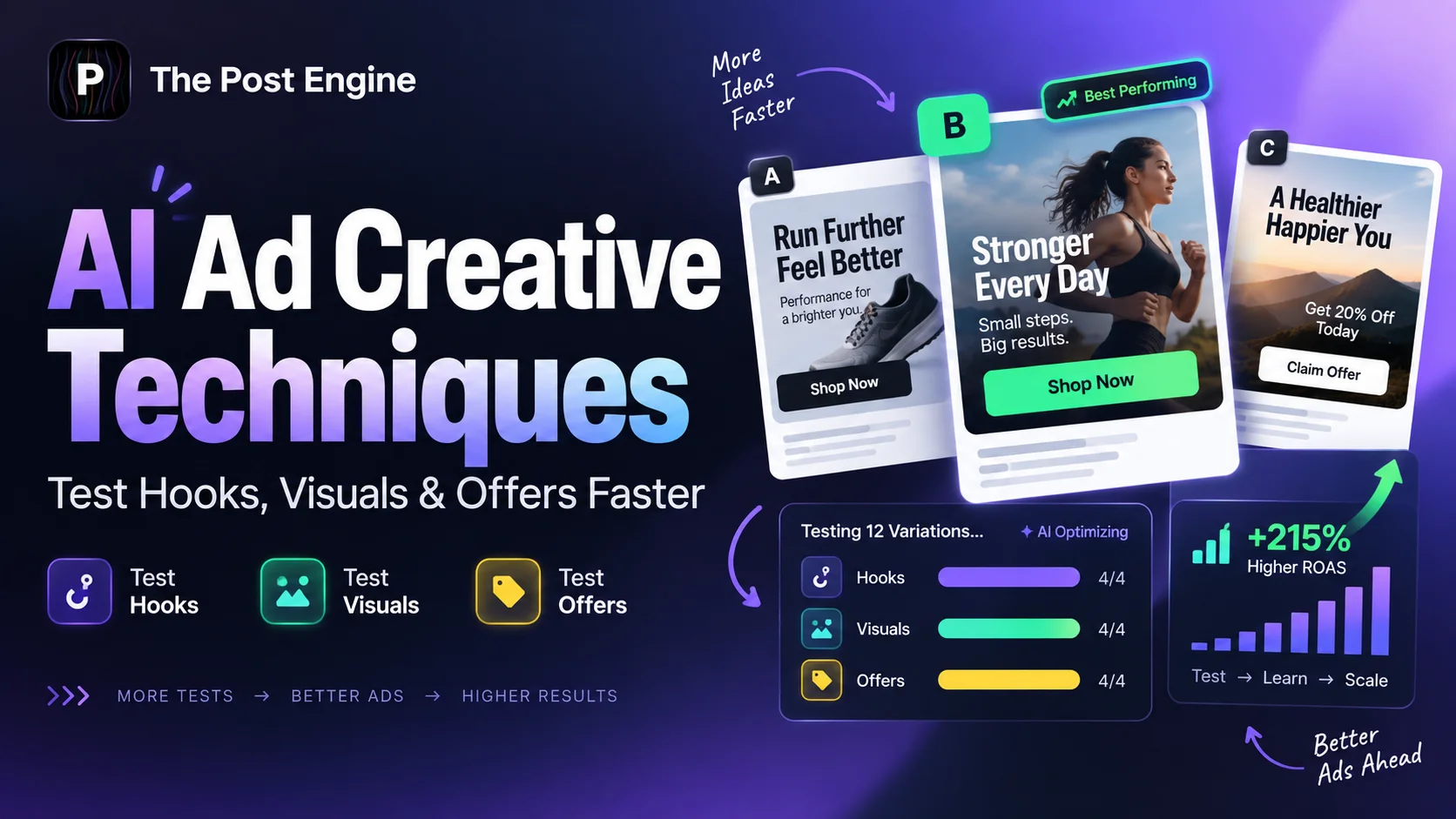
Learn how to use AI to test ad hooks, visuals, offers, and CTAs faster. Build a practical creative testing system for Meta, TikTok, and other social ads.
Creating one social media ad and hoping it works is no longer a reliable strategy.
You can have a strong product, a good audience, and a well-designed landing page — but the creative may still determine whether someone stops, watches, clicks, or buys.
The problem is that testing creative traditionally takes time.
You need different hooks.
Different visuals.
Different offers.
Different headlines.
Different calls to action.
AI changes that production problem.
Instead of spending hours creating every variation manually, you can use AI to generate controlled creative variations and spend more of your time deciding what is actually worth testing.
Meta now promotes creative diversification as part of its performance approach, encouraging advertisers to develop a variety of creative so its systems can deliver different messages to people who are more likely to respond. Meta also says its Advantage+ creative tools can generate image, video, audio, text, and other creative variations. Meta Advantage+ Creative
TikTok's current ad-testing guidance is even more explicit: test one variable at a time, define a clear objective, vary hooks and CTAs, compare creative approaches, and use performance data to build a repeatable creative playbook. TikTok Ad Testing Guide
The important distinction is:
AI should help you test more ideas. It should not replace the testing strategy.
Why Creative Testing Matters More Than Creating More Ads
More ads do not automatically mean better advertising.
The real objective is to discover which creative idea produces a better business outcome.
Meta's current performance guidance emphasizes creative diversification rather than relying on a single creative. Meta says advertisers should develop a variety of creatives so its AI can deliver different messages to people most likely to be interested.
TikTok similarly describes testing as a way to move from guessing to learning. Its current testing guide recommends defining a clear objective, changing one variable at a time, waiting for meaningful results, and measuring the KPI that matches the business goal.
That changes the workflow.
Instead of:
Create → Launch → Hope
use:
Hypothesis → Variation → Test → Measure → Learn → Iterate
AI makes the variation step faster.
The testing framework determines whether those variations actually teach you something.
The 4 Creative Variables Worth Testing
You don't need to test everything at once.
Start with the variables that can materially change how people perceive the ad.
Hook
What makes someone stop?
Visual
What do they see first?
Offer
Why should they take action?
CTA
What should they do next?
These variables work together, but testing them separately can make your results easier to interpret.
Google's advertising guidance similarly recommends setting a clear hypothesis, changing one variable at a time, choosing one or two success metrics, and documenting the results rather than changing multiple things simultaneously. Google Ads — Test With Confidence
Technique #1: Test Multiple Hooks
The first job of an ad is to earn attention.
TikTok's current creative guidance recommends testing hooks and notes that the first seconds are particularly important for short-form video. TikTok also reports that 90% of ad recall impact is captured within the first six seconds in the research it cites in its creative guidance. TikTok Creative Best Practices
Instead of producing five completely different ads, keep the main offer and visual concept similar while testing different openings.
For example:
Problem hook
“Still wasting hours creating social media posts?”
Outcome hook
“Create a week's worth of social content faster.”
Curiosity hook
“The biggest mistake small teams make with AI content.”
Contrarian hook
“More social media posts won't necessarily get you better results.”
Question hook
“What if your content workflow is the real problem?”
Now you have five hypotheses about what could motivate attention.
AI can help generate the variations.
Your job is to decide which differences are meaningful enough to test.
Technique #2: Change the Visual, Not the Message
Sometimes the message is good but the visual doesn't communicate it quickly enough.
Instead of changing the entire ad, test different visual treatments.
For the same message, you could test:
Product-focused visual
Show the product immediately.
People-focused visual
Show someone using the product.
Problem-focused visual
Show the problem before showing the solution.
Result-focused visual
Lead with the outcome.
Demonstration visual
Show the product actually working.
TikTok's official creative guidance emphasizes native-looking, mobile-first creative and recommends testing different creative formats, hooks, captions, sounds, and visual approaches.
Meta's Advantage+ Creative also supports AI-powered image variation, background generation, image expansion, animation, and text generation.
This creates a useful AI workflow:
One message → multiple visual hypotheses
rather than:
One message → one image
IMAGE 2 — CREATIVE VARIABLES
Technique #3: Test Different Offers
A strong creative cannot always compensate for a weak offer.
Your audience may like the ad but still have no reason to act.
That is why offers deserve testing.
For example:
Discount
20% off this week
Free trial
Try it free for 14 days
Bonus
Get the template pack free
Free shipping
Free delivery this weekend
Risk reduction
Cancel anytime
Value-focused
Save 5 hours every week
The best offer depends on your business model.
The important part is to test the proposition, not just the wording.
Google Ads supports ad-variation experiments that can test different promotions and benefit-focused messaging. Google Ads — Ad Variations
That means your test could be:
Same audience + same visual + same landing page
but:
Offer A vs. Offer B
Now you can learn whether the offer itself changes performance.
Technique #4: Test the CTA and Closing
A customer may understand the product and the offer but still not know what to do next.
Try different CTAs based on the user's level of intent.
Low-friction CTA
See how it works
Education CTA
Learn more
Trial CTA
Try it free
Purchase CTA
Shop now
Demonstration CTA
Watch the demo
Lead CTA
Get the guide
The CTA should match the stage of the customer.
You should also consider testing the closing structure of video ads.
TikTok recommends a three-part structure:
Hook → Body → Close
Its creative guidance reports that ads using strong opening value propositions can capture attention early, while CTA cards in the cited research produced a 19% uplift in likeability and 45% lift in recall. These figures are platform-specific findings cited by TikTok and should not be treated as universal benchmarks.
The takeaway is not “use this exact CTA.”
It's:
Test the closing message instead of assuming your first CTA is the best one.
Build Controlled AI Creative Variations
This is where many AI ad workflows go wrong.
Someone asks AI:
“Create 20 Facebook ads for my product.”
The output may contain 20 completely different ideas.
That sounds useful.
But it can make testing difficult.
You don't know whether performance changed because of:
The hook
The visual
The offer
The audience
The format
The CTA
The entire concept
A better method is controlled variation.
For example:
Control
Hook: Save time creating content
Visual: Product interface
Offer: 14-day trial
CTA: Try it free
Test A — Hook
Change only the hook.
Hook: Stop wasting hours creating content
Everything else stays the same.
Test B — Visual
Return to the original hook, but replace the interface screenshot with a person using the product.
Test C — Offer
Keep the original creative but replace the free trial with a limited-time discount.
This follows a core experimental principle recommended by both TikTok and Google: make your hypothesis clear and avoid changing multiple variables at the same time when the goal is to learn what caused the result.
AI can now produce the variants much faster.
The testing design is still the important part.
Choose the Right Metric Before You Test
A creative test needs a success metric.
Otherwise, you can end up choosing a winner based on whichever number looks best.
For example:
Goal: Awareness
Look at metrics such as:
Reach
Video views
Watch time
Ad recall or brand-lift measures when available
Goal: Traffic
Look at:
CTR
CPC
Landing-page visits
Goal: Leads
Look at:
Cost per lead
Lead conversion rate
Qualified leads
Goal: Sales
Look at:
CPA
Conversion rate
ROAS
Revenue
TikTok's current testing guidance recommends selecting KPIs that match the campaign objective, while Google Ads experiments similarly emphasize choosing the success metric before evaluating the test.
Don't let:
“This ad has a higher CTR.”
automatically mean:
“This ad is better.”
A higher click-through rate is not necessarily better if those clicks don't convert.
IMAGE 3 — TESTING LOOP
Turn Winning Tests Into a Creative System
The real value of testing isn't finding one winning ad.
It's building a library of creative learnings.
Imagine your tests show:
Problem hooks → highest CTR
Product demonstrations → highest conversion rate
Free trial offer → lowest CPA
Shorter videos → better completion rate
Now you have a creative playbook.
Your next campaign can start with:
Winning hook patterns
Winning visual patterns
Winning offers
Winning CTAs
Then test new combinations.
This turns advertising into a learning system:
Test → Learn → Document → Reapply → Test Again
Google's current experimentation guidance explicitly recommends documenting results and using past learnings to inform future tests.
Build Faster Ad Creative With The Post Engine
AI makes creative testing more practical because you can produce controlled variations without rebuilding every asset manually.
The key is to keep the test structure clear.
For example, you can start with one ad concept:
Core message: Save time creating social media content.
Then create variations around specific elements:
Hook variations
Stop wasting hours on content.
Create more without adding another tool.
Your content workflow shouldn't take all day.
Visual variations
Product interface
Product in use
Before/after workflow
Offer variations
Free trial
Discount
Bonus
The Post Engine can be useful when you need to turn those creative hypotheses into multiple branded ad assets rather than producing each version completely from scratch.
→The Post Engine AI Content Studio
The important part is that the platform supports the creative production step.
Your advertising strategy should still determine:
What are we testing?
Why are we testing it?
What metric decides the winner?
What did we learn?
That keeps AI in the role where it is most useful:
Producing more creative options so your team can test more intelligently.
For the broader content-production workflow, Visit this [AI Social Media Content: The Complete Guide to Creating Better Content at Scale].
Frequently Asked Questions
What should I test first in a social media ad?
Start with a variable that could materially change performance. Hooks are often a useful first test for short-form video, while visuals, offers, and CTAs are other strong candidates. Test based on your campaign objective.
Should I test multiple variables at once?
Usually not when your goal is to understand what caused the difference. Meta, TikTok, and Google all provide testing systems that encourage controlled experimentation or keeping other variables constant when isolating a creative change.
How many ad variations should AI create?
There is no universal number. Create enough variations to test meaningful hypotheses, but avoid generating dozens of tiny differences that teach you nothing.
Should the winning ad always get the entire budget?
Not automatically. Check whether the result is statistically meaningful and whether the winning creative actually improves the business metric you care about.
Can AI optimize ad creative automatically?
Increasingly, yes. Meta's Advantage+ Creative can generate and optimize creative variations, while platforms such as TikTok and Google provide automated and experimental tools. But human strategy is still needed to decide what to test and how to interpret the results.
Final Takeaway
AI has changed the speed of ad creation.
But faster production isn't the real advantage.
The real advantage is being able to test more meaningful ideas.
Start with a hypothesis.
Test the hook.
Test the visual.
Test the offer.
Test the CTA.
Choose the metric before the test begins.
Change one important variable at a time when you need to understand causality.
Then document what you learn.
The process becomes:
Hypothesis → Create → Test → Measure → Learn → Improve
That is how AI turns from a content-generation tool into a creative testing advantage.
The goal isn't to create 100 ads.
It's to discover which creative idea deserves your next dollar.