Learn how to check AI-generated social media content for factual errors, brand inconsistencies, weak claims, and platform mistakes before publishing.
AI can turn an idea into a social media post in seconds.
But generating the post is only half the job.
AI can also produce:
Incorrect statistics
Outdated information
Unsupported claims
Wrong product details
Repetitive language
Inconsistent brand messaging
Captions that don't fit the platform
Visuals that don't accurately represent the product
These mistakes can be easy to miss because the final output may look polished and sound confident.
That makes quality control more important as AI becomes part of everyday content production.
Sprout Social's 2026 research found that marketers are rapidly adopting AI while consumers still want brands to maintain a human element in social content. Its recommendation is to use AI for efficiency and insights without replacing human judgment. Sprout Social — 2026 Social Media Content Strategy Report
Google takes a similar people-first approach to AI-assisted content: what matters is the quality, originality, reliability, and usefulness of the final content, not simply whether AI was involved in creating it. Google Search Central — Creating Helpful, Reliable, People-First Content
So the goal isn't to stop using AI.
It's to create a reliable quality check before AI-generated content reaches your audience.
Why AI Content Needs a Quality Check
AI is good at producing fluent content quickly.
Fluent does not always mean correct.
A caption can sound professional while containing an incorrect statistic.
A product description can sound convincing while describing a feature the product doesn't actually have.
An AI-generated image can look realistic while changing the shape, color, or details of the real product.
The problem is confidence.
AI doesn't always signal uncertainty when information is incorrect.
That's why your workflow should separate:
Generation
from
Approval
Think of AI as the first production step, not the final editor.
A simple process is:
Generate → Check → Correct → Approve → Publish
This becomes especially important for brands publishing frequently, because a small error repeated across dozens of posts can become a much bigger brand problem.
Check #1: Verify Facts and Numbers
This should be the first check for any post containing factual information.
AI-generated content can include:
Incorrect statistics
Wrong dates
Invented sources
Misquoted research
Outdated information
Incorrect percentages
False comparisons
For example, imagine AI writes:
“80% of marketers now use AI for social media.”
Don't publish the number simply because it sounds realistic.
Ask:
Where did this number come from?
Is the source credible?
Is the research recent?
Does the original research actually say that?
If you cannot verify the claim, remove it or rewrite the sentence without the unsupported number.
Google's guidance emphasizes creating reliable content and encourages creators to evaluate whether their information is original, trustworthy, complete, and useful to people. Google — Creating Helpful, Reliable, People-First Content
A simple rule
Every important number gets a source.
That includes:
Statistics
Market sizes
Percentages
Pricing
Dates
Survey results
Performance claims
Check #2: Check Product and Brand Information
AI may understand your general industry while knowing nothing about your specific product.
This can create dangerous details.
Before publishing product-focused content, verify:
Product name
Is it written correctly?
Features
Does the product actually have the feature AI described?
Pricing
Is the price current?
Availability
Is the product or feature available in the markets you're targeting?
Compatibility
Does it work with the systems, platforms, or products mentioned?
Guarantees
Does the business actually offer the guarantee or promise?
This is particularly important for e-commerce, SaaS, finance, healthcare, and other industries where inaccurate information can directly affect customer decisions.
AI should work from verified product information, not assumptions.
Check #3: Remove Generic AI Language
Accuracy isn't the only problem.
Even when everything is technically correct, the post may still sound like it was written by a machine.
Look for phrases such as:
“Take your business to the next level.”
“Unlock your full potential.”
“Game-changing solution.”
“In today's fast-paced digital landscape.”
“Revolutionize your strategy.”
These expressions aren't always wrong.
The problem is that they often communicate very little.
Replace vague claims with something specific.
Instead of:
“Revolutionize your social media workflow.”
Try:
“Reduce the number of steps between creating a post and scheduling it.”
Instead of:
“Unlock powerful growth.”
Try:
“Help your team publish more consistently without rebuilding every post from scratch.”
Specific language makes the content easier to understand and less interchangeable.
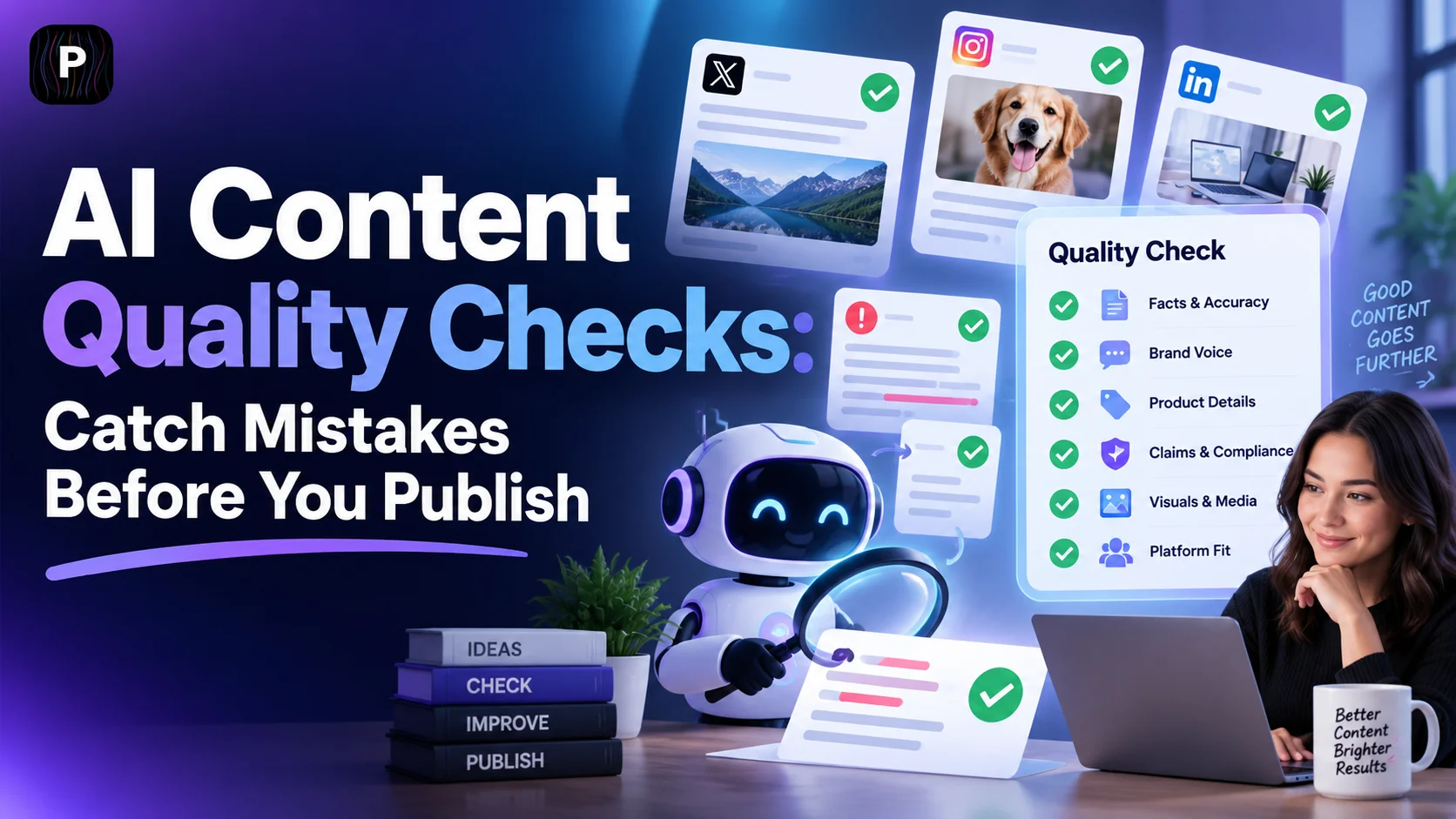
IMAGE 2 — QUALITY CHECK
Check #4: Review Claims and Promises
AI can make marketing language stronger than the evidence supports.
For example:
“This tool will double your conversions.”
That is a very different claim from:
“This tool can help teams create campaigns faster.”
Before publishing, examine:
Performance claims
Health claims
Financial claims
Guarantees
Superlatives
Comparisons
Ask:
Can we actually prove this statement?
If not, make the claim more precise.
This isn't about making every post cautious and boring.
It's about making the difference between marketing language and factual promises clear.
A strong post can still be persuasive without making claims the business cannot support.
Check #5: Check the Visuals
AI-generated visuals can introduce errors that aren't obvious from the caption.
Look closely at:
Products
Does the product actually look like the real product?
Logos
Is the logo correct?
Text
Are words spelled correctly?
Packaging
Are labels, colors, and proportions accurate?
People
Do faces, hands, clothing, and body proportions look natural?
Context
Does the visual actually represent what the caption says?
For a product advertisement, this check becomes even more important.
Imagine an AI image generating a bottle with the wrong label.
The image may look beautiful.
But it is still inaccurate.
A beautiful mistake is still a mistake.
Check #6: Adapt the Content to the Platform
A post can be factually correct and still be the wrong content for the platform.
Before publishing, ask:
Instagram: Is the visual or opening strong enough to work in a fast-scrolling feed?
TikTok: Does the video communicate its value quickly?
LinkedIn: Does the tone and context fit a professional audience?
Facebook: Is the post appropriate for the audience and format?
YouTube: Does the title and opening match what the viewer expects?
Don't simply copy one AI-generated version everywhere.
The message can stay consistent while the execution changes.
This is especially important because social platforms have different audience behaviors and discovery systems. Sprout Social's 2026 research found that consumers have different expectations depending on the network, reinforcing the need to adapt how brands show up on each platform. Sprout Social — 2026 Social Media Content Strategy Report
Build a Simple AI Content Quality Checklist
Before publishing an AI-assisted post, run it through six checks.
1. Facts
Is every important claim accurate?
2. Brand
Does it sound like our brand?
3. Product
Are all product details correct?
4. Claims
Can we support everything we're promising?
5. Visual
Does the visual accurately represent the subject?
6. Platform
Is this version appropriate for where we're publishing it?
You can turn this into a simple workflow:
AI Generation
↓
Fact Check
↓
Brand Check
↓
Claim Check
↓
Visual Check
↓
Platform Check
↓
Publish
This takes a little more effort than pressing “Generate.”
But it can prevent much more expensive mistakes later.
IMAGE 3 — QUALITY WORKFLOW
Use The Post Engine as Part of Your Quality Process
Quality control starts before the final post reaches your audience.
The Post Engine can be part of the production environment where your team creates and organizes social media content, while the quality checklist above acts as the approval layer.
For example:
Content idea
↓
Create with the correct brand context
↓
Review the generated content
↓
Check facts and claims
↓
Verify product details
↓
Inspect the visual
↓
Approve the final version
The important distinction is that AI-assisted creation does not have to mean AI-approved publishing.
Your team can use The Post Engine to keep the content-production process organized while maintaining a human quality gate before publishing.
Better prompt → Better output → Quality check → Publish
For the performance stage after publishing, [How to Turn Social Media Analytics Into Better AI Content].
That creates a more complete system:
Prompt → Create → Check → Publish → Measure → Improve
Frequently Asked Questions
Can AI-generated social media content be trusted?
It can be useful, but important facts, claims, product information, and visual details should be reviewed before publishing.
What should I check first?
Start with factual claims and numbers. An incorrect statistic or product detail can undermine an otherwise strong post.
Does every AI post need human review?
The level of review should depend on the content and risk. Posts containing factual claims, product information, sensitive subjects, or regulated information deserve more careful review.
Can AI fact-check its own content?
AI can help identify claims that need verification, but it should not be treated as the only authority for verifying important facts. Check important information against reliable primary or authoritative sources.
Should AI-generated visuals always be checked?
Yes, especially when the visual represents a real product, person, location, document, interface, or other specific object.
Final Takeaway
AI makes social media production faster.
But faster publishing also means mistakes can spread faster.
A good quality-control process doesn't need to be complicated.
Check:
Facts
Brand voice
Product details
Claims
Visuals
Platform fit
Then publish.
The ideal workflow is not:
Generate → Publish
It is:
Generate → Check → Correct → Approve → Publish
AI can help your team produce more.
Quality control makes sure “more” doesn't become more mistakes.