Is your AI social media content generic? Learn the most common prompt mistakes and practical techniques for creating more specific, useful, and on-brand social media posts.
AI can create a social media post in seconds.
But there is a problem.
You ask:
“Write an Instagram post about social media marketing.”
And you get something that sounds like thousands of other posts:
“Take your social media strategy to the next level with these powerful tips...”
The grammar may be correct.
The structure may be clean.
But the content feels generic.
That's usually not because the AI model is incapable of producing better content.
The bigger problem is that the prompt gives it too little information to work with.
Sprout Social identifies incomplete prompts, weak brand-voice direction, and overly broad requests as common reasons social-media AI output becomes generic or off-brand. Sprout Social — How to Write Social Media AI Prompts
Predis's own prompt guidance also emphasizes that specific instructions and context can improve AI-generated results. Predis — How to Write Prompts That Actually Work
So the real question isn't:
“Which AI tool should I use?”
It's:
“Am I giving the AI enough information to create something specific?”
Why AI Social Media Content Becomes Generic
AI doesn't automatically know:
Who your customers are
What makes your brand different
What your audience already knows
What you want the post to achieve
What platform you're publishing on
What language your customers use
What your brand should never say
When those details are missing, the model has to fill the gaps.
That often produces safe, broad language.
The problem is usually not the AI model itself.
It is missing context.
A vague prompt gives the model too much freedom.
A structured prompt gives it a clearer path.
The goal isn't necessarily to write the longest possible prompt.
It's to provide the right information.
Mistake #1: Giving AI a Topic Instead of a Goal
One of the most common prompts looks like this:
“Create an Instagram post about customer retention.”
The problem is that “customer retention” is a subject, not an objective.
AI doesn't know whether you want to:
Educate
Generate leads
Promote a product
Start a discussion
Drive clicks
Build trust
Explain a problem
A better prompt gives the AI a job.
Instead of:
“Write a post about customer retention.”
Try:
“Create an educational Instagram carousel explaining why small businesses lose repeat customers. The goal is to help business owners identify three retention mistakes and save the post for later.”
Now the AI knows:
Topic + format + audience + goal + outcome
That dramatically reduces ambiguity.
Mistake #2: Not Defining the Audience
“Write for business owners” is still too broad.
A restaurant owner and a SaaS founder may both be business owners, but their problems, vocabulary, buying decisions, and examples are completely different.
Compare:
“Create a post for business owners about customer retention.”
with:
“Create a LinkedIn post for owners of small e-commerce brands doing $10K–$100K in monthly sales. Explain why repeat customers are important when acquisition costs are rising. Use practical examples and avoid marketing jargon.”
The second gives the model a much clearer target.
A strong prompt should answer:
Who is reading this?
What do they already know?
What problem are they experiencing?
What do you want them to understand or do?
Mistake #3: Giving No Brand Voice or Examples
Another common problem is saying:
“Make it professional and engaging.”
Those words are too subjective.
Professional to one brand may mean formal and corporate.
For another, it may mean simple, direct, and conversational.
Instead of describing your voice only with adjectives, give AI examples.
For example:
“Write in a direct, practical tone. Use short sentences. Avoid hype. Don't use phrases such as ‘game-changing,’ ‘unlock,’ or ‘take your business to the next level.’ Here's an example of our writing style: [paste example].”
Examples give the model something concrete to follow.
Sprout Social recommends giving AI context around tone, audience, examples, and other details when creating social content. Sprout Social — How to Write Social Media AI Prompts
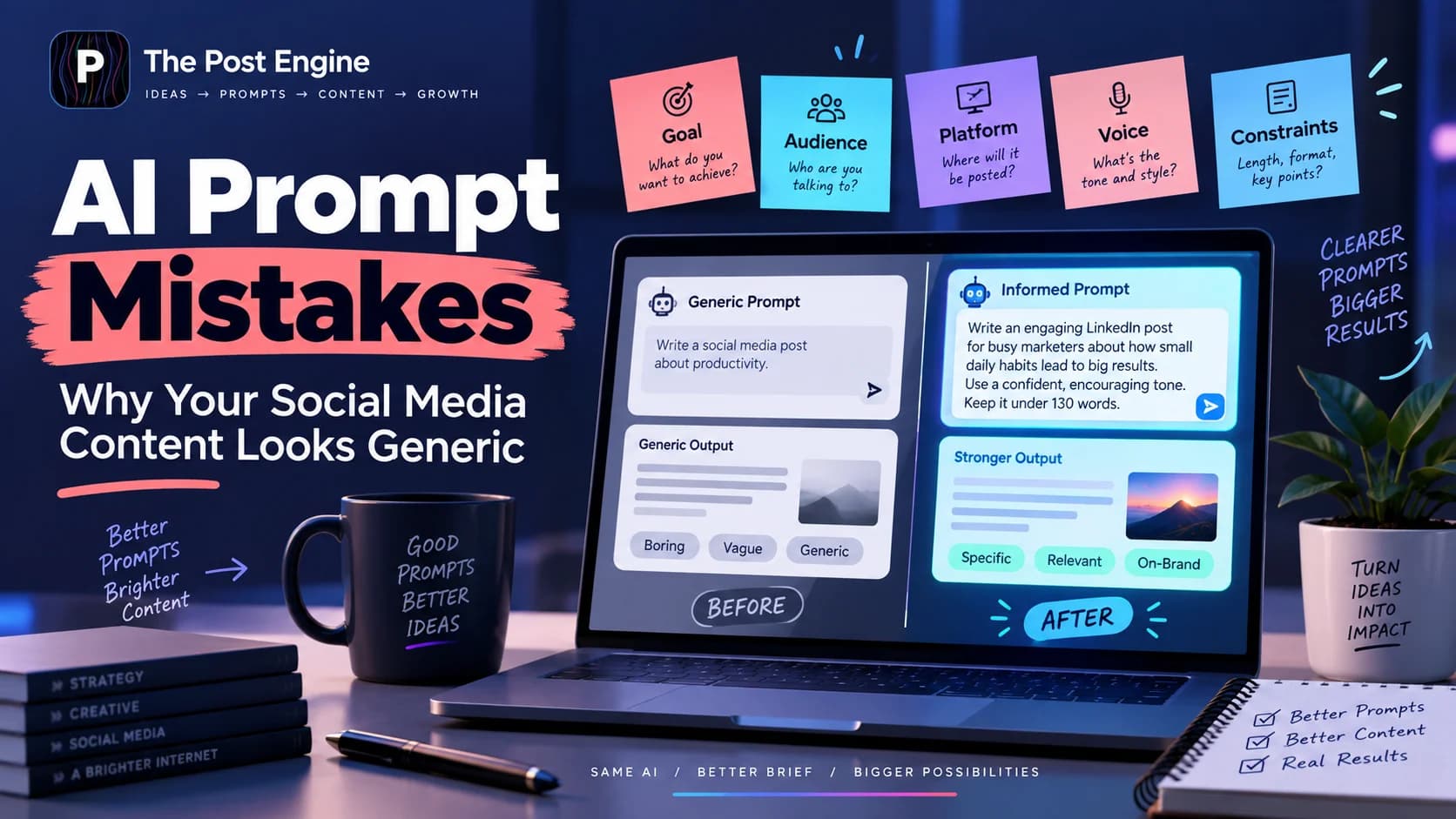
IMAGE 2 — PROMPT FORMULA
Mistake #4: Ignoring the Platform
A prompt that works for Instagram may produce poor content for LinkedIn.
The audience expectation is different.
The format is different.
The way people consume the content is different.
Instead of:
“Create a social media post about our new feature.”
Specify:
“Create a LinkedIn post announcing our new feature. Target marketing managers. Explain the problem it solves, give one practical example, and finish with a question that encourages discussion.”
Or:
“Create an Instagram carousel announcing the same feature. Use a strong first slide, short text, and six slides maximum.”
Same idea.
Different execution.
The platform should be part of the prompt whenever the content format or audience behavior changes.
Mistake #5: Giving AI No Constraints
More freedom does not always produce better content.
Without constraints, AI may:
Write too much
Use repetitive phrases
Add unnecessary explanations
Create weak CTAs
Overuse emojis
Add marketing clichés
Change the intended tone
Add rules.
For example:
“Write 120–150 words.”
“Use one CTA.”
“No emojis.”
“Avoid buzzwords.”
“Use one concrete example.”
“Do not make unsupported claims.”
“Keep the first sentence under 12 words.”
Constraints give the model a clear boundary.
This is especially useful for social media because platform-specific content often has limited space and attention.
Mistake #6: Asking for Everything in One Prompt
Sometimes the problem isn't that the prompt is too short.
It's that the prompt is trying to do too many things at once.
For example:
“Research the topic, create five ideas, write captions, create hooks, make a carousel, write a video script, add hashtags, create three CTAs, and optimize everything.”
That can make the output inconsistent.
A better approach is to work in stages:
Step 1: Generate content angles.
↓
Step 2: Choose the strongest angle.
↓
Step 3: Create the post.
↓
Step 4: Create variations.
↓
Step 5: Review and refine.
This gives you more control over the final content.
A Better AI Prompt Framework for Social Media
Instead of memorizing dozens of prompts, use a simple framework.
Context
Give AI the information it needs.
What is the brand?
What does it sell?
What problem does it solve?
Audience
Explain exactly who the content is for.
Goal
Tell AI what the post should achieve.
Platform
Specify Instagram, TikTok, LinkedIn, Facebook, or another channel.
Format
Tell it whether you want:
Carousel
Short video
Caption
Text post
Story
Ad
Image concept
Voice
Describe the brand style and provide an example when possible.
Constraints
Set length, structure, words to avoid, CTA rules, and other requirements.
Reference
Give AI information it can actually use:
Product details
Customer feedback
Previous content
Brand guidelines
Examples
Research
The framework becomes:
Context → Audience → Goal → Platform → Format → Voice → Constraints → References
The more important the content, the more useful this structure becomes.
IMAGE 3 — BEFORE/AFTER PROMPT
Build Better AI Prompts With The Post Engine
The biggest prompt problem is often missing context.
Every time you ask an AI tool to create a post, you shouldn't have to repeat your brand name, audience, tone, positioning, content preferences, and style from scratch.
This is where The Post Engine's Brand DNA can make the prompting process more practical.
Instead of starting with:
“Write an Instagram post about customer retention.”
you can start from your existing brand context and build the prompt around the actual content task:
Brand context
→ Who you are and how you communicate
Audience
→ Who should see the post
Content objective
→ What the post needs to achieve
Content request
→ What you want AI to create
Platform and format
→ Instagram carousel, LinkedIn post, short video, and so on
This turns prompting from:
“Tell AI what to write.”
into:
“Give AI the context it needs to write for my brand.”
The advantage isn't simply having a longer prompt.
It's having a reusable source of brand context that can inform future content requests.
For example, your team can focus on the actual task:
“Create a LinkedIn post explaining three mistakes small businesses make when trying to retain customers.”
instead of rebuilding the entire brand briefing every time.
This can make AI-assisted creation more consistent across different people, formats, and campaigns.
You can also connect this approach with [How to Generate Different Social Media Post Styles in One Place] when explaining how one well-defined content idea can be adapted into different social formats.
For a broader look at AI-assisted social content creation, see [AI Social Media Content: The Complete Guide to Creating Better Content at Scale].
The key principle remains:
Don't create longer prompts. Create better-informed prompts.
That is the real difference between:
Generic AI output
and
Content that actually sounds like your brand.
IMAGE 4 — CONTEXT TO CONTENT
Frequently Asked Questions
Why does my AI-generated social media content sound generic?
Usually because the model doesn't have enough context about your audience, brand, goal, platform, or desired style.
Should prompts be long?
Not necessarily.
A short prompt with the right information can be better than a long prompt filled with unnecessary instructions.
Should I give AI examples of my previous posts?
Yes. Examples can help communicate patterns of tone, structure, vocabulary, and style more clearly than adjectives alone.
Should every platform use a different prompt?
Not necessarily, but the prompt should account for differences in audience, format, length, and platform behavior.
Can AI create completely original brand content?
AI can help generate new combinations and ideas, but the strongest brand content usually includes original information, experiences, perspectives, examples, or evidence supplied by the business.
Final Takeaway
Generic AI content usually doesn't start with a bad model.
It starts with insufficient information.
A prompt such as:
“Write a post about our product.”
leaves too many decisions to the AI.
A better prompt tells it:
Who → Why → What → Where → How → Rules → Examples
That gives the model something specific to work with.
And remember:
AI should generate from your brand context, not replace it.
The goal isn't to make AI sound more human by adding random phrases.
The goal is to give AI enough real information, clear direction, and brand perspective that the result has something worth saying.
Better input → Better context → Better output.
And when AI becomes part of your social media workflow, the strongest results come from combining its speed with your brand's judgment.