Learn how to avoid creative fatigue when using AI for social media content. Discover how to create more varied, authentic, and engaging content with AI.
AI makes it easier than ever to create social media content.
But creating more content doesn't automatically mean creating better content.
When the same hooks, layouts, visuals, captions, and AI-generated style appear again and again, your audience can start scrolling past them.
This is becoming a bigger problem in 2026. Hootsuite identifies authenticity and rapid creative experimentation as major social trends, while HubSpot reports that 77% of social media marketers say authenticity is more important than production value.
The solution isn't to stop using AI.
It's to use AI without letting your content become repetitive.
What Is AI Creative Fatigue?
Creative fatigue happens when your audience repeatedly sees similar content and becomes less interested in it.
With AI, the problem can happen faster because generating another post is easy.
You might keep using:
The same hook structure
The same visual style
Similar captions
Identical layouts
Repeated content topics
The result can be technically good content that simply feels predictable.
Research and industry reports in 2026 increasingly point toward a need for more experimentation and authenticity as AI-generated content becomes more common.
Why AI Content Starts Looking the Same
AI tools learn from patterns.
That's useful when you want reliable output.
But without enough creative direction, the output can become repetitive.
For example, a brand might repeatedly publish:
“3 mistakes you're making…”
followed by:
“Here's what you need to know…”
with the same colors, image style, and layout.
After a while, the problem isn't quality.
It's sameness.
Current social-media research describes a growing audience preference for content that feels human, natural, and less over-produced.
5 Ways to Avoid Creative Fatigue
1. Change the Angle, Not Just the Words
Don't rewrite the same idea five times.
Change the perspective.
For one topic, try:
Problem angle
“Why your content isn't getting attention.”
Contrarian angle
“Posting more isn't the answer.”
Educational angle
“3 reasons your content gets ignored.”
Story angle
“We changed one thing in our content strategy.”
Same topic.
Different reason to pay attention.
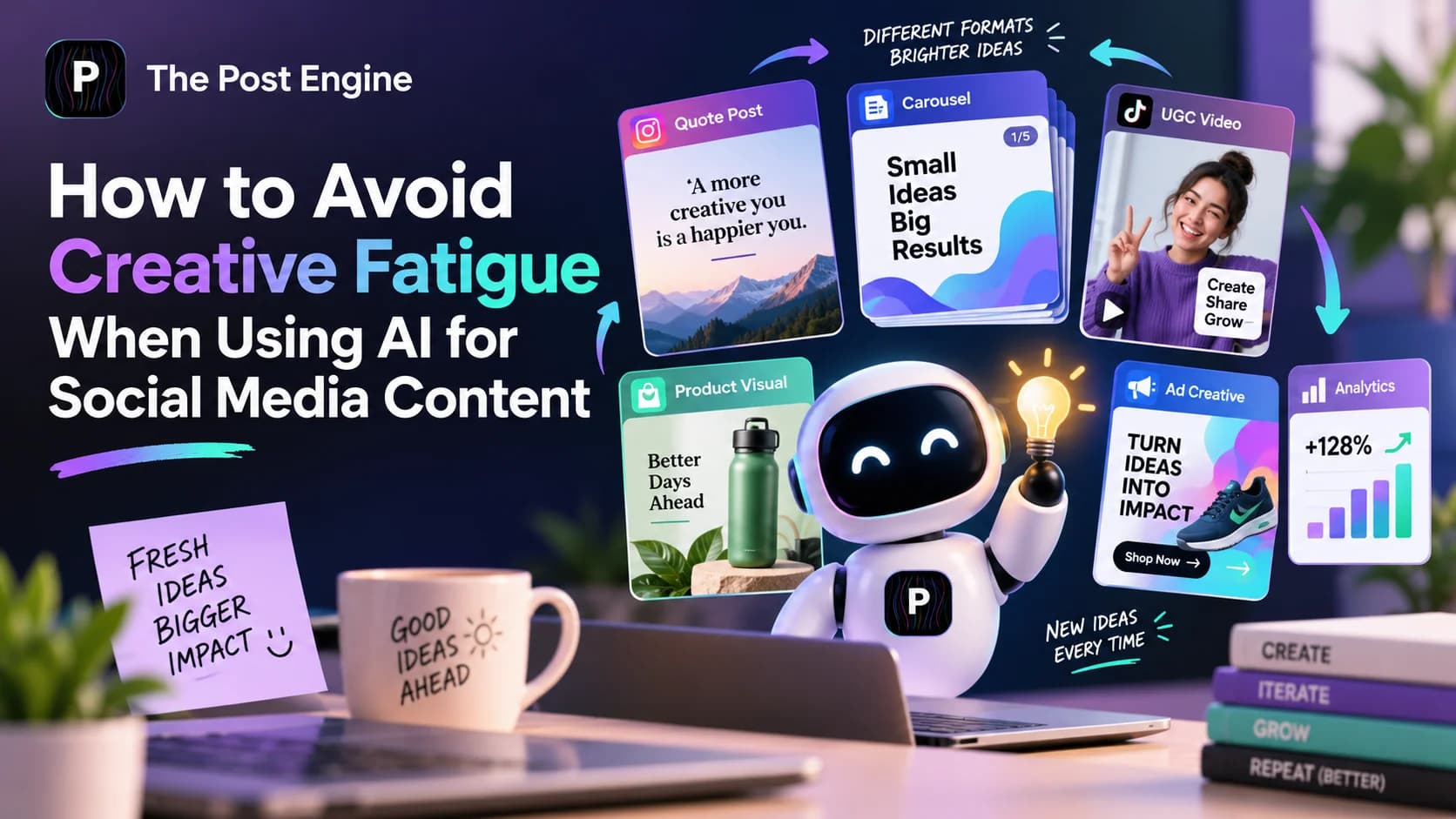
2. Build Multiple Creative Formats
Don't turn every idea into the same post.
One idea could become:
This keeps your content system varied without requiring completely new ideas every day.
The Post Engine's AI Content Studio can support different content formats from the same broader workflow.
3. Give AI Your Brand Context
Your AI content should not sound like everyone else's.
The Post Engine's Brand DNA gives the system context about your brand voice, audience, positioning, offers, and content style.
That allows you to create content that is not just AI-generated, but brand-aligned.
4. Study Competitors—but Don't Copy Them
Creative fatigue can happen when brands keep repeating their own ideas.
Competitor research can help you discover new directions.
Look at:
New hooks
Different formats
Topics competitors are missing
New visual approaches
Customer problems they haven't addressed
The Post Engine's Competitor Intelligence is designed to reveal competitors' strategies, hooks, positioning, and content gaps.
Then turn those insights into your own ideas.
Competitor insight → Audience need → Your angle → Original content
5. Test New Creative Ideas Regularly
Don't wait until engagement drops before changing your content.
Create variations of:
Hooks–Visuals–Formats–Topics–Offers–Creators
Then analyze which patterns work.
Hootsuite's 2026 trends report specifically highlights creative pattern analytics, rapid experimentation, and continuous testing as important parts of modern social workflows.
This turns AI from a content duplication tool into a creative testing tool.
###################IMAGE 2 — CREATIVE VARIATION
Keep AI Content Human
Using AI doesn't mean every part of the content needs to look artificial.
Add human elements such as:
-Personal opinions
-Real examples
-Customer stories
-Original insights
-Natural language
-Real product experiences
This matters because consumers are becoming more cautious about AI-generated content. Hootsuite reports that authenticity is a key differentiator in 2026, while Sprout Social reports continued consumer preference for human-generated content.
The goal is not:
AI-generated content everywhere.
The goal is:
AI-assisted content that still feels worth consuming.
Create Better AI Content With The Post Engine
The strongest way to avoid creative fatigue is to connect several inputs instead of relying on AI generation alone.
Brand DNA
→ Keep content recognizable.
→ Find new opportunities.
→ Create different formats.
→ Experiment without starting over.
→ Learn what deserves more attention.
This matches The Post Engine's broader unified workflow of strategy → creation → analysis → scheduling → publishing.
################IMAGE 3 — POST ENGINE WORKFLOW
Frequently Asked Questions
What is creative fatigue in social media?
Creative fatigue happens when audiences repeatedly see similar content and become less responsive to it.
Does using AI automatically cause creative fatigue?
No. AI can increase creative fatigue when it produces repetitive content, but it can also help prevent it by making experimentation and variation easier.
How can I make AI content feel less generic?
Give AI clear brand context, use original ideas, vary your formats and angles, and add human insights and experiences.
How often should I change my social media creative?
There is no universal schedule. Monitor performance and audience response, then refresh creatives when patterns begin to decline.
Is AI still useful if audiences want authentic content?
Yes. AI can handle repetitive production work while humans provide the strategy, personality, judgment, and authenticity that make the content valuable.
Final Takeaway
AI should help you create more possibilities, not more copies.
The best approach is:
Use AI for speed.
Use Brand DNA for consistency.
Use competitor insights for new ideas.
Use variations for experimentation.
Use analytics to learn what works.
In 2026, the advantage isn't simply producing more AI content.
It's producing content that still feels different, relevant, and worth stopping for.