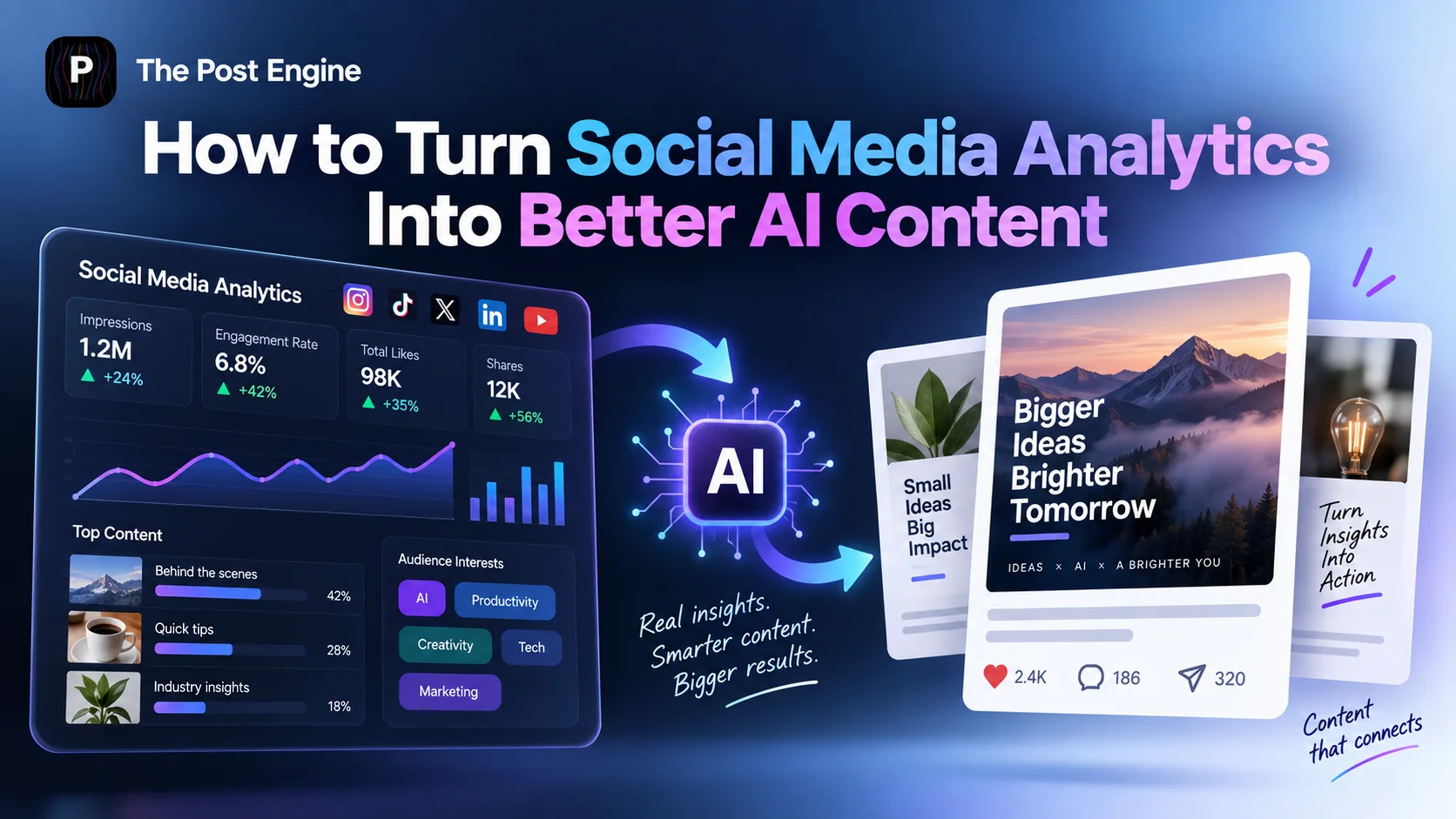
Learn how to use social media analytics to improve AI content. Discover which metrics matter, how to find winning patterns, and how to create smarter content.
Creating AI content is fast.
But speed is only useful when you know what is actually working.
A post can get thousands of impressions and still produce little meaningful engagement. Another post may reach fewer people but generate more saves, shares, comments, or clicks.
That's why social media analytics should not only be used for reporting.
Your performance data should influence what you create next.
Current 2026 guidance increasingly treats analytics as a decision-making layer: use performance data to understand what works, identify patterns, and improve future content rather than simply collecting metrics.
Why Analytics Should Influence Your AI Content
AI can generate dozens of content ideas.
But it doesn't automatically know which ideas are most valuable to your audience.
Your analytics provide that feedback.
For example:
High saves → educational content may be valuable.
High shares → relatable or useful content may be resonating.
High watch time → the topic or opening may be working.
Low engagement → the topic, hook, format, or audience targeting may need improvement.
The goal isn't to chase every metric.
It's to turn performance signals into better creative decisions.
Meta's current guidance also positions AI as useful across the content cycle, including performance analysis and optimization.
5 Metrics That Can Improve Your Content Decisions
1. Engagement Rate
Look at which content gets meaningful interaction relative to its reach.
Don't just ask:
“Which post got the most likes?”
Ask:
“Which type of content consistently creates a response?”
2. Shares
Shares can indicate that the content is useful, relatable, entertaining, or worth passing to someone else.
Find the topics and formats that repeatedly earn shares.
Then create new variations around the same underlying idea.
3. Saves
High saves can be a strong signal for educational, reference, or problem-solving content.
For example:
“5 social media mistakes”
may be worth turning into:
A carousel
A short video
A text post
A checklist
4. Watch Time
For video, don't only measure views.
Look at how long people stay.
A strong topic with a weak opening may get clicks but lose viewers quickly.
That tells you to improve the hook, not necessarily abandon the topic.
5. Clicks and Conversions
A post can have average engagement but still drive valuable traffic or conversions.
Choose metrics based on your objective rather than treating every post as a popularity contest. Current analytics guidance similarly recommends connecting metrics to business goals rather than relying only on vanity numbers.
Find Patterns Instead of Looking at Individual Posts
One viral post doesn't automatically mean you've discovered your winning strategy.
Look for patterns across multiple posts.
For example:
This is where analytics becomes much more useful.
You're no longer asking what happened.
You're asking what should we create next?
IMAGE 2 — ANALYTICS TO CONTENT
Turn Performance Insights Into New Content
Once you find a winning pattern, don't simply repeat the exact same post.
Expand it.
For example:
Winning topic:“Why your social media posts aren't converting.”
Turn it into:
Carousel:“5 reasons your posts aren't converting.”
Text post:“Your problem may not be reach.”
Video:“Here's why views don't always become customers.”
Quote:“Attention isn't the same as conversion.”
Ad:“Turn attention into action.”
One performance insight can become an entire content cluster.
This is especially powerful with AI because AI can help create variations quickly while you focus on the strategy and final creative decisions. Recent 2026 AI-social guidance also emphasizes using AI for ideation, generation, iteration, and performance analysis as part of one workflow.
Keep Your AI Content On-Brand
Performance alone shouldn't control your content.
A post can perform well and still be completely wrong for your brand.
That's why analytics should work together with Brand DNA.
The Post Engine's Brand DNA helps establish your brand voice, audience, positioning, offers, and content style.
That creates a better system:
Performance data + Brand context = Better content decisions
→ How to Find Your Brand Voice on Social Media
Use Competitor Insights With Your Analytics
Your own analytics tell you what your audience responds to.
Competitor intelligence can show you what your market is doing.
Combine both.
For example:
Your analytics: Educational posts perform well.
Competitor intelligence: Competitors rarely create short educational videos.
Opportunity: Create short educational videos around topics your audience already responds to.
The Post Engine's Competitor Intelligence is designed to reveal competitor strategies, hooks, positioning, and content gaps.
This helps you move from:
“What worked for us?”
to:
“What is working for us, what is missing in the market, and what should we test next?”
IMAGE 3 — DATA + COMPETITOR INSIGHTS
Build a Content Feedback Loop With The Post Engine
The most useful AI content workflow doesn't end when you publish.
It continues:
Brand DNA
→ Understand your brand.
Competitor Intelligence
→ Understand the market.
→ Create content.
→ Get real audience data.
→ Identify what works.
Create new variations
→ Improve the next round.
This connects directly with The Post Engine's unified workflow across strategy, creation, analysis, scheduling, and publishing.
→ Create AI UGC Ads with The Post Engine.
IMAGE 4 — FEEDBACK LOOP
Frequently Asked Questions
How can analytics improve AI-generated content?
Analytics can show which topics, formats, hooks, and messages are performing best, allowing you to create better variations instead of relying entirely on guesswork.
Which social media metrics matter most?
It depends on your goal. Engagement, shares, saves, watch time, clicks, and conversions can all be useful signals when connected to the objective of the content.
Should I create more content from my best-performing posts?
Yes, but don't simply duplicate them. Identify the underlying topic, format, hook, or audience need and create fresh variations.
Can AI analyze social media performance?
AI can help summarize performance data, identify patterns, and support optimization decisions. Current 2026 guidance from Meta specifically highlights AI-assisted performance analysis and optimization.
Should analytics completely control my content strategy?
No. Analytics should inform your decisions, while brand positioning, audience needs, creativity, and human judgment remain important. Sprout Social's 2026 research similarly emphasizes using AI for efficiency and insights without replacing human taste.
Final Takeaway
Don't use analytics only to create reports.
Use them to create better content.
The strongest loop is:
Create → Publish → Measure → Find patterns → Create better variations → Measure again
The Post Engine connects Brand DNA, Competitor Intelligence, content creation, publishing, and Analytics & Growth so performance can become part of the content creation process—not something you look at after everything is finished.
Turn your social media data into better content with The Post Engine →