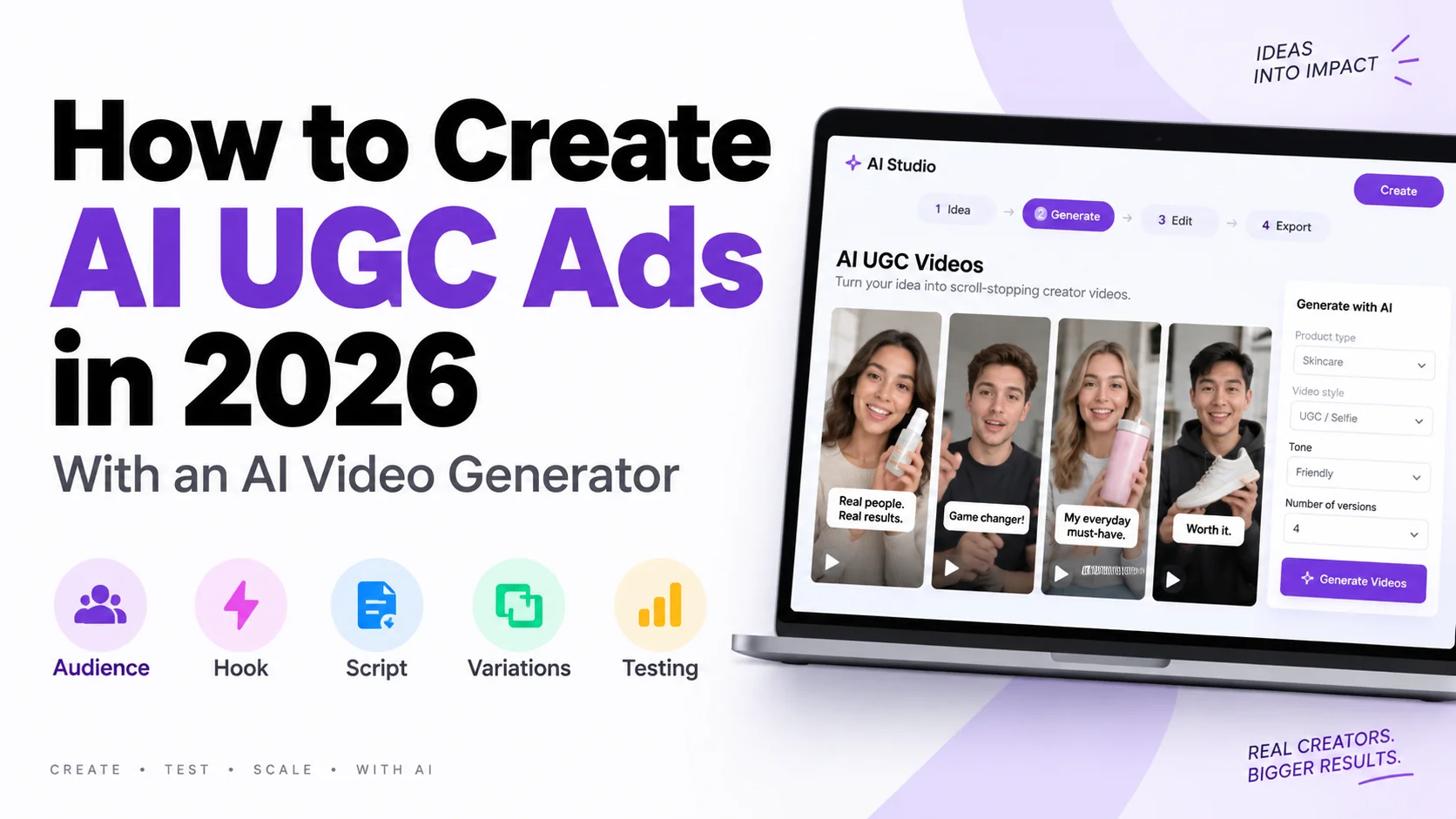
Learn how to create AI UGC ads in 2026 using AI video generators. Discover the right hooks, scripts, visuals, and workflow for creating social media ads faster.
Creating UGC ads used to mean finding creators, sending products, filming content, waiting for edits, and producing multiple versions.
AI is changing that workflow.
In 2026, AI video tools can help brands create creator-style ads, test different hooks, generate variations, and produce short-form video creatives much faster. The biggest advantage is not simply generating one video.
It's being able to test more creative ideas.
AI UGC works best when the script, hook, product angle, and creative direction are strong.
With The Post Engine, AI-powered content creation can become part of a broader workflow that connects your brand, content ideas, creative production, and performance feedback.
What Is an AI UGC Ad?
An AI UGC ad is a video advertisement designed to look and feel like creator-generated content while using AI for some or all of the production.
This can include:
AI-generated presenters or avatars
AI voiceovers
AI-generated scenes
Product demonstrations
Captions and text overlays
Multiple creative variations
The goal is to maintain the authentic, direct-to-camera style of UGC while making production faster and more scalable.
Want to compare AI-generated UGC with traditional creator content? Read AI UGC vs Real UGC: Which Is Better for Social Media Ads in 2026?
Why Brands Are Using AI UGC Ads in 2026
Traditional UGC production can become expensive and slow when a brand needs many creative variations.
AI makes it easier to create different:
Hooks → Scripts → Creators → Scenes → Product angles → Versions
That makes AI particularly useful for paid social testing.
Current 2026 industry coverage shows AI UGC moving toward higher-volume creative testing rather than simply replacing traditional creator content.
The important lesson is simple:
Don't use AI to create more bad ads. Use AI to test more good ideas.
5 Elements of a Strong AI UGC Ad
1. A Strong Hook
Start with something that gives the viewer a reason to keep watching.
Example:
“I didn't expect this to work, but…”
2. A Clear Problem
Show the problem your product solves.
“I was wasting hours trying to…”
3. A Product Moment
Show the product naturally instead of turning the video into a traditional commercial.
4. Social Proof or Result
Show an outcome, benefit, demonstration, or believable use case.
5. Clear Call to Action
End with one simple next step.
“Try it for yourself.”
How to Create an AI UGC Ad Step by Step
Step 1: Choose the Audience
Define exactly who the ad is targeting.
A skincare ad for teenagers should not use the same angle as a skincare ad for working professionals.
Step 2: Choose One Pain Point
Don't try to sell everything in one video.
Pick one problem and build the ad around it.
Step 3: Write the Hook
Create 3–5 hook variations before generating the video.
For example:
Problem: Product photos take too long.
Hook 1: “I stopped spending hours creating product content.”
Hook 2: “Here's how we create product ads in minutes.”
Hook 3: “You don't need a full production team for this anymore.”
Step 4: Create the Script
Keep the language natural.
UGC-style ads should sound like a person talking—not like a corporate commercial.
Step 5: Generate the Video
Choose the AI presenter, voice, environment, product placement, and visual style.
Step 6: Add Captions and Branding
Make the video easy to follow without sound and keep the visual identity consistent.
Step 7: Export Multiple Versions
Create different versions with different hooks, openings, and product angles.

Use Brand DNA to Keep Your Ads On-Brand
AI can generate content quickly.
But fast content is not useful when every ad sounds like a different company.
The Post Engine's Brand DNA helps identify your brand's voice, positioning, audience, content pillars, formats, and patterns.
Use that information when creating AI UGC scripts and creative directions.
For example:
Brand: Premium skincare
Tone: Clean, expert, trustworthy
Hook:
“Here's the skincare mistake I wish I stopped making sooner.”
Instead of:
“OMG, you NEED this product!”
Same product.
Different brand. for more information check this : How to Find Your Brand Voice on Social Media
Create Multiple UGC Ad Variations
One of the biggest advantages of AI video generation is variation.
Instead of creating one ad, build a small testing matrix.
This lets you discover which combinations work best.
Creating more variations also makes creative fatigue easier to manage. See How to Avoid Creative Fatigue When Using AI for Social Media Content
Use Competitor Intelligence to Find Better Ad Angles
Before creating another ad, study what competitors are already communicating.
Look for:
Repeated customer problems
Common hooks
Product positioning
Popular formats
Different offers
Creative gaps
The Post Engine's Competitor Intelligence helps brands analyze competitors and identify content opportunities across platforms.
The goal isn't to copy the competitor.
Instead:
Competitor pattern → Audience need → Your product → Original angle

Common AI UGC Mistakes to Avoid
Making the ad look too artificial
Overly perfect delivery, unnatural expressions, or unrealistic product interactions can reduce trust.
Starting too slowly
Don't spend the first few seconds explaining who you are.
Start with the problem, result, question, or product.
Using generic scripts
AI-generated content can sound repetitive when the script isn't based on a specific audience and offer.
Creating only one version
The strength of AI is iteration.
Test multiple hooks and angles.
Forgetting AI disclosure requirements
Platform rules can require disclosure for realistic AI-generated content. TikTok, for example, requires AIGC labeling or clear disclosure for qualifying AI-generated content, and its ad tools include an AI-generated-content disclosure option.
If your AI content still struggles to get attention, read Why Your AI Social Media Content Isn’t Getting Engagement — And How to Fix It
Always check the latest requirements of the platform where you plan to run the ad.
Create AI UGC Ads With The Post Engine
A strong AI UGC workflow shouldn't stop at video generation.
You also need:
Brand intelligence
→ Know how your brand should sound.
Competitor intelligence
→ Understand what is already working.
→ Turn ideas into content.
Analytics
→ Learn which creative directions deserve more testing.
The Post Engine brings these parts into one broader content workflow, combining Brand DNA, Competitor Intelligence, AI Content Studio, publishing, and Analytics & Growth.

Frequently Asked Questions
What is an AI UGC ad?
An AI UGC ad is a creator-style advertisement produced or enhanced with artificial intelligence, including AI avatars, voices, scripts, scenes, or editing.
Can AI UGC ads replace real creators?
Not always. AI is useful for speed, variation, localization, and testing, but authentic human creators can still be valuable when trust, lived experience, or real product use is central to the campaign.
What makes an AI UGC ad effective?
A strong hook, specific audience problem, believable product demonstration, clear benefit, natural delivery, and strong creative testing.
Can I use AI UGC ads on TikTok and Instagram?
Yes, but you need to follow each platform's advertising and AI-content rules. TikTok specifically has disclosure requirements for qualifying AI-generated content.
How many AI UGC ads should I create?
Instead of focusing on one exact number, create enough variations to test different hooks, angles, creators, and product messages.
Final Takeaway
AI UGC ads are not simply about generating a realistic AI person.
The real opportunity is building a repeatable creative testing system.
Start with:
Audience
↓
Problem
↓
Hook
↓
Script
↓
AI Video
↓
Creative Variations
↓
Testing
↓
Optimization
The Post Engine can help connect your brand intelligence, competitor research, creative production, publishing, and analytics into one workflow.