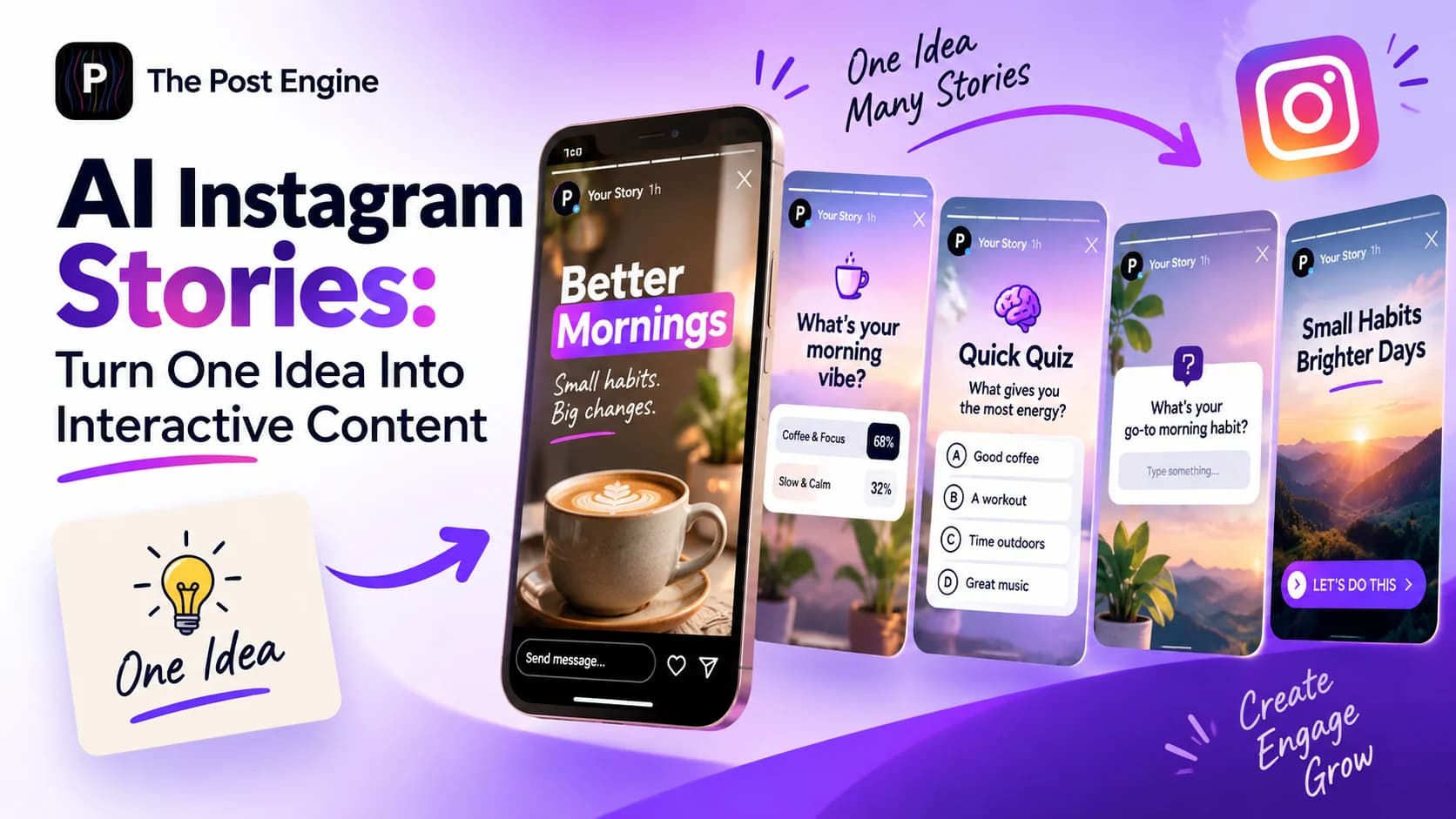
Learn how to turn one idea into interactive Instagram Stories with AI using polls, questions, quizzes, Story sequences, CTAs, and product content.
One content idea doesn't have to become one social media post.
It can become an entire Instagram Story sequence.
A product launch can become a question, product reveal, benefit, poll, and CTA.
A blog topic can become a hook, quick lesson, quiz, and link.
Stories are designed for fast, vertical, full-screen content, and Meta says Instagram Stories are particularly suited to helping businesses communicate products and ideas in an immersive format. Meta for Business — Stories Ads
The better approach is:
Start with one idea. Then turn it into a sequence people can watch, tap, answer, and act on.
Why Turn One Idea Into an Instagram Story Sequence?
One Story frame may communicate one message.
A sequence can communicate a complete idea.
For example:
Frame 1: “What's your biggest content problem?”
↓
Frame 2: Poll
↓
Frame 3: Quick solution
↓
Frame 4: Quiz
↓
Frame 5: Example
↓
Frame 6: CTA
This gives the audience several opportunities to participate instead of simply watching and moving on.
Buffer's current 2026 Instagram guidance explains that interactive Stories can help deepen relationships with existing followers, while polls, questions, and other interactive elements can also provide audience insights. Buffer — How the Instagram Algorithm Works: Your 2026 Guide
Stories are therefore useful for more than announcements.
They can become a conversation.
Start With One Clear Story Goal
Before asking AI to create your Stories, decide what you want the sequence to accomplish.
Your goal could be:
Educate
Generate replies
Promote a product
Collect opinions
Drive website traffic
Build anticipation
Promote another piece of content
For example:
Goal: Launch a new product
The sequence could become:
Problem → Product reveal → Benefit → Poll → CTA
Or:
Goal: Educate
It could become:
Question → Answer → Example → Quiz → Final tip
Starting with one clear objective prevents AI from generating unrelated slides.
Every frame should move toward the same outcome.
Later's current Instagram Stories guidance recommends planning Stories as a sequence and mixing formats rather than relying on one repetitive template. Later — Instagram Story Engagement Ideas: 21 Hacks to Try in 2026
Turn Ideas Into Interactive Questions
Questions can turn passive viewers into participants.
Instead of:
“Here are five Instagram tips.”
Try:
“What's your biggest Instagram problem?”
Then ask:
A: StoriesB: ReelsC: CaptionsD: Getting ideas
The next frame can answer the most common response.
You can also turn responses into new content:
Question → Audience response → New content idea
This creates a feedback loop between your audience and your content strategy.
Later's research and examples show how question-based Story interactions can be used to collect feedback, understand audience interests, and create follow-up content. Later — 5 Ways to Collect Customer Feedback on Instagram
Best combination:
Question → Response → Useful answer → Next step
Use Polls and Quizzes to Create Participation
Polls are useful when you want a quick decision.
For example:
“Which product photo would you choose?”
A: LifestyleB: Studio
Or:
“Would you try this?”
YesNot sure
Quizzes work especially well for educational content.
For example:
“Which content format is best for showing a product transformation?”
A: Before & AfterB: Quote GraphicC: Text-only Post
Then reveal the answer in the next frame.
Later's 2026 Instagram Stories guide specifically recommends interactive stickers such as polls, questions, and Add Yours for encouraging participation. Later — Instagram Story Engagement Ideas: 21 Hacks to Try in 2026
Don't use an interactive element just because it is available.
Use it because it gives the viewer a reason to respond.
Best combination:
Question → Interaction → Result → Explanation
IMAGE 2 — INTERACTIVE STORY FORMATS
Turn One Topic Into a Multi-Frame Story
You don't need a new idea for every frame.
Start with one topic and break it into smaller moments.
For example:
Topic: “How to Create Better Product Photos”
Frame 1: Hook“Your product photos look flat?”
Frame 2: Problem“Here's what might be missing.”
Frame 3: Tip“Add context around the product.”
Frame 4: Poll“Studio or lifestyle?”
Frame 5: ExampleShow both approaches.
Frame 6: CTA“Create more product content.”
One idea has now become six connected pieces of content.
The same approach can work for:
Blog topicsProductsTutorialsCustomer questionsIndustry tipsPromotions
Instagram Stories are built around vertical, full-screen viewing, which makes them useful for presenting a sequence rather than forcing an entire message into one frame. Meta for Business — Stories Ads
IMAGE 3 — STORY SEQUENCE
Add Links and Clear Calls to Action
An interactive Story should eventually tell the viewer what to do next.
For a website:
Learn more
For a product:
Shop now
For a blog:
Read the full guide
For another video:
Watch now
Instagram's Link sticker can send viewers directly to an external website from an organic Story. Instagram Help Center — About Link Sticker on Instagram Stories
That makes the final frame especially important.
For example:
Frame 1: ProblemFrame 2: TipFrame 3: ExampleFrame 4: “Want the full guide?”Frame 5: Learn More
The interaction creates interest.
The CTA gives that interest somewhere to go.
Meta also recommends leaving space for Story ad interface elements so important text, logos, and visual information are not covered. Instagram Help Center — About Link Sticker on Instagram Stories
IMAGE 4 — CTA STORY
Use AI to Create Different Story Angles
AI can help you expand one idea into several Story concepts.
Start with:
“I want to promote a new skincare product.”
AI could generate:
Product-Focused Story
Product reveal → Feature → Benefit → CTA
Educational Story
Common problem → Tip → Product solution → CTA
Interactive Story
Question → Poll → Product → Result
Social Proof Story
Customer quote → Product → Result → CTA
Behind-the-Scenes Story
Product creation → Detail → Finished product → Launch
The important part isn't asking:
“Create some Instagram Stories.”
Give AI a complete brief:
Topic + Goal + Audience + Story format + CTA
Then refine the output to match your brand voice and visual identity.
This approach also makes it easier to create several Story variations without changing the original idea.
IMAGE 5 — AI STORY ANGLES
Build Stories for Products and Promotions
One product can produce several different Story angles.
For example:
Product: Wireless headphones
You could create:
Story 1: “What's your biggest problem with headphones?”
Story 2: Poll
Story 3: Product reveal
Story 4: “40-hour battery life”
Story 5: Lifestyle image
Story 6: “Work or travel?”
Story 7: Shop CTA
The product remains the focus, but the Story creates interaction before asking for the sale.
Meta reports that businesses use Stories to introduce products and drive actions, and its current Stories guidance emphasizes quick-to-understand content and full-screen mobile creative. Meta for Business — Stories Ads
This approach can work for:
New launchesLimited-time offersProduct tutorialsCustomer reviewsRestocksBundlesSeasonal promotions
IMAGE 6 — PRODUCT STORY
Use Story Analytics to Improve Your Content
Creating more Stories isn't necessarily the goal.
Creating better Stories is.
Look at what happens after you publish.
Useful signals include:
ReachRepliesSharesLink clicksTaps forwardTaps backExits
Buffer notes that Instagram's ranking systems use signals such as whether people are likely to tap into a Story, reply to it, or move to the next Story. Buffer — How the Instagram Algorithm Works: Your 2026 Guide
This means your analytics can help you diagnose the sequence.
For example:
If viewers consistently exit after Frame 2, the transition may be weak.
If a poll generates many responses, the topic could become a future Reel.
If a Story gets strong link clicks, the same CTA structure may be worth testing again.
The useful loop is:
Create → Publish → Measure → Learn → Create again
IMAGE 7 — STORY ANALYTICS
Create AI Instagram Stories With The Post Engine
The advantage of AI Stories isn't simply generating more frames.
It's turning one content idea into several connected interactions.
With The Post Engine, you can start with a product, topic, or content idea and develop different social creative directions around it.
A simple workflow can look like:
Content idea
↓
Choose Story goal
↓
Create Story sequence
↓
Choose visual style
↓
Add interactive element
↓
Add CTA
↓
Create variations
↓
Publish
For example:
One product
→ Product Story→ Educational Story→ Poll Story→ Customer Story→ Promotional Story
The underlying idea stays the same, but the angle, interaction, visual treatment, and CTA can change.
→How to Generate Different Social Media Post Styles in One Place
IMAGE 8 — THE POST ENGINE
Frequently Asked Questions
Can AI create Instagram Story ideas?
Yes. AI can help generate hooks, questions, polls, quizzes, Story sequences, CTAs, and different creative directions from one topic.
What makes an Instagram Story interactive?
Interactive Story content can include polls, quizzes, questions, sliders, Add Yours, links, and other available Story features. Later — Instagram Story Engagement Ideas: 21 Hacks to Try in 2026
How many frames should an Instagram Story have?
There is no universal number. A short sequence can work well when every frame moves the idea forward. The important part is avoiding unnecessary slides.
Can Instagram Stories drive website traffic?
Yes. Instagram's Link sticker lets businesses direct viewers from an organic Story to an external website. Instagram Help Center — About Link Sticker on Instagram Stories
Can I schedule interactive Instagram Stories?
Yes, but there are platform limitations. Later's current publishing documentation says features such as stickers, polls, quizzes, links, music, and other Instagram-native elements may require notification publishing so they can be added directly inside Instagram. Later Help Center — Schedule & Publish Instagram Stories
Should every Story use an interactive element?
No.
Use an interaction when it supports the goal of the Story. One useful poll is better than filling every frame with unnecessary stickers.
Final Takeaway
You don't need a completely new idea for every Instagram Story.
Start with one idea.
Then turn it into:
Hook → Question → Poll → Tip → Example → Interaction → CTA
AI can help expand the idea, create variations, and speed up production.
But the strategy still comes first.
The process becomes:
One idea → Story sequence → Interaction → CTA → Publish → Learn
The best AI Instagram Stories aren't simply more content.
They're content designed to give people a reason to tap, answer, learn, and take the next step.