Learn how to use social media to retain customers, increase repeat purchases, build loyalty, and turn existing customers into long-term brand advocates.
Getting a customer to buy once is one thing.
Getting that customer to come back, stay engaged, and choose your brand again is another.
Social media is usually treated as a channel for attracting new customers. But it can also help brands stay connected with existing customers, provide useful information, encourage repeat purchases, and build loyalty.
According to Business.com’s guide to social media customer retention, social media can support customer relationships through ongoing communication, personalization, and loyalty-building activities.
The question is no longer only:
“How do we get more customers?”
It is also:
“How do we keep the customers we already have?”
Why Social Media Matters for Customer Retention
Getting a new follower or customer is only the beginning.
After a purchase, customers may still need help understanding the product, discovering new use cases, or deciding what to buy next.
Social media can help maintain that relationship.
For example:
Purchase → Follow → Learn → Engage → Buy Again → Recommend
Instead of treating your social channels only as an acquisition tool, use them as another place to provide value to customers after the sale.
Business.com’s customer retention guide also highlights the importance of building ongoing relationships rather than focusing only on new customer acquisition.
Understand What Existing Customers Need
Existing customers usually have different needs from people discovering your brand for the first time.
A new prospect may ask:
“What is this?”
An existing customer may ask:
“How can I get more value from it?”
That means retention-focused content can include:
Education — tips and tutorials that help customers get better results.
Product guidance — useful features, workflows, and best practices.
Updates — new products, features, improvements, or announcements.
Inspiration — different ways to use what they already purchased.
Community — opportunities to interact and share experiences.
The more useful your content becomes after the purchase, the more reasons customers have to remain connected.
Create Post-Purchase Content
One of the easiest retention strategies is creating content that helps customers use your product better.
For example, a coffee equipment brand could publish:
“3 Ways to Improve Your Espresso”
instead of publishing another:
“Buy Our Coffee Machine”
Other examples include:
How-to tutorials
Product tips
Maintenance guides
Advanced use cases
Common mistakes
New ways to use an existing product
The idea is simple:
Purchase → Use → Learn → Improve → Return
Post-purchase content gives customers value without turning every social post into another sales pitch.
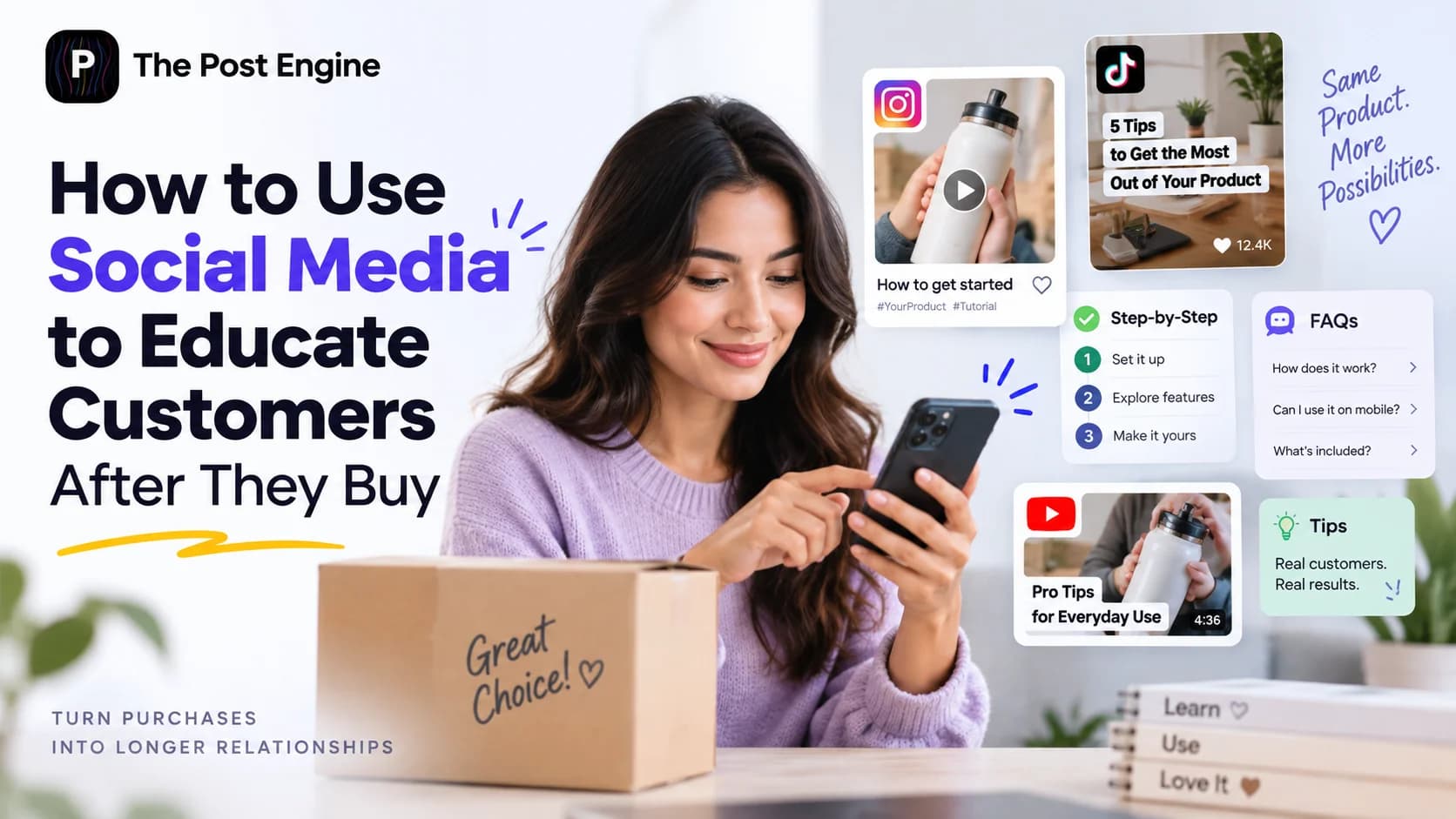
IMAGE 2 — POST-PURCHASE CONTENT
Build Relationships Through Social Media
Retention isn't only about what you publish.
It's also about how you interact.
Reply to useful comments.
Answer customer questions.
Acknowledge feedback.
Help people solve problems.
When customers see that the brand actually responds, social media becomes more than a publishing channel.
It becomes part of the customer relationship.
HubSpot's 2026 Instagram research also highlights responsive customer service and consistent replies as important for building trust and longer-term loyalty. Read HubSpot's 2026 Instagram Marketing Report.
Reward Customers Without Over-Promoting
Loyalty doesn't always require another discount.
You can give customers reasons to stay connected through:
Early access to launches
Exclusive information
Customer-only events
Useful tutorials
Special offers
Customer recognition
The goal is to make customers feel that being connected to your brand has value.
A good retention strategy balances promotion with useful experiences.
Turn Customers Into Brand Advocates
Your best customers can become part of your marketing.
A loyal customer may:
Leave a review
Share your product
Tag your brand
Recommend you to friends
Create user-generated content
Share their results
This creates a powerful cycle:
Good experience → Loyalty → Advocacy → New customers
Shopify's customer loyalty metrics guide also includes customer lifetime value, repeat purchase rate, and other measures that help businesses understand longer-term customer relationships.
Re-Engage Inactive Customers
Some customers eventually stop interacting with your brand.
Before sending another discount, think about why they became inactive.
Maybe they:
Don't know about new products
Need more education
Had a bad experience
Simply haven't seen relevant content recently
Use social media to give them a reason to reconnect.
For example:
“3 New Ways to Get More From the Product You Already Own”
can be more useful than:
“20% OFF — Buy Now.”
Re-engagement should focus on relevance, not just promotion.
Measure Customer Retention
Likes and followers are useful, but retention requires deeper metrics.
Repeat Purchase Rate
How many customers purchase more than once?
Shopify defines repeat purchase rate as the percentage of customers who have made more than one purchase. See Shopify's repeat-purchase metrics.
Customer Retention Rate
A common formula is:
[(Customers at end − New customers) ÷ Customers at start] × 100
Purchase Frequency
How often do returning customers buy?
Customer Lifetime Value
How much value does a customer generate throughout the relationship?
You should also monitor social signals from existing customers, including comments, shares, saves, messages, and community participation.
The goal isn't to find the highest engagement number.
It's to understand whether social media is helping customers stay connected and come back.
→ How to Turn Social Media Analytics Into Better AI Content
IMAGE 3 — RETENTION METRICS
Build the Workflow With The Post Engine
A retention strategy still needs consistent execution.
The workflow can look like:
Customer need
↓
Content idea
↓
Create
↓
Publish
↓
Measure
↓
Improve
With The Post Engine, you can turn retention-focused ideas into social media content and manage the publishing process from one workflow.
For example:
Customer need: “How can I get better results?”
↓
Content idea: “5 Ways to Get More From Your Product”
↓
Create: Social post, visual, or video
↓
Publish: Share across your social channels
The The Post Engine AI Content Studio can be used as the content-production layer, while your performance data helps determine what should be created next.
You can also see How to Generate Different Social Media Post Styles in One Place to explore how one retention idea can be adapted into different formats.
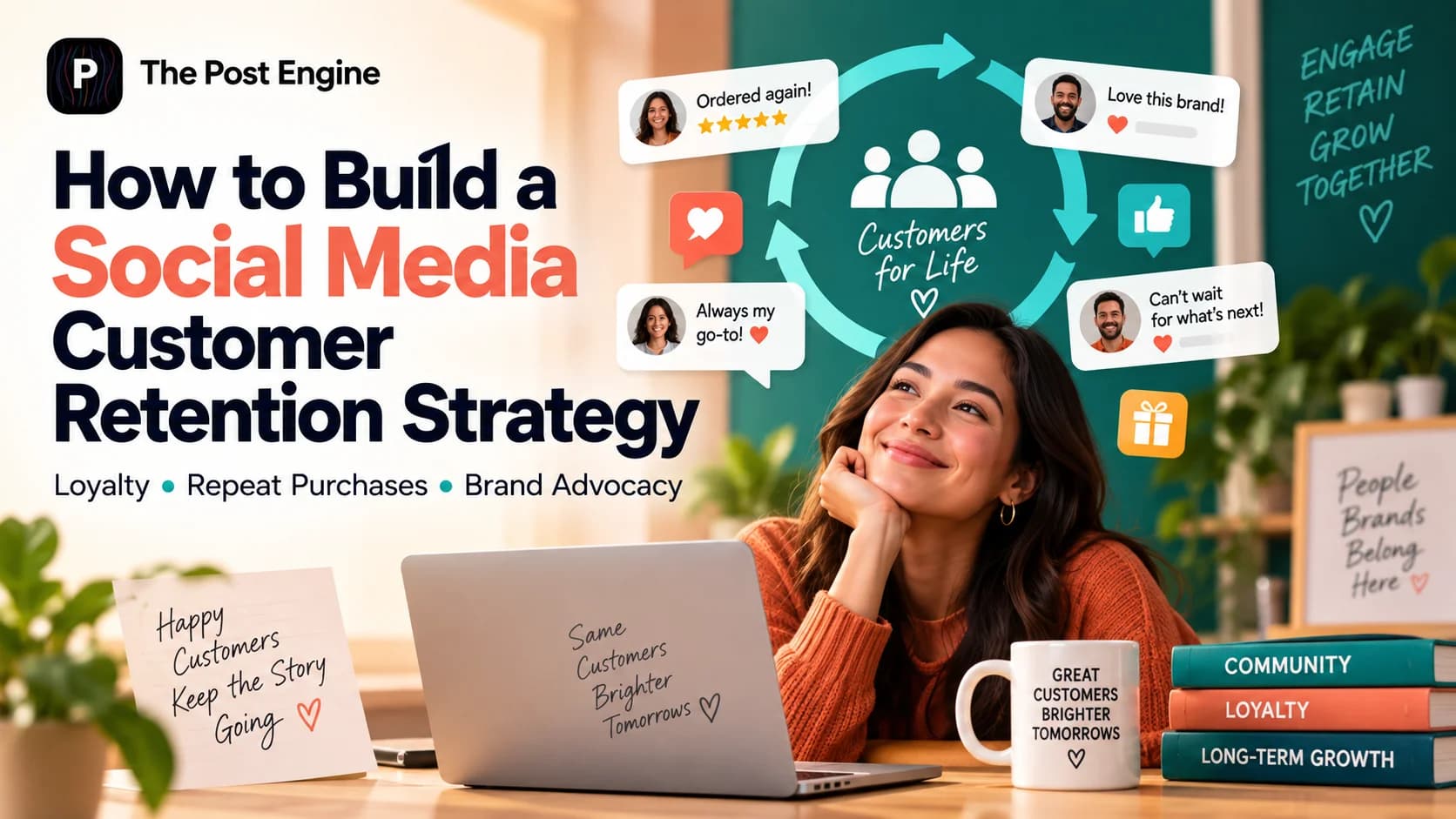
IMAGE 4 — RETENTION LOOP
Frequently Asked Questions
Can social media improve customer retention?
Yes. Social media can help brands maintain relationships through useful content, communication, education, recognition, and relevant offers.
What content is best for customer retention?
Tutorials, product tips, customer stories, use cases, updates, and educational content are strong starting points.
Should retention content stop promoting products?
No. The goal is to balance promotion with content that provides value to existing customers.
Which retention metric should I track first?
For many e-commerce businesses, repeat purchase rate is a useful starting point. Subscription businesses may focus more heavily on retention and churn.
How often should I publish retention content?
There is no universal number. Focus on consistency and usefulness rather than publishing simply to fill a calendar.
Final Takeaway
Social media shouldn't stop being useful after someone buys from you.
Use it to help customers:
Learn → Use → Engage → Return → Recommend
Create useful post-purchase content.
Respond to customers.
Reward loyalty.
Recognize advocates.
Re-engage inactive customers.
Then measure what happens and improve the strategy.
The goal isn't simply to get another sale.
It's to give customers a reason to come back.
Build your social media content workflow with The Post Engine →