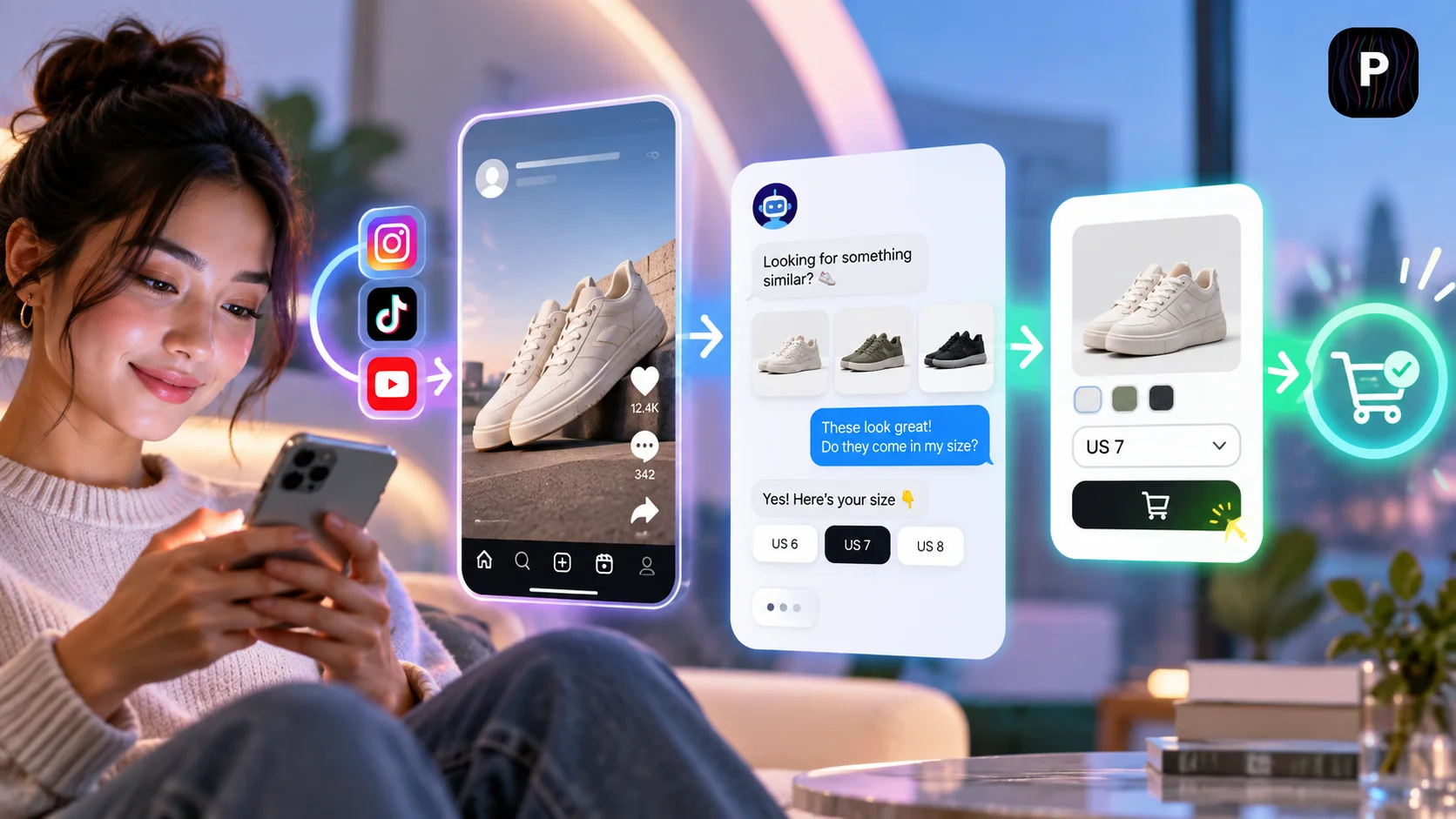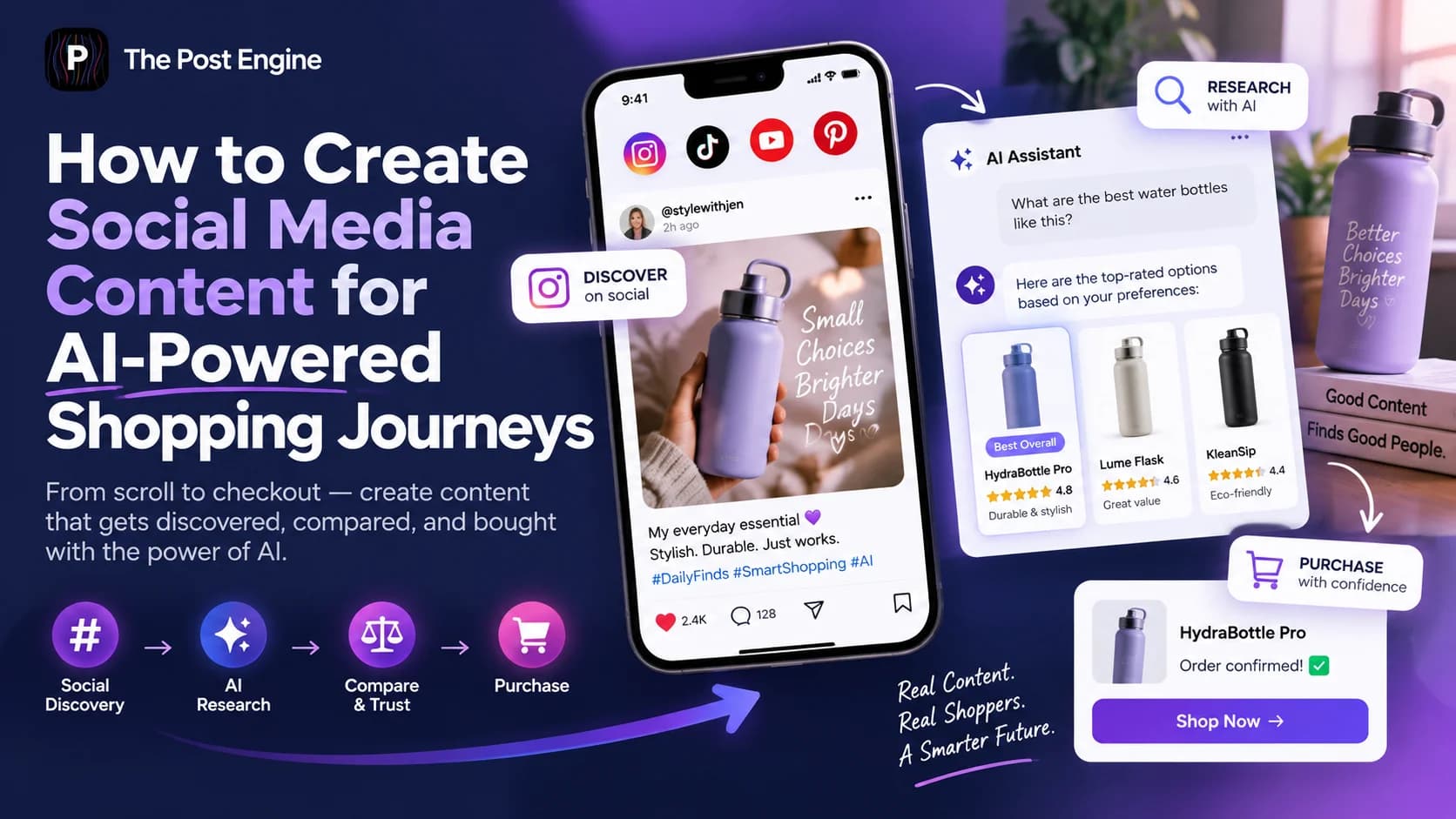
Let’s discover and learn how to create social media content that supports AI-powered shopping journeys with clearer product information, comparisons, proof, use cases, and content designed for AI-assisted discovery.
The shopping journey is changing.
Customers are no longer relying only on traditional search engines, product pages, and store websites to decide what to buy.
They are increasingly asking AI tools to:
Discover products
Compare options
Summarize reviews
Explain features
Find alternatives
Make recommendations
McKinsey's 2026 ConsumerWise research found that 68% of U.S. consumers had used at least one AI tool in the previous three months, with 19% of AI users using it to discover or decide on brands, products, or services. McKinsey — Shopping Gets an AI Assist
The shift is becoming more commercial too. Salesforce reported in July 2026 that agentic search as the first step in the purchase journey had grown 200% year over year, based on data from more than 1.5 billion global shoppers. Salesforce — Agentic Search Grows 200% as Purchase Journeys Start in AI Chats
So social content now has another job:
Help customers understand your product before, during, and after an AI-assisted shopping decision.
Understand the New AI Shopping Journey
Traditional ecommerce often looked like:
Search → Website → Product Page → Checkout
The new journey can look more like:
Social discovery → AI research → Comparison → Questions → Product choice → Purchase
Sometimes the customer may never follow that path in a perfectly linear way.
Deloitte describes agentic commerce as a progression from AI-assisted discovery to shopping agents that can search, compare, and eventually purchase on behalf of consumers. Deloitte — Agentic Commerce: The Future of AI in Retail
That changes what brands should publish.
Instead of creating content only to generate clicks, create content that helps answer:
What is this product?
Who is it for?
How is it different?
Why should I trust it?
When should I choose it?
Make Product Information Easy to Understand
AI-assisted shoppers need clear information.
That means your social content should avoid vague claims such as:
“The ultimate choice.”
Instead, communicate specifics:
“Lightweight aluminum frame, 8-hour battery life, and USB-C charging.”
Useful product content can highlight:
Materials
Dimensions
Compatibility
Features
Use cases
Price context
Availability
Key limitations
Google's current AI-commerce guidance makes the same point from the product-data side: AI-powered shopping experiences depend on accurate, complete product information, and incomplete merchant data can prevent shoppers from finding the right products. Google — AI Is Changing Retail. Here's How Businesses Can Keep Up
The lesson for social content is simple:
Be specific enough to help a customer make a decision.
IMAGE 2 — PRODUCT INFORMATION
Create Comparison Content AI-Assisted Shoppers Can Use
AI shoppers often compare multiple options before deciding.
McKinsey found that among European consumers who use AI for shopping, 63% use AI to compare options such as brands, models, prices, and reviews, while 41% are comfortable with AI summarizing reviews and highlighting trade-offs. McKinsey — AI to Browse but Not to Buy
That creates an opportunity for comparison-focused social content.
For example:
Instead of:
“Our running shoes are better.”
Create:
Model A: Lightweight
Model B: More cushioning
Or:
Best for: Long-distance runners
Best for: Everyday training
Other useful comparison formats include:
Feature vs. feature
Product A vs. Product B
Beginner vs. advanced option
Budget vs. premium
Use case vs. use case
The goal isn't to make every comparison favor your product.
It's to make the decision easier to understand.
Show Real-World Use Cases
AI can compare specifications.
But customers still need context.
Show:
Who uses the product
Where it is used
What problem it solves
What the experience looks like
For example:
Product: Portable projector
Instead of only listing brightness and resolution, create content showing:
Bedroom movie night
Business presentation
Outdoor event
This gives the shopper a way to connect a specification to a real situation.
McKinsey's research on AI-assisted shopping shows that AI is increasingly used for research and discovery, which makes useful, contextual product information more important across the digital ecosystem. McKinsey — An Update on EU Consumer Sentiment: The Uptake of AI Shopping Tools
Best combination:
Product detail + real situation + clear outcome
IMAGE 3 — USE CASE
Build Trust With Proof and Specific Details
AI can recommend a product.
But shoppers still need a reason to believe the recommendation.
Trust signals can include:
Specific specifications
Customer evidence
Demonstrations
Clear policies
Transparent comparisons
Real product photography
Verified claims
This matters because AI-assisted shopping doesn't eliminate uncertainty.
McKinsey found that even though AI is becoming important in product research, consumers remain cautious about trusting both generative AI and social media during shopping. McKinsey — From Likes to Buys
Adobe's 2026 retail research also found that AI-referred shoppers can be highly valuable: AI-driven traffic to U.S. retail sites increased 393% year over year in Q1 2026, and in March, AI traffic converted 42% better than non-AI traffic in Adobe's dataset. Adobe — AI Traffic Grows but Retail Sites Lag in AI Search Visibility
That makes accuracy and trust more than branding issues.
They can affect whether AI-referred shoppers continue toward purchase.
IMAGE 4 — TRUST SIGNALS
Create Content Around Natural Shopping Questions
AI-powered shopping is conversational.
Customers may ask:
“What's the best laptop for video editing under $1,000?”
“Which moisturizer is better for dry skin?”
“What's the difference between these two cameras?”
That suggests a useful content strategy:
Question → Useful answer → Product context → Evidence
Google's AI Max for Shopping already responds to more conversational product searches such as questions about quality, comfort, materials, and fit rather than relying only on exact product keywords. Google — Upgrade Your Shopping Campaigns With AI Max for Shopping
So instead of creating content around only:
“Product X”
create content around:
“Who should buy Product X?”
“Product X vs. Product Y: what's the difference?”
“What should you know before buying Product X?”
This makes the content more useful for humans and closer to the way AI-assisted shopping conversations are evolving.
IMAGE 5 — SHOPPING QUESTIONS
Make Your Content Useful Beyond the Social Feed
Your social posts shouldn't be isolated assets.
The information inside them should connect with the rest of your product ecosystem.
For example:
Social post
→ Product page
→ Product feed
→ AI shopping system
→ Purchase
OpenAI's current shopping experience uses product metadata from merchants and third-party providers to surface relevant products, while Google similarly relies on product data to power AI-driven shopping experiences. OpenAI — Shopping With ChatGPT Search Google — Introducing the Universal Cart and More Ways to Help You Shop
This means consistency matters.
If your social content says one thing, your product page says another, and your product feed is outdated, customers—and AI systems—have a harder time understanding the offer.
McKinsey's fashion research now describes Generative Engine Optimization (GEO) as an increasingly important complement to SEO because AI systems synthesize information rather than simply ranking webpages. McKinsey — The State of Fashion 2026: The AI Shopper
Build AI-Ready Social Content With The Post Engine
The goal isn't to turn every social post into technical product documentation.
It's to make your content clear, useful, consistent, and easy to understand.
With The Post Engine, you can turn product information into different social formats while keeping the creative direction consistent.
For example:
Product information
↓
Choose customer question
↓
Create comparison / use-case / benefit content
↓
Create visual
↓
Add caption
↓
One product can therefore support:
Comparison post
Buying guide
Feature graphic
Use-case creative
FAQ post
→How to Turn Your Website Into a Social Media Content Engine
That article covers the content source; this one focuses on making that content useful for a new AI-assisted shopping journey.
IMAGE 6 — POSTENGINE
Frequently Asked Questions
What is an AI-powered shopping journey?
It is a shopping process where AI helps consumers discover, research, compare, evaluate, recommend, or potentially purchase products.
Why does social media matter for AI-powered shopping?
Social content can provide additional product context, demonstrations, comparisons, experiences, and brand information that complement product pages and other digital sources.
Should social media content be optimized for AI?
Don't write robotic content for AI.
Instead, make your content clear, specific, factual, contextual, and consistent. These qualities also make content more useful to human shoppers.
What type of social content works best for AI-assisted shoppers?
Useful formats include:
Comparisons
Product demonstrations
Buying guides
Use cases
Feature explanations
FAQs
Trust-focused content
Is AI shopping already happening?
Yes. McKinsey found significant AI use for product research in 2026, while Salesforce reported 200% year-over-year growth in agentic search as a first step in the purchase journey. McKinsey — AI to Browse but Not to Buy Salesforce — Agentic Search Grows 200%
Final Takeaway
AI is changing how people discover and evaluate products.
The new journey can look like:
Social discovery → AI research → Comparison → Proof → Decision → Purchase
That means brands should create social content that does more than attract attention.
It should help answer:
What is it?
Who is it for?
How does it compare?
Why should I trust it?
How is it used?
Your advantage isn't creating content that “looks AI-ready.”
It's creating content that is useful enough for both the shopper and the AI-assisted journey around them.