Learn how to use social media DMs for faster customer service, product questions, order support, personalized recommendations, and AI-assisted responses without losing the human touch.
Your social media DMs are more than a place for casual conversations.
Customers use them to ask about products, solve problems, check orders, request recommendations, and decide whether they can trust a brand.
In fact, Hootsuite's 2026 research says 75% of consumers want to message businesses the way they message friends and family, while 53% say quickly responding to direct questions and comments is one of the most appealing things a brand can do on social media. Hootsuite — Social Media Customer Service: 2026 Enterprise Guide
At the same time, Salesforce reports that 82% of service organizations provide customer service through social media, showing that social support is already becoming a normal service channel rather than an optional extra. Salesforce — Why Your Business Needs Social Media Customer Service
The opportunity is:
Turn your DMs from a notification inbox into a customer-service channel.
Why DMs Are Becoming a Customer Service Channel
Customers don't always want to open a website, find a phone number, or search through a help center.
They may already be looking at your Instagram, Facebook, TikTok, or other social account.
So they ask:
“Does this come in black?”
“When will my order arrive?”
“Which product should I choose?”
“Can I return this?”
These conversations can happen before or after a purchase.
Salesforce research shows that 79% of service organizations use messaging apps, reflecting the wider shift toward asynchronous conversations that customers can continue when convenient. Salesforce — The 6 Customer Service Channels People Prefer
Meanwhile, Intercom's 2026 research found that 36% of support teams plan to invest in social messaging in 2026, roughly equal to planned investment in chat and email. Intercom — Transformation in Action: Raising the Bar for Customer Experience
The message is clear:
People increasingly expect support to be available where they already communicate.
Answer Product Questions Before They Stop a Purchase
A DM isn't always a support problem.
Sometimes it's a buying question.
For example:
“Is this suitable for sensitive skin?”
“What size should I order?”
“Does this work with iPhone?”
“What's the difference between these two?”
A helpful answer can remove the last piece of uncertainty before purchase.
This is especially important because social platforms increasingly sit inside the shopping journey. Salesforce reports that 50% of shoppers discover new products on social media, while social and messaging channels are increasingly involved in purchasing and support. Salesforce — Connected Shoppers Report
A strong response should be:
SpecificShortHelpfulEasy to act on
Instead of:
“Yes, we have several sizes.”
Try:
“Yes. For a 90–100 cm waist, we'd recommend Medium. If you're between sizes, Large will give you a more relaxed fit.”
The goal isn't simply to answer.
It's to remove friction.
IMAGE 2 — PRODUCT QUESTION
Separate Simple Questions From Complex Problems
Not every DM needs the same type of response.
Create a simple distinction.
Simple
• Opening hours
• Shipping times
• Product availability
• Basic pricing
• Return policy
• Product specifications
These can often be answered immediately.
Complex
• Damaged orders
• Billing problems
• Refund disputes
• Account issues
• Sensitive complaints
These may need a human or another support channel.
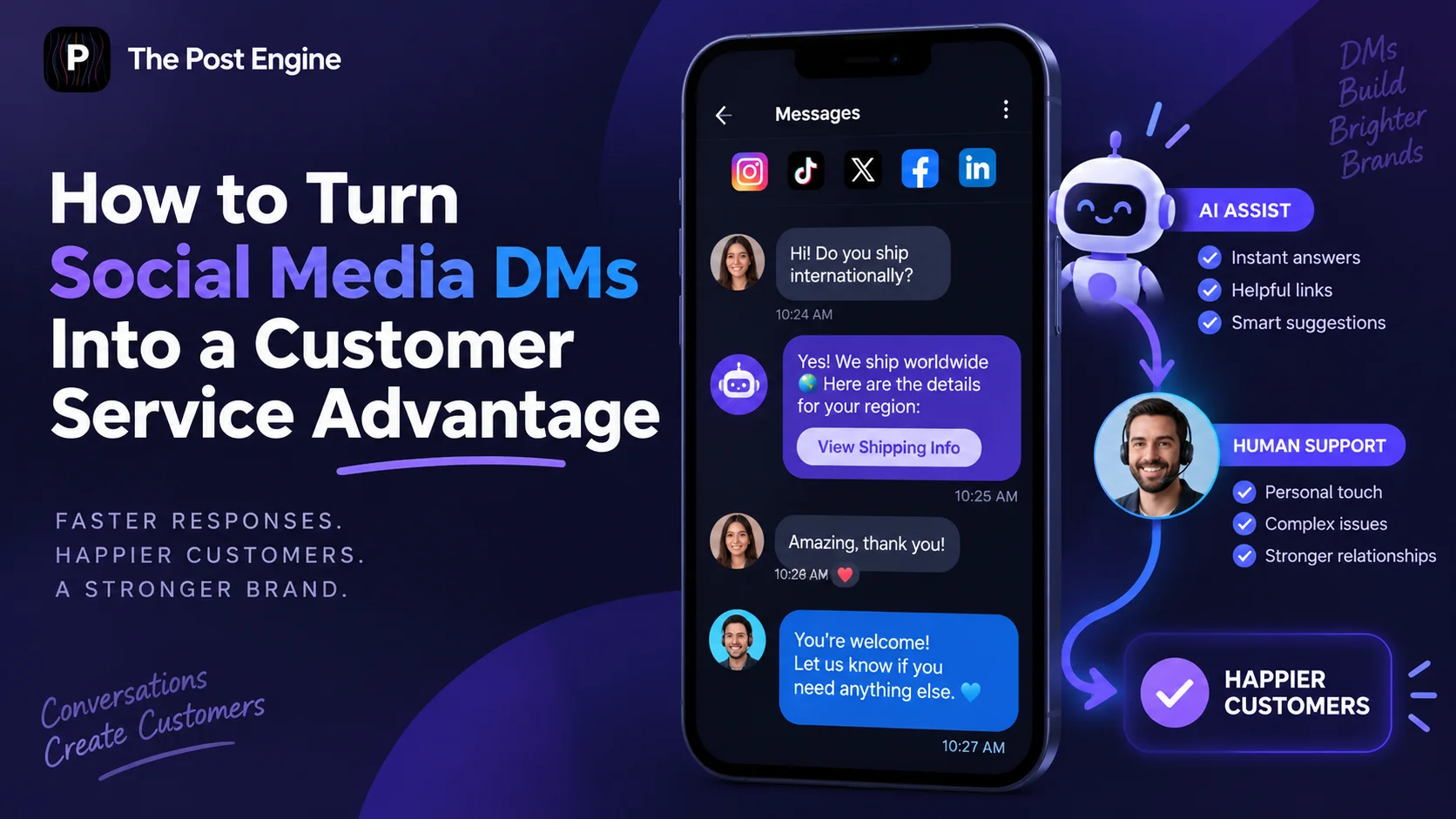
This distinction becomes particularly useful when AI is involved.
Hootsuite's 2026 customer-service research says AI chatbots can handle repetitive conversations while human teams focus on more complex cases. Hootsuite — DM Automation in 2026: How to Set It Up Right
A practical rule is:
Automate the predictable. Escalate the complicated.
Respond Quickly Without Sounding Robotic
Speed matters.
But speed alone isn't enough.
A one-word automated response may arrive instantly and still frustrate the customer.
Hootsuite reports that 77% of customers expect to interact with someone immediately when they contact a company, while more than half of consumers say fast responses to direct questions and comments are particularly appealing. Hootsuite — Social Media Customer Service: 2026 Enterprise Guide
At the same time, Sprout Social's research notes that customers want more than a fast reply—they want the issue actually resolved. Sprout Social — Social Media Customer Service Statistics
So build response templates around:
Acknowledgement → Answer → Next step
Example:
“Absolutely. That model is available in black. You can see the available sizes here: [link]. Let me know if you'd like help choosing the right one.”
That feels much more human than:
“Your request has been received.”
IMAGE 3 — HUMAN VS ROBOTIC
Use AI for Repetitive DM Conversations
AI is especially useful when your team receives the same questions repeatedly.
For example:
“What are your shipping times?”
“Do you ship internationally?”
“What is your return policy?”
“Is this product available?”
A well-designed AI assistant can answer these routine questions quickly and hand more complicated conversations to a human.
This isn't just theory.
Intercom's 2026 Customer Service Transformation Report surveyed 2,470 support professionals across four regions and found that 82% of senior leaders had invested in AI for customer service, while 87% planned to invest in 2026. However, only 10% said they had reached mature AI deployment. Intercom — 2026 Customer Service Transformation Report
The important lesson is:
Adding AI isn't the finish line. Integrating it properly is.
Your AI system needs:
• Accurate information
• Clear escalation rules
• Human handoff
• Consistent brand language
• Regular review
Keep the Human Touch for Important Conversations
AI should not be the answer to every DM.
Certain conversations need empathy, judgment, or context.
For example:
“My package arrived damaged.”
“I've been waiting two weeks.”
“I'm really disappointed with this product.”
The customer isn't only asking for information.
They're asking for someone to take responsibility.
Intercom's 2026 research found that 58% of customer-service teams consider improving customer experience their top priority for 2026, up from 28% the previous year. Intercom — The AI Deployment Gap Is Widening
That shift matters.
As AI handles more routine conversations, human agents can spend more time on situations where empathy and judgment create the most value.
IMAGE 4 — HUMAN ESCALATION
Turn Repeated DMs Into Better Social Content
Your DMs can also tell you what content is missing.
Suppose customers repeatedly ask:
“Does this work on Android?”
That may become a product FAQ post.
If people constantly ask:
“Which size should I choose?”
Create a size guide.
If customers keep asking:
“How does it work?”
Create a demonstration video.
The loop becomes:
DM question → Identify pattern → Create content → Answer publicly → Reduce repeated questions
This makes customer service part of your content research.
Hootsuite's 2026 guidance recommends combining social listening and customer service so brands can understand customer needs beyond the messages that arrive directly in their inbox. Hootsuite — Social Media Customer Engagement: 2026 Enterprise Guide
IMAGE 5 — DM TO CONTENT
Measure Whether Your DM Support Is Working
Don't judge customer service by the number of messages you answer.
Look at what happens after the conversation.
Useful metrics include:
• First response time
• Resolution rate
• Customer satisfaction
• Message volume
• Escalation rate
• Link clicks
• Conversion from support conversations
Hootsuite recommends tracking response time, CSAT, resolution rate, message volume, and the balance between automated and human responses. Hootsuite — Social Media Customer Service: 2026 Enterprise Guide
One useful question is:
Did the customer get what they needed?
A fast response that doesn't solve the problem is not a successful interaction.
Create a Better Social Content Workflow With The Post Engine
DMs can reveal what customers want to know.
Your content can answer those questions before they need to ask.
With The Post Engine, you can turn recurring customer needs into planned social content while keeping your brand's visual direction consistent.
For example:
Customer DM
→ “Which product is right for beginners?”
↓
Content idea
→ Beginner's guide
↓
Social creative
→ Carousel / Product post
↓
Caption
→ Key differences + recommendation
↓
Publish
Now the original question becomes useful content for hundreds of other potential customers.
The Post Engine combines content creation, scheduling, publishing, and analytics in one platform, which can make this content-response loop easier to manage. The Post Engine — AI-Powered Content Engine
→How to Turn Customer Questions Into a Social Media Content Strategy
That creates a natural content cluster between customer conversations, content creation, and customer service.
IMAGE 6 — POSTENGINE WORKFLOW
Frequently Asked Questions
Should brands use DMs for customer service?
Yes. Social messaging has become an important customer-service channel, particularly for customers who already use social platforms to discover products and communicate with brands. Salesforce — Why Your Business Needs Social Media Customer Service
How quickly should businesses respond to DMs?
There is no single universal target, but customers increasingly expect fast responses. Hootsuite reports that 77% expect immediate interaction, while its 2026 guide recommends aiming for a response within the first hour where possible. Hootsuite — Social Media Customer Service: 2026 Enterprise Guide
Can AI handle social media DMs?
Yes, particularly repetitive questions and simple requests. Complex, sensitive, or emotional situations should have a clear human escalation path. Intercom — 2026 Customer Service Transformation Report
Should every DM receive the same response?
No. Templates can speed up routine support, but responses should still reflect the customer's actual question and situation.
Can customer DMs become content ideas?
Absolutely. Repeated questions can reveal gaps in product education, FAQs, and social content. Turning those patterns into useful posts can reduce repetitive questions while helping other customers.
Final Takeaway
Your DMs are not just another notification channel.
They're a direct source of:
• Customer questions
• Purchase opportunities
• Product feedback
• Support requests
• Content ideas
The process becomes:
DM → Understand → Respond → Resolve → Learn → Create
Use AI to handle repetitive conversations.
Use humans for situations that require judgment and empathy.
And use the questions customers ask today to create content that helps the next customer tomorrow.
A well-managed DM inbox doesn't just solve customer problems. It can become a customer-service advantage and a source of better marketing.