Discover and learn how to create social media content for micro-communities using niche interests, community insights, relevant formats, creators, and value-driven content instead of generic mass-market posts.
Creating content for everyone sounds like a good strategy.
But on social media, broad content can easily become generic content.
A post designed for millions of people may be relevant to almost nobody.
Micro-communities offer a different approach.
Instead of targeting:
“People interested in fitness”
you might create content for:
“People training for their first marathon.”
Instead of:
“Coffee lovers”
you could target:
“People learning how to make specialty coffee at home.”
Kantar's 2026 Marketing Trends report identifies micro-communities as a major force in social media marketing, noting that people are moving toward smaller spaces where they can connect around shared interests. Kantar also reports that brands using knowledge-sharing micro-community platforms in China achieved 25% higher marketing ROI, while nearly 40% of consumers trust micro-community recommendations as much as personal recommendations. Kantar — Marketing Trends 2026
The better approach is:
Don't try to make every post relevant to everyone. Make each post highly relevant to someone.
What Is a Micro-Community?
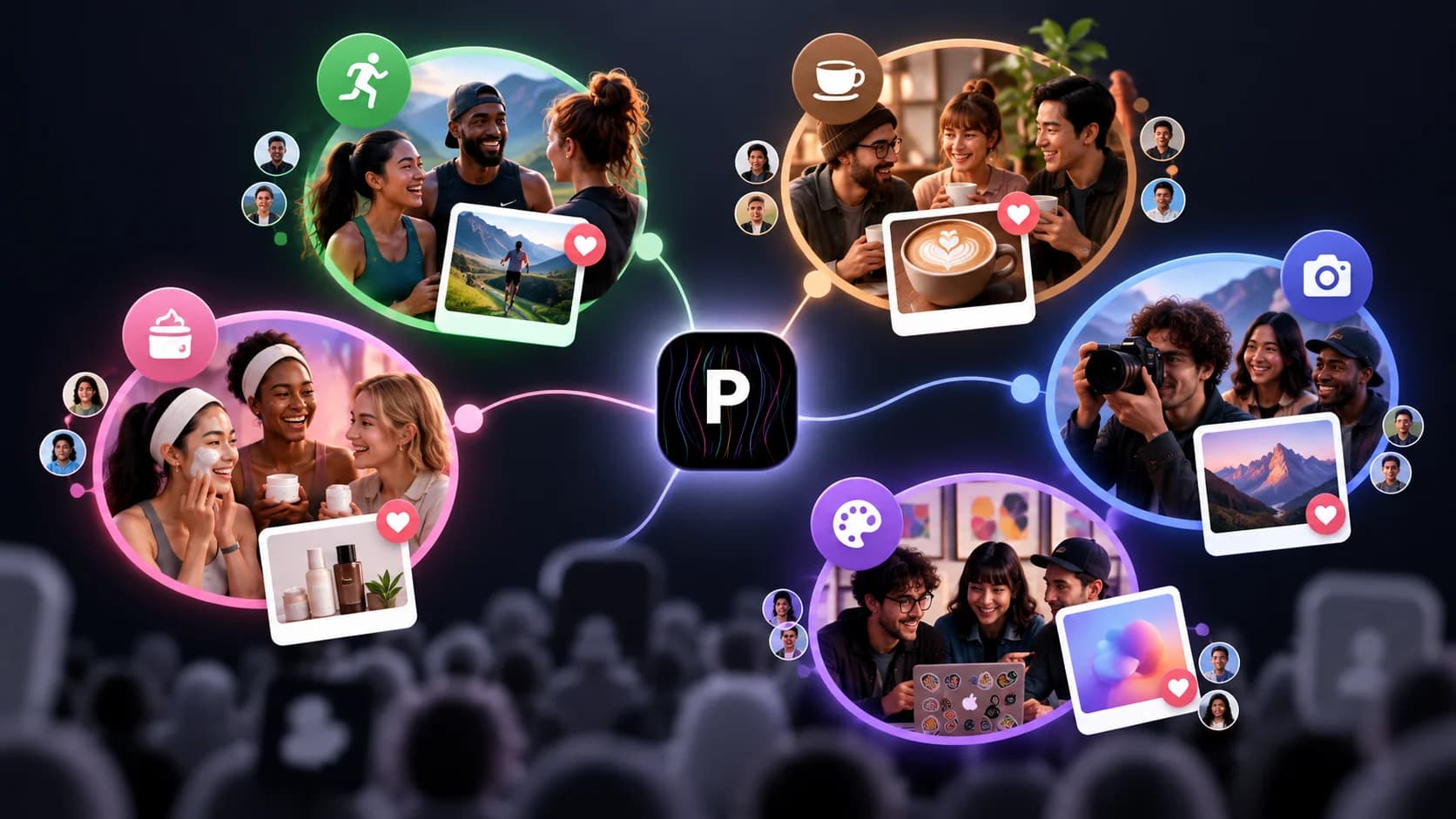
A micro-community is a relatively small group of people connected by a specific interest, identity, need, activity, or problem.
For example:
Fitness
→ Home workouts
→ First-time marathon runners
→ Strength training for beginners
→ Trail runners
Beauty
→ Minimal skincare routines
→ Curly-hair care
→ Sensitive-skin products
→ Professional makeup artists
Technology
→ Freelance designers
→ No-code founders
→ PC builders
→ AI video creators
The smaller audience isn't necessarily a disadvantage.
It can make the content more relevant.
Kantar says algorithmic feeds increasingly reward generic, sales-heavy content while people are moving toward smaller communities where they can find more meaningful conversations and tangible value. Kantar — Micro-Communities Become a Major Force in Social Media Marketing
The goal isn't:
Reach everyone.
It's:
Be highly useful to the right people.
Find the Specific Interest Behind Your Audience
Don't stop at a broad category.
Ask:
What does this audience actually care about?
For example:
Broad audience: E-commerce owners
Possible micro-communities:
Shopify beginners
Solo store owners
Beauty ecommerce brands
Print-on-demand sellers
Small fashion brands
Each group has different problems.
A Shopify beginner might need:
“How to create your first product page.”
A beauty brand might need:
“How to turn product benefits into Instagram content.”
The more specific the problem, the easier it becomes to create useful content.
WARC's July 2026 research found that 67% of marketers still rely on basic demographic data, even though 59% agree traditional demographic segmentation is no longer effective. Its research argues that community intelligence can provide a richer picture of what people actually care about. WARC — The New Creative Advantage: How Community Intelligence Is Reshaping Creative Success in the Age of AI
IMAGE 2 — AUDIENCE TO NICHE
Replace Demographics With Shared Interests
Age, location, and gender can still be useful.
But they don't always tell you why someone cares about a topic.
Consider two customers:
Customer A: 24-year-old woman living in Paris
Customer B: 44-year-old man living in Toronto
Demographically, they're very different.
But both might belong to the same micro-community:
Beginner landscape photographers.
Their shared interest can be much more useful for content creation than their age or location.
Build content around:
Goals
Challenges
Language
Preferences
Habits
Shared references
WARC's recent community-intelligence research argues that when people search, comment, share, and buy around the same interests, those actions can create a much richer understanding of what matters to them. WARC — Community Intelligence and Creative Success
Create Content Around Community Problems
Once you know the community, stop asking:
“What should our brand post?”
Ask:
“What is this group trying to solve?”
For a community of first-time marathon runners:
How to avoid common training mistakes
What to pack for race day
How to choose running shoes
How to recover after long runs
For freelance designers:
How to price projects
How to manage revisions
How to build a portfolio
How to find better clients
This creates content that feels like it belongs inside the community, rather than content created from outside looking in.
Kantar specifically recommends that brands provide tangible value instead of relying on promotion when participating in micro-communities. Kantar — Marketing Trends 2026
Best combination:
Specific community + specific problem + practical solution
Speak the Language of the Niche
A strong micro-community has its own vocabulary.
Members may already understand:
Terms
Shortcuts
References
Pain points
Trends
Inside jokes
Using the right language can make your content feel more relevant.
But don't force it.
The goal isn't to pretend to be part of a community.
The goal is to understand it well enough to communicate naturally.
For example, content for experienced photographers should not explain basic concepts in the same way as content for absolute beginners.
Create different versions for:
Beginner
“What is shutter speed?”
Intermediate
“How to balance shutter speed and ISO for fast-moving subjects.”
Advanced
“When to prioritize shutter speed over exposure consistency in changing light.”
Same category.
Completely different content needs.
Work With People Who Already Belong to the Community
You don't have to build community credibility entirely by yourself.
Creators, experts, moderators, and active members already understand the audience.
Kantar reports that only 27% of creator content strongly connects to the brand, and recommends moving toward longer-term creative platforms and clearer alignment between brands and creators. Kantar — Marketing Trends 2026
Instead of asking a niche creator:
“Promote our product.”
try:
“Help us solve a problem your community actually has.”
That could become:
Expert tutorial
Community Q&A
Product test
Niche challenge
Member spotlight
The community gets value.
The creator brings credibility.
The brand becomes part of the conversation.
IMAGE 3 — COMMUNITY CREATOR
Turn Community Conversations Into Content
Your best niche content ideas may already exist inside community conversations.
Look at:
Comments
Questions
Discussions
Reviews
Creator videos
Community posts
Suppose a photography community repeatedly discusses:
“How do I make product photos look less flat?”
That conversation can become:
Carousel: 5 ways to add depth
Reel: Before vs. after
Story: Poll on studio vs. lifestyle
Tutorial: Lighting setup
Product post: Recommended creative setup
This creates a useful feedback loop:
Community conversation → Content idea → New content → Community response
WARC calls this type of continuous interaction an “Intelligence Loop”, where search, conversation, sharing, and buying behavior can feed better creative decisions. WARC — The New Creative Advantage
Measure Relevance Instead of Just Reach
Micro-community content may reach fewer people.
That doesn't automatically make it weaker.
Measure whether the right people respond.
Look at:
Saves
Shares
Qualified comments
Profile visits
Direct messages
Community participation
Leads
Conversions
For example:
Mass-market post
100,000 views
500 likes
5 sales
Micro-community post
12,000 views
300 saves
80 meaningful comments
42 sales
The second post reached fewer people.
But it may have been far more valuable.
Kantar's 2026 research explicitly argues that authenticity and relevance can matter more than raw reach in micro-communities, and highlights ROI and organic advocacy as important measures. Kantar — Marketing Trends 2026
So don't ask only:
“How many people saw it?”
Ask:
“How many of the right people cared?”
IMAGE 4 — RELEVANCE VS REACH
Turn One Community Insight Into Multiple Creatives
This is where The Post Engine can fit naturally into the process.
Suppose you discover one recurring problem inside a niche community:
“Small ecommerce brands struggle to create enough product content.”
That single insight can become:
Educational carousel
→ Explain the problem
→ Show a possible solution
Short video
→ Demonstrate the process
Checklist
→ Give practical steps
Story
→ Ask the community about its biggest challenge
The important part is that the content starts with community intelligence, not a generic content prompt.
→The Hidden Engagement Problem: Why People Interact With Social Content Without Liking or Commenting
That article can help explain to you why the success of niche content should not be judged by visible likes and comments alone.
IMAGE 5 — MICRO-COMMUNITY CONTENT
Frequently Asked Questions
What is a micro-community?
A micro-community is a smaller group of people connected by a specific interest, identity, goal, problem, or activity.
Are micro-communities better than large audiences?
Not necessarily. They serve different purposes. Micro-communities can offer stronger relevance and peer connection, while broad audiences can provide greater reach.
How do I find a micro-community for my brand?
Start with your customers' shared interests, problems, use cases, conversations, and behaviors. Look beyond broad demographic categories.
Should brands sell directly inside micro-communities?
Usually, value should come first. Kantar's 2026 research specifically recommends tangible value and authentic participation rather than sales-heavy messaging. Kantar — Marketing Trends 2026
Can AI help create micro-community content?
Yes, but the important input is the community insight. AI can help turn a specific insight into multiple content formats, but generic prompts often produce generic results.
Final Takeaway
Mass audiences can give you reach.
Micro-communities can give you relevance.
Instead of creating one message for everyone:
Find the smaller group that cares deeply about a specific thing.
Then:
Understand their interest
Find their problems
Use their language
Create useful content
Work with trusted voices
Listen to their conversations
Measure relevance
The process becomes:
Community → Insight → Content → Conversation → Trust
You don't need every person on social media to care about your content.
You need the right people to feel that your content was made for them.