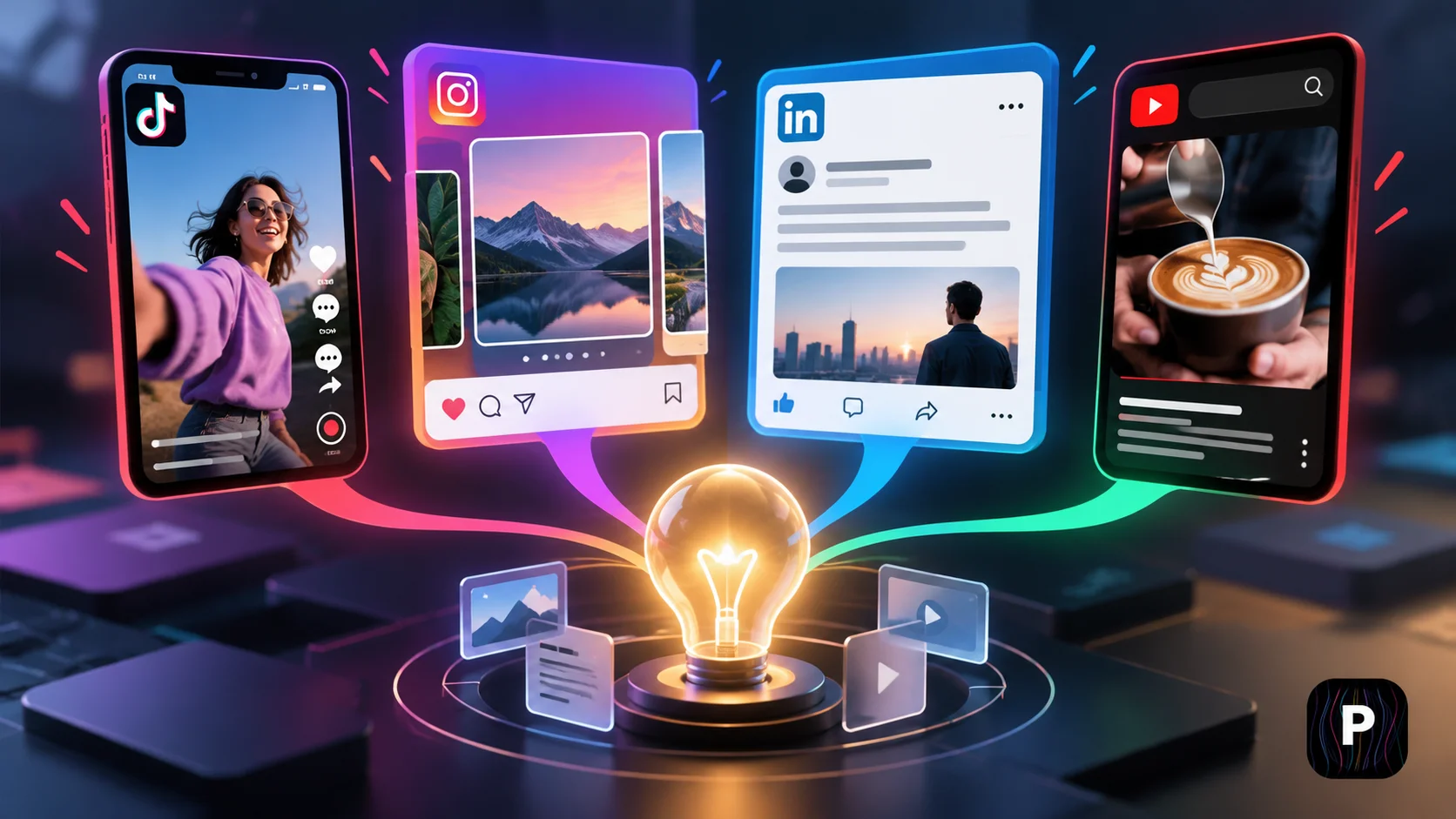
Discover what makes content feel natural on TikTok, Instagram, LinkedIn, and YouTube, and learn how to adapt one idea to each platform's format, audience behavior, and creative culture.
One idea can work across multiple social platforms.
But one version rarely works equally well everywhere.
A fast, sound-led TikTok can feel completely natural on TikTok but awkward on LinkedIn.
A detailed LinkedIn post can provide valuable professional insight but feel too formal for Instagram.
A YouTube Short can benefit from both a strong opening and a clear topic because viewers can discover Shorts through recommendations and search.
The problem isn't cross-platform content.
It's cross-platform sameness.
Sprout Social's 2026 research emphasizes that audiences have different expectations across social networks and that brands need to understand platform-specific behavior rather than treating social media as one single channel. Sprout Social — 2026 Social Media Content Strategy Report
The better approach is:
Keep the idea consistent. Change the way the idea lives on each platform.
What Makes Content Feel Native?
Native content doesn't necessarily mean content created completely inside an app.
It means the content behaves like the content users expect to find there.
That can involve:
Format
Pacing
Tone
Editing
Length
Sound
Text style
Platform features
For example, the same product launch could become:
TikTok: “I tested this for seven days…”
Instagram: “3 things I noticed…”
LinkedIn: “3 lessons we learned launching this product.”
YouTube Shorts: “3 things to know before buying it.”
The subject is the same.
The experience is different.
TikTok: Build for Entertainment and Discovery
TikTok expects content to feel like it belongs in the For You feed rather than looking like a traditional advertisement.
TikTok's official Creative Codes recommends a TikTok-first approach using native styles, trends, vertical 9:16 video, dynamic editing, text overlays, sound, and a Hook → Body → Close structure. TikTok Creative Codes — 6 Principles for Creating Effective Ads
TikTok reports that 74% of viewers say TikTok-first ads catch their attention, while its research found TikTok-first creative drove 3.3x more actions such as clicks, likes, and shares than the comparison across other platforms in its study. TikTok for Business — Creative Best Practices
So instead of:
“Introducing our new product.”
try:
“I didn't expect this product to solve this problem.”
Then show the result.
Useful TikTok ingredients
Fast opening
Vertical framing
Native-style captions
Sound
Movement
Human delivery
Relevant trends
TikTok's current creative guidance also recommends 9:16 framing, 720p or higher, and keeping important elements away from the platform UI. TikTok Creative Codes — Production Principles
The objective isn't to force every post into a trend.
Make it feel like something a TikTok user would naturally watch.
IMAGE 2 — TIKTOK
Instagram: Build for Visual Consumption
Instagram needs a different treatment because it contains several content environments:
Reels
Stories
Carousels
Feed posts
That means “Instagram content” doesn't have one single format.
For a Reel, prioritize:
Visual hook + movement + short story
For a carousel:
Strong first slide + useful information + swipe progression
For Stories:
Quick frames + interaction + clear CTA
For example:
TikTok: “I tested this…”
Instagram Reel: Product transformation
Instagram carousel: “5 things to know before buying”
Instagram Story: “Which one would you choose?”
The underlying idea stays the same, but the viewer experience changes.
Sprout Social's 2026 research highlights the importance of understanding what audiences expect on each network instead of assuming one content approach works everywhere. Sprout Social — 2026 Social Media Content Strategy Report
The key is to think about how people consume the specific Instagram format, not simply upload the same creative.
IMAGE 3 — INSTAGRAM
LinkedIn: Build for Professional Value
LinkedIn needs a different reason to stop scrolling.
Instead of:
“Look what we made.”
lead with:
“What we learned.”
or:
“Here's the mistake companies keep making.”
or:
“Three lessons from launching this product.”
LinkedIn recommends using formats such as custom images, video, documents, Articles, and other Page formats. Its current Page guidance says companies posting weekly see a 2x lift in engagement, while video gets 5x more engagement on average in its reported data. LinkedIn Pages — Best Practices
For example:
Same product launch
TikTok:
“I tried it for seven days.”
Instagram:
“Here's what changed.”
LinkedIn:
“3 lessons we learned building and launching it.”
The product hasn't changed.
The reason to care has.
LinkedIn also recommends visual formats and behind-the-scenes stories that show what makes a company unique. LinkedIn — Create a LinkedIn Company Page
IMAGE 4 — LINKEDIN
YouTube Shorts: Build for Watching and Discovery
YouTube Shorts sits between short-form entertainment and YouTube's broader discovery ecosystem.
That changes the content strategy.
YouTube says Shorts can be discovered through recommendations and search, so the topic itself needs to be easy to understand. YouTube — Shorts Search and Discovery Tips
For example:
“3 mistakes to avoid when buying a camera”
works because the viewer immediately knows what they'll learn.
YouTube Shorts can now run for up to 3 minutes, giving creators more room when a topic needs additional explanation. YouTube — Understand Three-Minute YouTube Shorts
Useful ingredients include:
Clear topic
Fast introduction
Useful information
Strong visual progression
Relevant sound
And unlike TikTok, you shouldn't assume that a trend is always more important than the information itself.
YouTube notes that there is no single preferred Shorts format; recommendations are influenced by individual viewer behavior and interests. YouTube — Shorts Search and Discovery Tips
Stop Copying the Same Post Everywhere
Cross-posting saves time.
But blindly cross-posting can make content feel out of place.
Imagine:
TikTok video with native captions and sound
↓
Downloaded
↓
↓
Same video
↓
Same caption
The content may technically work.
But it doesn't feel native.
A better workflow is:
One core idea
↓
TikTok version
→ Entertainment + sound + native editing
Instagram version
→ Visual storytelling + interaction
LinkedIn version
→ Professional insight
YouTube Shorts version
→ Searchable explanation
TikTok itself recommends Recut and Remix: adapt existing creative to 9:16, then add native captions, effects, trends, and other TikTok-specific elements rather than simply uploading the original unchanged. TikTok — Creating Made Easier
IMAGE 5 — SAME IDEA, DIFFERENT PLATFORM
Keep the Brand Consistent Without Making Content Identical
Being native doesn't mean losing your brand.
Keep the elements that should remain recognizable:
Brand voice
Visual identity
Product positioning
Core message
Brand values
Change the elements that should respond to the platform:
Format
Pacing
Hook
Caption style
Editing
CTA
This creates a useful balance:
Same brand. Different platform experience.
For example, your brand could keep the same product colors and visual identity while changing the editing style and content structure for TikTok, Instagram, LinkedIn, and YouTube.
That is more effective than forcing every platform to look identical.
Measure Each Platform by Its Own Behavior
Don't compare every platform using one metric.
A TikTok may succeed because it gets:
High watch time
An Instagram carousel may succeed through:
Saves and shares
A LinkedIn post may succeed through:
Meaningful comments and clicks
A YouTube Short may succeed through:
Views and engaged viewing
YouTube's current Shorts analytics separates Views from Engaged views, allowing creators to understand not just how many times content was viewed but how viewers continued watching. YouTube — Get Started Creating YouTube Shorts
LinkedIn provides Page analytics for content performance, visitors, followers, and engagement. LinkedIn Pages — Best Practices
So don't ask:
“Which platform got the most likes?”
Ask:
“Did this content behave like successful content on this platform?”
Adapt One Idea Into Platform-Specific Content
This is where The Post Engine can fit naturally.
You don't need to create four completely unrelated campaigns.
Start with:
One idea
↓
Choose the platform
↓
Choose the native format
↓
Adapt the message
↓
Create the creative
For example:
One idea: “3 mistakes ecommerce brands make with product photos”
TikTok
→ 20-second creator-style video
→ Carousel + Reel variation
→ Professional insight post
YouTube Shorts
→ Search-friendly educational Short
The brand message stays connected while the creative execution changes.
The Post Engine can support this process by giving you a consistent starting point for creative production without forcing every platform version to look identical.
→How to Generate Different Social Media Post Styles in One Place
→How to Build a Social Media Workflow From Idea to Published Post
Those articles cover style variation and workflow; this one focuses specifically on making the same idea feel natural on different platforms.
IMAGE 6 — POSTENGINE
Frequently Asked Questions
What does “platform-native content” mean?
It means content designed around the expectations, behavior, features, and culture of the platform where it appears.
Should I post the same content on every platform?
You can reuse the core idea, but adapt the format, pacing, language, CTA, and creative execution to each platform.
Is TikTok content always better when it uses trends?
No. Trends can help when they're relevant, but TikTok's Creative Codes also emphasize structure, stimulation, sound, and TikTok-first execution. TikTok Creative Codes
What makes LinkedIn content different?
Professional value, expertise, discussion, and useful business insights are particularly important. LinkedIn also supports video, documents, Articles, and other Page formats. LinkedIn Pages — Best Practices
Can one idea work on TikTok, Instagram, LinkedIn, and YouTube?
Yes.
The idea can stay the same.
The experience should change.
Final Takeaway
Platform-native content doesn't mean creating everything four times.
It means understanding that people use different platforms in different ways.
Use:
TikTok → Entertainment + trends + sound
Instagram → Visual storytelling + interaction
LinkedIn → Expertise + professional value
YouTube Shorts → Watching + discovery + useful information
Then keep your:
Brand → Message → Identity
consistent across all of them.
The process becomes:
One idea → Platform behavior → Native format → Adapt → Publish → Learn
Don't make your audience feel like they're seeing the same post everywhere.
Give them the same brand experience in a way that feels natural wherever they find you.