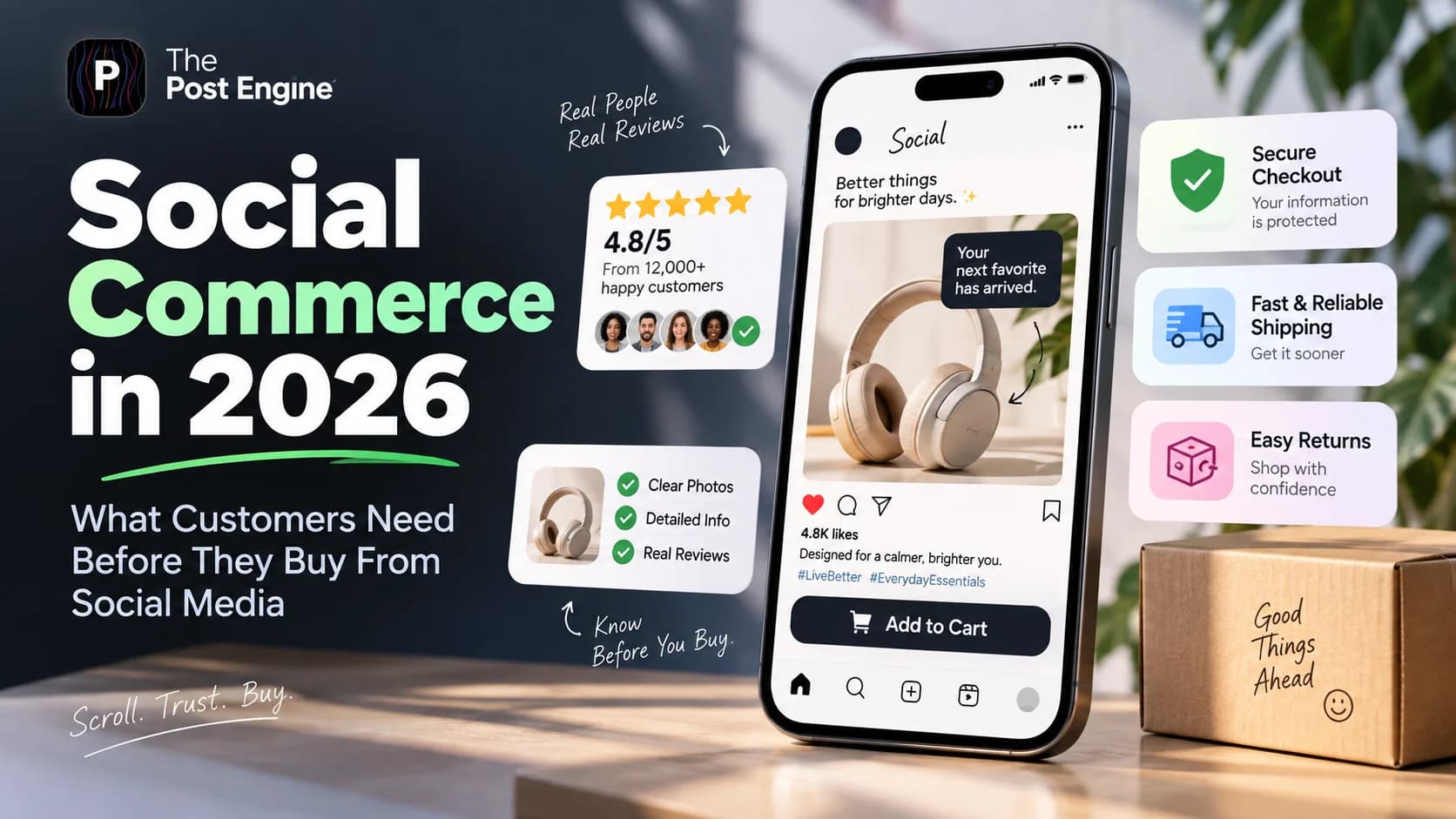
Discover what customers need before buying through social media in 2026, from trusted reviews and secure checkout to clear product information, easy returns, and authentic content.
Social media can get someone interested in a product in seconds.
Getting that person to actually buy is another story.
A customer may discover a product through a Reel, watch a creator demonstrate it, read comments, check reviews, compare alternatives, and still leave before checkout.
That's because discovery and trust are not the same thing.
Shopify's 2026 social commerce research identifies trust, privacy, returns, short-form video, reviews, and conversational commerce as major factors shaping social shopping. It also reports that 93% of customers read a retailer's review policy before buying. Shopify — Social Commerce Trends for 2026
The gap becomes even clearer in newer consumer research. ESW found that 45% of U.S. consumers discover products through social media, but only 27% trust social-commerce checkout experiences. Retail TouchPoints — U.S. Shoppers Embrace AI and Social Discovery, But Trust Still Drives Checkout
The better approach is:
Don't only create content that makes people want the product. Create content that helps them feel confident buying it.
Show Exactly What the Customer Is Buying
Social content can create desire very quickly.
But customers also need clarity.
They want to know:
What is the product?
What does it include?
What does it look like in real life?
What size is it?
Who is it for?
How is it used?
This matters because social-commerce shoppers can make decisions directly from content without first visiting a traditional product page.
A 2026 ecommerce trends report found that how-to content and product demos were among the social-content formats that influenced purchasing decisions, alongside user-generated content and offers. Ecommerce News — 2026 E-Commerce Trends Report
Instead of:
“Meet our newest product.”
show:
Product → Feature → Use → Result
The less the customer has to guess, the easier the decision becomes.
IMAGE 2 — PRODUCT CLARITY
Make Reviews and Social Proof Easy to Find
People don't want to rely only on what the brand says about itself.
They want evidence from other people.
Shopify's 2026 social-commerce research reports that after seeing creator content, 37% of shoppers search for more reviews, 33% read comments, and 28% compare opinions from other creators. Shopify — Social Commerce Trends for 2026
That makes your social proof part of the buying experience.
Useful formats include:
Customer reviews
Verified-buyer quotes
Customer photos
Product demonstrations
Before-and-after examples
Frequently mentioned benefits
A 2026 open-access study in Future Business Journal also found that trust in social-media advertising and customer reviews are linked to online purchase intention, with brand image playing a mediating role. Future Business Journal — Social Media Advertising, Trust, and Customer Reviews
The important thing is not simply showing five-star ratings.
Show why customers trusted the product.
Answer the Questions That Create Purchase Doubt
Customers often hesitate because they still have one unanswered question.
For example:
“Will this fit me?”
“Is it compatible with my phone?”
“How long does delivery take?”
“Can I return it?”
“What's the difference between these two?”
These are not random questions.
They are purchase obstacles.
Turn them into content:
Question → Answer → Demonstration → CTA
For example:
“Which size should I choose?”
→ Size guide
→ Real customer example
→ Product link
This makes your social content more useful than a simple product promotion.
It also connects naturally with your existing customer-question content strategy, without making this article about content ideation itself.
Make Returns, Shipping, and Pricing Clear
A customer can like your product and still decide not to buy.
Sometimes the problem isn't the product.
It's the uncertainty around the purchase.
Shopify reports that 93% of customers read a retailer's review policy before purchasing, while its 2026 social-commerce research also identifies returns and privacy as important conversion levers. Shopify — Social Commerce Trends for 2026
So don't hide important information.
Make content around:
Shipping time
Shipping cost
Return window
Refund process
Payment options
Product availability
For example:
“Order today → ships in 24 hours → 30-day returns.”
That's much more useful than:
“Shop now.”
Best combination:
Product + Price + Delivery + Returns + CTA
IMAGE 3 — PURCHASE CONFIDENCE
Show the Product in Real Use
A polished product image can create attention.
A real demonstration can create confidence.
Show:
How it looks when used
How it works
How large it really is
What comes in the package
What the result looks like
How it compares in everyday situations
The 2026 Ecommerce Trends Report found that how-to and product-demo content ranked among the formats influencing shoppers' purchase decisions. Ecommerce News — 2026 E-Commerce Trends Report
For example:
Product: Portable blender
Instead of:
“Powerful portable blender.”
show:
Fruit → ingredients → blending → finished drink → cleanup
The viewer gets the answer:
“What would using this actually be like?”
IMAGE 4 — PRODUCT DEMO
Reduce Trust Friction at Checkout
The final step can still kill the sale.
Visa's 2026 Morocco study provides a useful example of the trust gap. 87% of Moroccan consumers surveyed had purchased directly through social commerce, yet among people who experienced financial scams, 53% said the incident happened on social media. Only 23% trusted AI agents to complete checkout at the time of the study. Visa — 2026 Stay Secure Study: Morocco
That means brands need to communicate trust before asking for payment.
Useful trust signals include:
Secure payment options
Verified seller information
Clear refund policy
Real customer reviews
Accurate product details
Visible customer support
Consistent brand information
A 2026 ScrollSignal study of 1,000 U.S. social shoppers found that 27% named trust as the factor that would most improve social shopping, compared with 8% who named lower prices. ScrollSignal — The Social Commerce Trust Gap
The lesson is simple:
A discount can't always compensate for a lack of trust.
IMAGE 5 — TRUST SIGNALS
Keep the Path From Discovery to Purchase Simple
Social commerce works best when the customer doesn't have to fight their way through the buying process.
The journey might look like:
Social post
↓
Product
↓
Details
↓
Trust
↓
Checkout
The longer the journey becomes, the more opportunities there are for the customer to leave.
Sprout Social's 2026 social-commerce research describes social commerce as shortening the path to purchase through shoppable content and in-app shopping features. Sprout Social — Social Commerce: Definition, Trends and Best Practices
You can also connect related content naturally:
Product post → comparison → review → product page → checkout
Don't make every post push for an immediate sale.
Some content should create:
Discovery
Some should create:
Confidence
And some should create:
Conversion
Together, they create a stronger shopping journey.
IMAGE 6 — SOCIAL COMMERCE JOURNEY
Create Social Commerce Content With The Post Engine
Social commerce requires more than a product photo and a “Buy Now” button.
You need different creative assets for different stages of the decision.
With The Post Engine, you can turn the same product into different social-commerce creatives.
For example:
Product
→ Product showcase
→ Feature post
→ Comparison
→ Customer proof
→ Product demonstration
The workflow can become:
Product information
↓
Customer concern
↓
Choose content angle
↓
Create creative
↓
Add CTA
↓
↓
Measure
→AI Product Videos: Turn Static Images Into Dynamic Social Ads
→7 Ways to Make Your Social Media Content More Accessible
The first helps strengthen product demonstration, while the second helps ensure the buying information remains accessible to more customers.
IMAGE 7 — POSTENGINE
Frequently Asked Questions
What do customers need before buying through social media?
They generally need enough information and confidence to answer:
What is it?
Is it right for me?
Can I trust the seller?
What do other customers say?
What happens if something goes wrong?
Does social proof really matter for social commerce?
Yes. Current research consistently points to reviews, customer content, and other forms of social proof as important parts of the social-shopping decision. Shopify reports that many shoppers seek additional reviews and comments after discovering products through creator content. Shopify — Social Commerce Trends for 2026
Is price the most important factor?
Not always. A 2026 ScrollSignal study found trust was the most frequently selected factor that would improve social shopping, ahead of lower prices. ScrollSignal — The Social Commerce Trust Gap
What type of social content helps sell products?
Useful formats include:
Product demonstrations
Reviews
How-to content
Comparisons
Use cases
Product explainers
Trust-focused content
Should every social post include a Buy Now CTA?
No.
Some posts should create discovery or confidence before the customer is ready to purchase. A stronger social-commerce strategy connects attention, information, proof, and conversion.
Final Takeaway
Social commerce isn't simply:
Post → Click → Buy
In 2026, the journey often looks more like:
Discover → Investigate → Compare → Trust → Purchase
Customers need more than an attractive product image.
They need:
Clear information
Real proof
Useful demonstrations
Transparent policies
Secure purchasing
A simple path to checkout
The strongest social-commerce content doesn't pressure people to buy.
It removes the reasons they might hesitate.