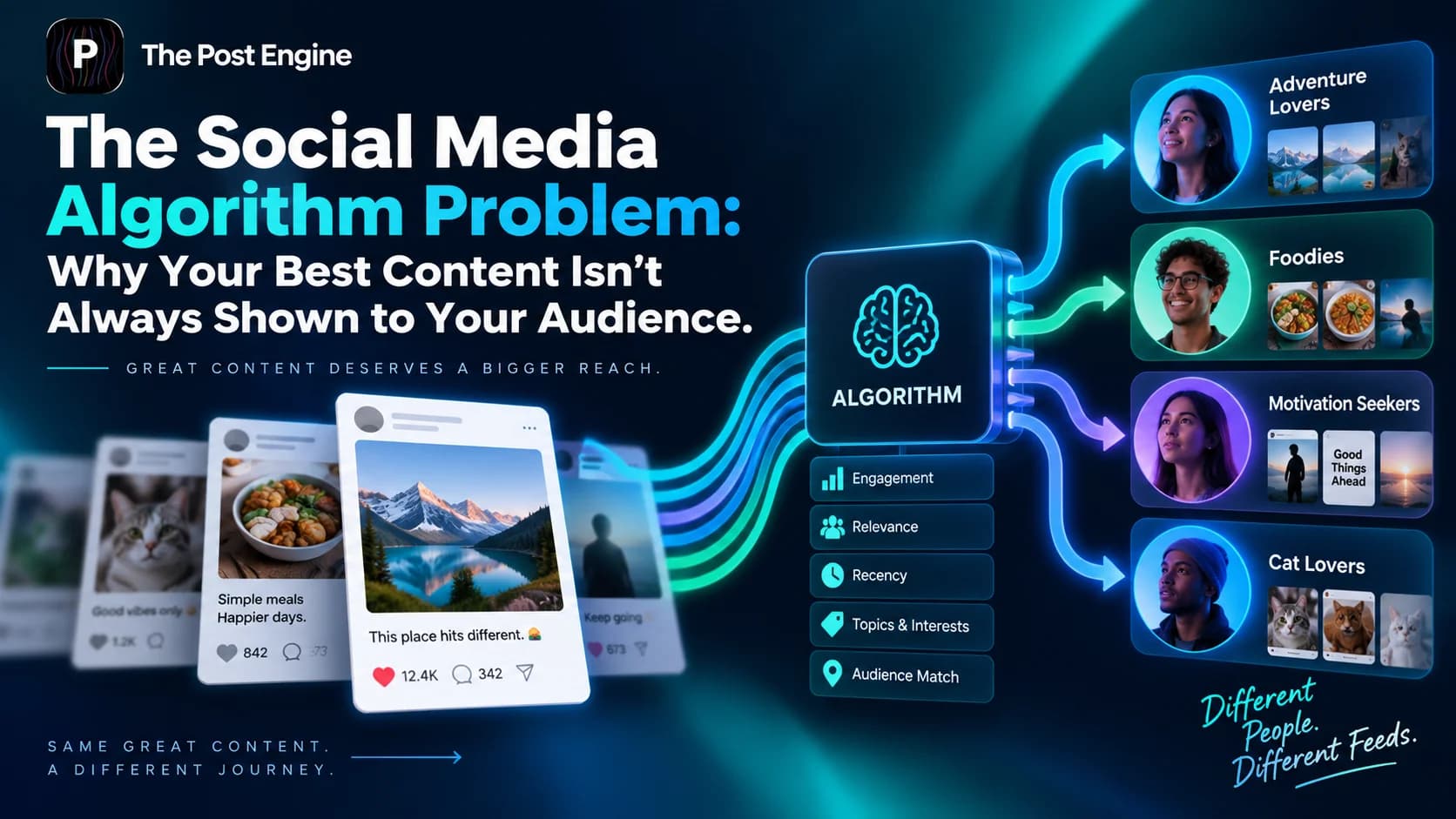
Learn why social media algorithms don't show every post to every follower, how recommendation systems rank content, and what brands can do to improve distribution.
You publish a post you genuinely believe is one of your best.
The visual is strong.
The information is useful.
The caption is well written.
But the results are disappointing.
A few hours later, you start asking:
“Why didn't my followers see it?”
The answer is more complicated than “the algorithm didn't like it.”
Modern social platforms don't simply publish every post to every follower in chronological order. Recommendation systems increasingly decide which content is most relevant to each individual user.
YouTube, for example, says its recommendation system is personalized around viewer interests, behavior, and satisfaction rather than simply showing every new upload to everyone. (YouTube's Recommendation System)
TikTok similarly says its For You recommendations are based on signals including user interactions, content information, and user information, with interaction signals such as watch behavior generally weighted heavily. (How TikTok Recommends Content)
So your best post is not automatically your best post for every person.
That distinction explains a lot of the frustration brands experience with social-media reach.
Why Your Followers Don't Automatically See Every Post
A common assumption is:
“I have 10,000 followers, so my next post should be shown to 10,000 people.”
That's not how modern recommendation systems work.
Platforms need to decide what each individual person is most likely to want to see.
One follower might regularly watch your videos.
Another might only interact with your carousels.
Another may have stopped engaging with your content months ago.
Another may be more interested in a completely different topic.
The platform can therefore treat those four followers differently.
YouTube explicitly explains that recommendations are personalized based on signals such as watch history, search history, subscriptions, likes, dislikes, “Not interested” feedback, and satisfaction surveys. (How YouTube Recommendations Work)
This means:
Follower count ≠ guaranteed reach
Your followers are an audience you can potentially reach.
They are not a guaranteed distribution list.
The Algorithm Is Personalized to the Viewer
There isn't one universal feed.
Two people can open the same platform at the same time and see completely different content.
TikTok explains that its For You feed is personalized around interests and interactions. Signals include videos users like, share, comment on, watch fully, or skip, as well as content information and factors such as location and language. (How TikTok Recommends Content)
YouTube works similarly.
Its recommendation system learns from a viewer's individual behavior and compares that behavior with patterns from other viewers to determine what content may be relevant. (YouTube's Recommendation System)
This creates an important shift:
The platform isn't only ranking your content. It's matching your content to people.
That means a post can be excellent and still reach fewer people because the system hasn't found enough viewers for whom it is relevant.
Why Good Content Can Still Underperform
A strong piece of content can struggle for reasons that have little to do with whether the content is objectively “good.”
The Topic May Have Limited Interest
Some topics simply have smaller audiences.
YouTube explicitly identifies topic interest as an external factor affecting how many people see content. A topic with naturally limited demand has fewer potential viewers, even when the content itself is strong. (YouTube's External Recommendation Factors)
A niche topic isn't necessarily bad.
It simply has a smaller potential audience.
Competition May Be High
You aren't competing only against your previous posts.
Your content competes with everything else the viewer could watch.
YouTube states that recommendations rank content against other videos a viewer might want to watch, meaning strong content can still receive less distribution when competition for the same audience is intense. (YouTube's External Recommendation Factors)
This is why:
“My content is better than before”
doesn't always mean:
“My reach should be higher than before.”
The competitive environment may have changed.
The Audience May Not Understand the Value Quickly
A useful post can still lose distribution if people don't recognize why they should stop and watch.
YouTube's current guidance breaks content performance into three broad areas:
Appeal — Did people choose to watch?
Engagement — Did they continue watching?
Satisfaction — Did they actually enjoy the content?
(Understand Content Performance for YouTube Recommendations)
The exact signals differ by platform, but the principle is useful everywhere:
Good information is not enough if the audience doesn't recognize its value.
The Difference Between Content Quality and Content Distribution
This distinction is one of the most important things to understand.
Content quality
Is the content useful, accurate, entertaining, interesting, or well produced?
Content distribution
Does the platform identify people who are likely to want that content?
These are different problems.
Imagine you create an excellent tutorial about a highly specific software feature.
The tutorial can be genuinely helpful.
But if only a small number of users care about that feature, the potential distribution is naturally limited.
Another example:
A simple video about a huge audience problem may reach many more people even if it took only 20 minutes to create.
That's why comparing posts only by production effort is misleading.
IMAGE 2 — DISTRIBUTION MODEL
What Algorithms Actually Look At
There is no single checklist shared by Instagram, TikTok, YouTube, LinkedIn, and every other platform.
However, official platform explanations show several recurring categories.
Viewer interest
Does this person normally enjoy this kind of content?
Interaction behavior
Do people watch, click, share, comment, save, or otherwise interact?
Content relevance
Does the content match the topic or interests of the viewer?
Satisfaction
Do people appear satisfied after consuming the content?
Competition
How much other content is competing for the same attention?
Context
Factors such as language, location, device, time, and user behavior can influence recommendations.
TikTok explicitly says user interactions generally carry more weight for most users than some other recommendation factors. (How TikTok Recommends Content)
YouTube similarly says recommendations are based on personalization and content performance, including whether viewers choose to watch, continue watching, and appear satisfied. (YouTube's Recommendation System)
Why Topic Interest and Competition Matter
This is one of the most overlooked reasons content can fail to scale.
Suppose two brands create equally good videos.
Brand A talks about:
“How to solve a problem that millions of people experience.”
Brand B talks about:
“A very specific problem experienced by a few thousand people.”
Brand A has a much larger potential audience.
That doesn't mean Brand B's content is worse.
It means the addressable audience is different.
YouTube's current documentation explicitly separates creator performance from external factors such as topic interest, competition, seasonality, and changes in viewer behavior. (YouTube's External Recommendation Factors)
This is important when analyzing your own performance.
A lower-performing post isn't automatically evidence that the content was bad.
What Brands Should Stop Doing
Stop Treating Followers Like a Mailing List
Having followers does not guarantee that everyone will see every post.
Stop Blaming Every Bad Result on “The Algorithm”
Sometimes the problem is the topic.
Sometimes it is the audience fit.
Sometimes it is competition.
Sometimes the content doesn't communicate its value quickly enough.
Stop Copying Every “Algorithm Hack”
Platform recommendations change, and tactics that work in one context may not work in another.
Official YouTube guidance even emphasizes that creators should focus on their audience rather than trying to “beat” the recommendation system. (YouTube's Recommendation System)
Stop Treating One Underperforming Post as a Verdict
YouTube explicitly states that an individual video's underperformance does not automatically penalize the entire channel. What matters is how viewers respond when content is recommended to them. (Good to Know About Recommendations)
A single weak post is information.
It isn't necessarily a diagnosis of your entire account.
What Brands Should Do Instead
Start with the audience rather than the algorithm.
Ask:
Who is this content for?
Then:
What would make this person want to watch or read it?
Then:
What would make them continue?
And finally:
What would make them want more?
Use platform analytics to look for patterns across several posts rather than judging one post in isolation.
YouTube's latest creator guidance recommends looking at appeal, engagement, and satisfaction, including packaging, introductions, storytelling, and audience retention. (Understand Content Performance for YouTube Recommendations)
The practical lesson is:
Create for the audience.
Package for the audience.
Learn from the audience.
Then let the platform's recommendation system do what it is designed to do: match content with viewers who may find it relevant.
Build a Smarter Content System With The Post Engine
Understanding algorithms is only useful if you can turn the insights into a better content process.
A practical workflow is:
Audience
↓
Topic
↓
Content
↓
Platform adaptation
↓
Publish
↓
Measure
↓
Improve
The Post Engine can support the production side of that workflow by helping businesses create and adapt branded social-media content without treating every platform as exactly the same.
For example:
Audience need:Small businesses want to understand social-media scheduling.
↓
Content angle:“5 Scheduling Mistakes Small Businesses Make”
↓
Create:Post, carousel, or video
↓
Adapt:Adjust the format and presentation for each platform
↓
Measure:Review how audiences respond
For content production, see The Post Engine AI Content Studio.
For using performance information to improve future content, read [How to Turn Social Media Analytics Into Better AI Content].
And for the broader discovery side of modern social platforms, see [Social Media Search Is Changing: What Brands Need to Know in 2026].
IMAGE 3 — AUDIENCE-FIRST LOOP
Frequently Asked Questions
Does the algorithm hide your posts from followers?
Not necessarily. Modern recommendation systems personalize what users see, so individual followers may receive different content based on their interests and behavior.
Why does one post go viral while another similar post doesn't?
Differences in audience response, topic interest, competition, timing, personalization, and context can all influence distribution.
Does having more followers guarantee more reach?
No. Followers create an audience base, but recommendation systems can decide which content is relevant to which viewers.
Does posting more often make the algorithm favor your account?
There is no universal rule that simply posting more guarantees higher distribution. YouTube explicitly says its recommendation system evaluates individual content based on viewer response and personalization rather than mechanically rewarding a particular posting frequency. (YouTube's Recommendation System)
Should brands try to “hack” the algorithm?
It's better to understand the recommendation system and focus on audience value than to build a strategy around short-term tricks.
Final Takeaway
Your best content isn't guaranteed to reach everyone who follows you.
And that isn't necessarily a failure.
Modern social platforms are increasingly personalized recommendation systems.
They look at:
Who is watching
What they care about
What they choose
How long they stay
Whether they seem satisfied
What else is competing for their attention
That means the goal isn't to create content the algorithm “likes.”
The goal is to create content that the right audience wants.
So when a great post underperforms, don't immediately ask:
“What is wrong with the algorithm?”
Ask:
“Did we reach the right people, with the right topic, in the right context?”
That question gives you something much more valuable than another algorithm hack:
a better content strategy.