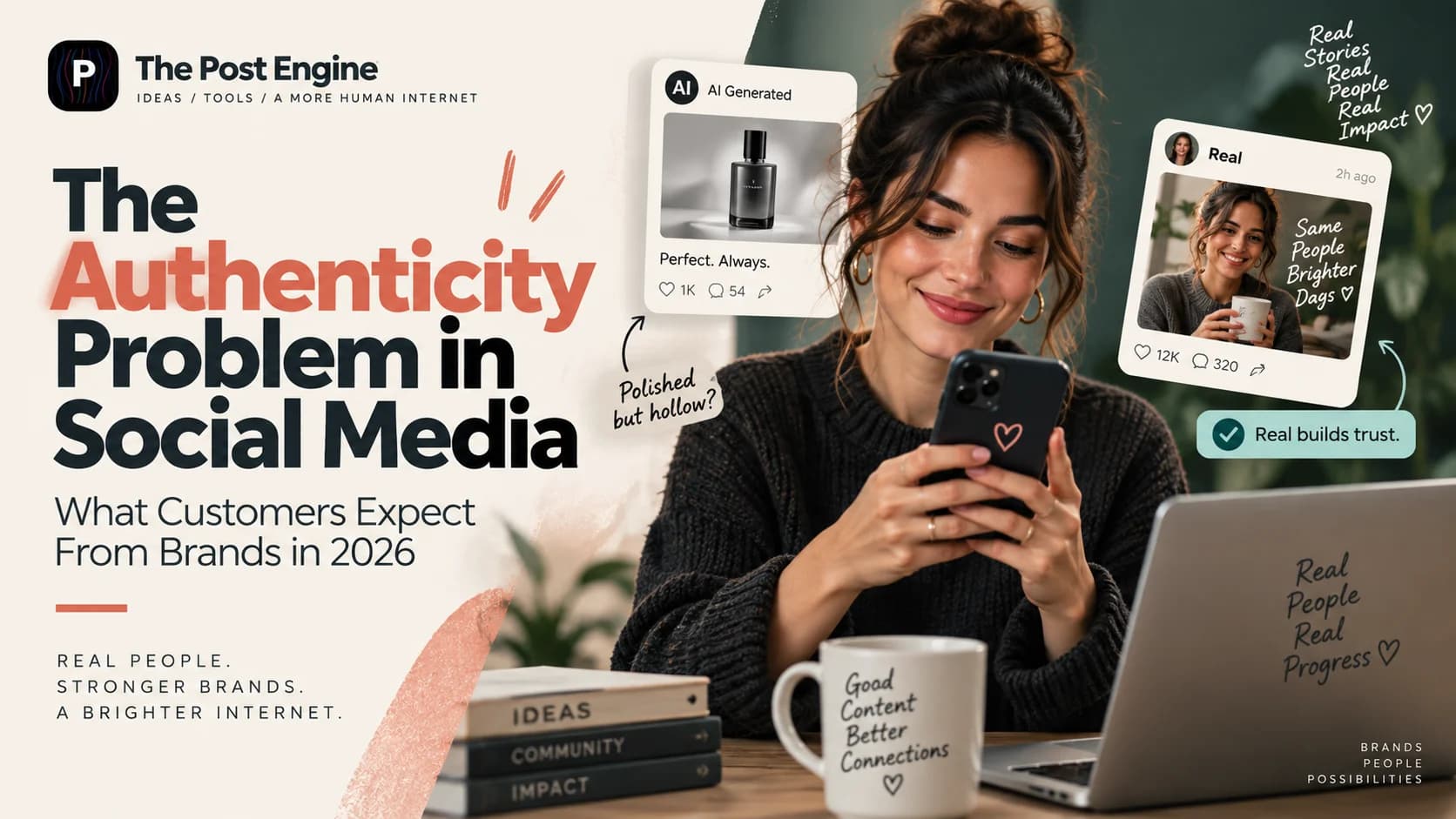
Discover what customers expect from brands on social media in 2026, why human content matters, and how brands can build trust in an AI-saturated environment.
Social media has never had more content.
It has also never been harder for customers to know what to trust.
AI can now generate images, videos, captions, voices, avatars, and entire campaigns in minutes. That gives brands unprecedented production speed. But it also creates a new problem: when everything can look polished, realistic, and convincing, polish alone becomes less meaningful.
Customers are increasingly looking for signals that there is a real brand, real people, and real experience behind what they see.
Sprout Social's 2026 research, based on more than 2,300 consumers in the US, UK, and Australia, found that consumers want human-generated content to be brands' top content priority. Meanwhile, 94% of surveyed social media marketers say they use AI in their workflows, showing the growing gap between how quickly brands can produce content and what audiences actually want from it. Sprout Social — 2026 Social Media Content Strategy Report
That creates the authenticity problem:
How can brands use AI for efficiency without making their social media feel artificial?
The answer isn't to reject AI.
It is to make sure technology supports the human parts of the brand rather than replacing them.
Why Authenticity Has Become More Important in 2026
AI has changed the economics of content production.
A small marketing team can now create far more content than it could a few years ago.
That's valuable.
But when more brands can produce polished content quickly, content volume stops being a strong differentiator.
Sprout Social's 2026 report found that consumers want brands to prioritize human-generated content, while marketers are increasingly turning to AI for efficiency. The research surveyed more than 2,300 consumers and 1,200 marketers, making the tension between audience expectations and marketing workflows particularly clear. Sprout Social — 2026 Social Media Content Strategy Report
At the same time, YouGov and Meltwater surveyed almost 10,000 consumers across seven markets about their reactions to AI-generated content, specifically examining trust, skepticism, engagement, transparency, and disclosure. YouGov & Meltwater — Trust in the Age of Generative AI
This doesn't mean customers reject AI automatically.
It means brands need to think more carefully about where AI helps and where human presence matters most.
The competitive advantage may increasingly be:
Not who can create the most content
but:
Who can create content that still feels worth trusting.
What Customers Actually Mean by “Authentic”
Authenticity is often reduced to phrases like:
“Be real.”
“Show behind-the-scenes.”
“Use less polished content.”
Those ideas can help, but they don't fully explain what customers are looking for.
In practice, authenticity is closer to consistency between what a brand says and what people experience.
An authentic brand tends to have:
A Recognizable Point of View
Customers can understand what the brand believes, values, or specializes in.
Real Evidence
Claims are supported by demonstrations, experiences, customer stories, or useful details.
Human Context
People can see that actual humans make decisions, answer questions, create products, or serve customers.
Consistency
The brand doesn't sound completely different from one post to the next.
Transparency
The brand doesn't deliberately create a false impression about how something was made or who is behind it.
This is why authenticity is not simply a visual style.
It's a trust signal.
The AI Content Trust Problem
The challenge becomes more serious as synthetic content becomes harder to distinguish from real content.
YouGov and Meltwater's 2026 study describes a global environment in which consumers are increasingly deciding how much trust to place in AI-generated material and how they want brands to communicate about AI use. The study covers Australia, Canada, France, Germany, Singapore, the United Kingdom, and the United States. YouGov & Meltwater — Trust in the Age of Generative AI
Other 2026 research points in the same direction.
A Clutch survey of 408 U.S. consumers found that 93% said it matters that brand communications feel like they came from a real person, while 55% said they viewed a brand less favorably once they could tell AI produced the creative. Clutch — Human Signals Survey
Emplifi's 2026 research, based on more than 1,600 consumers in the US and UK, found that 93% said authentic brand engagement builds trust. Emplifi — Digital Authenticity in the Age of AI
The lesson is not:
“Never use AI.”
It's:
“Don't let AI become the personality of the brand.”
The Human Signals Customers Look For
When customers evaluate a brand on social media, they often look for evidence that feels difficult to fake.
Real People
A founder, employee, expert, customer, or creator can provide context that generic brand content cannot.
This doesn't mean every post needs a talking-head video.
It means customers should occasionally be able to see the people behind the business.
Specific Experience
Compare:
“Our product delivers amazing results.”
with:
“Here's what changed after using the product for 30 days.”
The second provides more information and feels easier to evaluate.
Real Customer Evidence
Reviews, customer stories, demonstrations, and real-world examples can provide credibility.
Emplifi's research found that 79% of consumers read at least three reviews before making a purchase. Emplifi — AI and Authentic Reviews
Personality
A brand that always sounds perfectly polished can become forgettable.
Human language, opinions, humor, preferences, and imperfections can make communication more recognizable.
Responsive Communication
Authenticity doesn't stop at publishing.
How a brand responds to comments, questions, complaints, and customer feedback is part of how customers judge it.
That is why a beautiful feed can still feel inauthentic if every interaction sounds automated.
IMAGE 2 — HUMAN SIGNALS
Authenticity Is More Than Showing Behind the Scenes
Behind-the-scenes content can help, but authenticity should not become another formula.
Posting:
“Here's our team having coffee!”
doesn't automatically make a brand authentic.
The stronger approach is to show something meaningful about how the business works.
For example:
A restaurant could show how a dish is prepared.
A SaaS company could show how a product decision was made.
A fashion brand could explain why a material was chosen.
An agency could show how it solved a real client problem.
An e-commerce company could show how products are packaged and tested.
The difference is:
Behind-the-scenes for attention
versus
behind-the-scenes that creates understanding.
Customers don't need constant access to your private life.
They need enough real context to understand who you are and how you operate.
How Brands Can Use AI Without Losing Their Human Voice
AI can still be extremely useful.
The solution is to give AI the right job.
Let AI Help With Speed
Use AI for:
First drafts
Idea expansion
Caption variations
Content adaptation
Research organization
Format variations
Production assistance
Keep Humans Responsible for Meaning
Humans should remain involved in:
Final messaging
Brand voice
Claims
Customer stories
Emotional context
Strategic decisions
Sensitive topics
Final approval
A useful model is:
Human insight → AI assistance → Human review → Final content
Not:
AI → Publish
This is consistent with Sprout Social's 2026 recommendation to use AI for efficiency and audience insights without replacing human taste. Sprout Social — 2026 Social Media Content Strategy Report
The goal isn't to hide AI.
The goal is to prevent AI from becoming the only source of thought behind the content.
Transparency Can Become a Competitive Advantage
As synthetic content becomes more common, transparency can become valuable in its own right.
This is especially relevant in 2026 because the EU's AI Act transparency rules began applying on 2 August 2026. The European Commission says the rules address transparency in situations including certain AI-generated and manipulated content and interactions with AI systems. European Commission — AI Act Transparency Rules
The Commission also provides guidance around transparency for AI-generated content.
For brands, transparency doesn't need to become a legal-text exercise in every social post.
The practical principle is simpler:
Don't intentionally make synthetic content look like real human experience when that distinction matters.
For example, if a brand uses an AI-generated person in an advertising creative, it should consider whether the audience could reasonably interpret that person as real.
If AI significantly alters a customer's image, the brand should consider whether the alteration changes the meaning of the testimonial or evidence.
And when disclosure is required, make it clear rather than hidden.
Transparency helps protect something more important than compliance:
credibility.
Measure Trust, Not Just Engagement
Authenticity can be difficult to measure because it isn't a single metric.
But you can look for signals.
Comment Quality
Are people sharing real experiences and asking thoughtful questions?
Direct Messages
Are customers comfortable contacting the brand?
Positive Mentions
Are people talking about the brand without being prompted?
Repeat Interaction
Do the same customers return and engage over time?
Customer Content
Are people voluntarily sharing products, experiences, or results?
Sentiment
Is the tone around the brand becoming more positive, neutral, or negative?
Most importantly, look beyond vanity metrics.
A post with fewer views but dozens of meaningful customer conversations can tell you more about trust than a post that gets a large number of shallow impressions.
McKinsey's 2026 State of the Consumer research highlights the growing role of social media in discovery and purchasing while also pointing to trust challenges around social media and generative AI. McKinsey — State of the Consumer 2026
That creates an important opportunity for brands:
Use social media to create evidence, not just exposure.
IMAGE 3 — TRUST FRAMEWORK
Build Authentic Social Content With The Post Engine
Authenticity still requires consistency.
A brand can have great human ideas but lose its identity if every post is created from scratch with a different tone, visual style, and message.
This is where The Post Engine can support the production side.
The goal is not to automate authenticity.
It is to make it easier to scale the brand system around authentic ideas.
For example:
Human insight
“Our customers keep struggling with this problem.”
↓
Content concept
Explain the problem through a real example.
↓
AI assistance
Generate format variations, captions, or visual directions.
↓
Human review
Add the brand's real experience, evidence, and point of view.
↓
Publish
Share the final content.
The Post Engine's Brand DNA can serve as the consistency layer for voice, positioning, audience, and brand direction, while its content-creation workflow can help turn human ideas into different social formats.
Read more : AI Social Media Content: The Complete Guide to Creating Better Content at Scale
Read more about using AI without losing strategy : How to Turn Social Media Analytics Into Better AI Content
The key principle remains:
Use AI to increase your team's capability, not to remove the human perspective customers are looking for.
IMAGE 4 — HUMAN + AI WORKFLOW
Frequently Asked Questions
Does authentic content mean avoiding AI?
No. AI can help with research, ideation, drafting, adaptation, and production. The important question is whether humans still provide the perspective, judgment, evidence, and personality behind the content.
Do customers dislike AI-generated content?
Not universally. The 2026 research shows that reactions vary by audience, platform, and context. The stronger signal is that people care about trust and transparency, and many consumers prefer communications that feel genuinely human. Sprout Social — 2026 Social Media Content Strategy Report
What makes social media content feel authentic?
Clear opinions, real experiences, specific evidence, human communication, consistency, and transparency can all strengthen authenticity.
Should brands disclose AI-generated content?
It depends on the content, jurisdiction, platform, and applicable rules. In the EU, new AI Act transparency obligations began applying on 2 August 2026 for certain AI-generated or manipulated content and interactions. European Commission — AI Act Transparency Rules
Is highly polished content less authentic?
Not necessarily.
Professional production can still feel authentic when the content contains real people, real evidence, a clear point of view, and genuine customer value.
The problem isn't polish.
It's when polish replaces substance.
Final Takeaway
In 2026, brands can produce more content than ever.
That doesn't mean customers want more content.
They want content they can believe.
The strongest signals of authenticity are not necessarily low production quality or constant behind-the-scenes videos.
They are:
Real people
Specific evidence
Useful experiences
Recognizable personality
Human interaction
Transparency
AI can help brands move faster.
But speed should not come at the cost of credibility.
The winning model is:
Human insight → AI assistance → Human judgment → Authentic content
As social feeds become increasingly crowded with synthetic media, the brands that stand out may not be the ones that look the most perfect.
They may be the ones that feel the most real.
IMAGE 5 — FINAL CONCEPT