Discover why people interact with social media content without liking or commenting, which hidden signals matter, and how brands can create content that earns saves, shares, clicks, and attention.
A social media post can look unsuccessful on the surface.
Few likes.
Few comments.
Almost no public conversation.
But people may still be:
Stopping to read it
Swiping through it
Saving it
Sharing it privately
Clicking through
Watching it again
Visiting your profile
This creates a problem for brands that judge content mainly by visible reactions.
WARC's January 2026 research found that 90% of the social media users studied showed some form of “invisible engagement,” such as zooming into images or spending time with posts without liking or commenting. Even more significantly, posts associated with invisible actions had a 10.1% median shop-engagement rate compared with 6.8% for posts associated with likes. WARC — Introducing Invisible Engagement and Why It Matters
The better approach is:
Don't measure only who reacts publicly. Measure what people actually do with your content.
What Is Invisible Engagement?
Invisible engagement describes actions that show interest but aren't necessarily visible as public likes or comments.
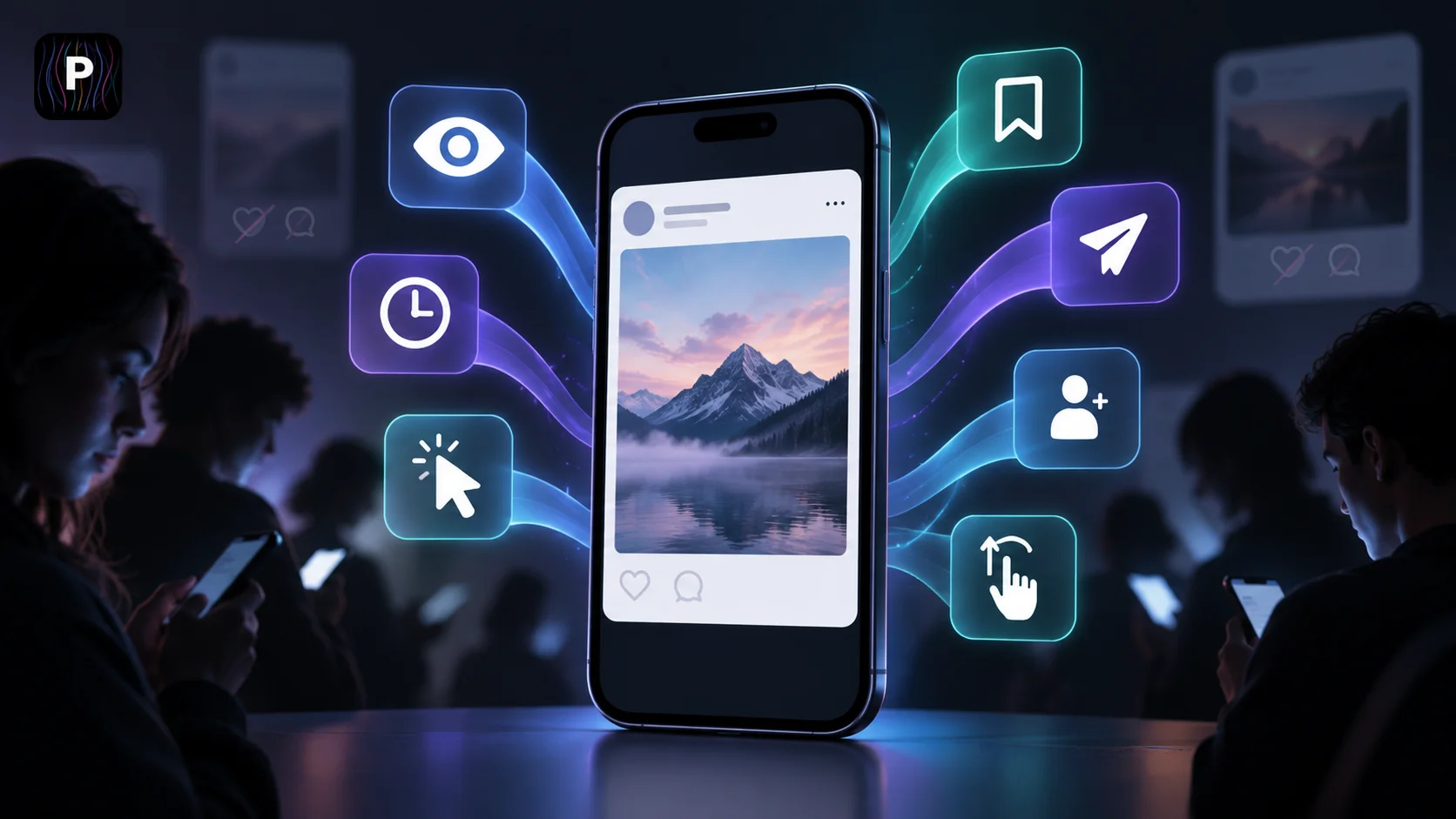
Examples include:
Saves
Private shares
Link clicks
Profile visits
Carousel swipes
Video views
Watch time
Image zooms
WARC describes these behaviors as important because traditional engagement metrics don't capture every way people interact with content. WARC — Why Marketers Should Embrace Invisible Engagement
A person may never comment on a product comparison but still save it.
Someone may never like a tutorial but send it to a colleague.
Someone may ignore the comments and click straight through to the product page.
The interaction is still meaningful.
It's simply less visible.
Why Likes and Comments Don't Tell the Whole Story
Likes and comments remain useful.
But they don't represent every type of audience intent.
A like can mean:
“I enjoyed this.”
A comment can mean:
“I want to participate publicly.”
But a save can mean:
“I need this later.”
A click can mean:
“I want more information.”
A private share can mean:
“Someone else should see this.”
These actions can have completely different business value.
Metricool's 2026 LinkedIn study found that likes fell 13%, comments 17%, and shares 10% year over year, while overall engagement increased by nearly 14%. The study attributes that growth partly to less-visible actions such as clicks, carousel swipes, video views, and link taps. Metricool — 2026 LinkedIn Study: The Rise of Invisible Interactions
That doesn't mean likes suddenly don't matter.
It means:
A quieter comment section doesn't automatically mean weaker content.
IMAGE 2 — VISIBLE VS INVISIBLE
Look at the Signals Behind the Interaction
Different actions tell you different things.
Saves
A save can indicate:
“I may use this later.”
Useful content often gets saved because it solves a future problem.
Examples:
Checklists
Buying guides
Comparisons
Tutorials
Templates
Shares
A share can indicate:
“Someone else should see this.”
Shareable content can be:
Useful
Relatable
Entertaining
Surprising
Relevant to a specific person
Clicks
A click shows that the viewer wanted to go somewhere.
That could be:
Your website
Product page
Landing page
Article
Signup page
Views and Watch Time
Views show exposure, but watch behavior provides more context.
Instagram Insights, for example, gives professional accounts access to views, accounts reached, interactions, accounts engaged, saves, shares, and other content-level metrics. Instagram — About Instagram Insights Instagram — Reels Insights
The important point is:
Don't treat every interaction as if it means the same thing.
Create Content People Save for Later
Some of your most useful posts may not generate many comments.
They become references.
Think:
“I'll come back to this.”
Create content around that behavior.
For example:
Instead of:
“3 productivity tips”
try:
“Save this 5-step productivity checklist.”
Instead of:
“How to choose a camera”
try:
“Camera Buying Checklist: 7 Things to Check Before You Buy.”
Instead of:
“Our product has these features”
try:
“Everything to Check Before Choosing a [Product Type].”
The objective is to make the content useful after the first viewing.
WARC's research found that invisible interactions such as zooming and spending time with content can reveal meaningful interest that public reactions don't capture. WARC — Introducing Invisible Engagement and Why It Matters
IMAGE 3 — SAVE-WORTHY CONTENT
Create Content People Want to Share Privately
Not every share happens publicly.
People can send content through:
DMs
Group chats
Messaging apps
Email
Private communities
Those actions can be difficult for brands to see.
That's part of why private sharing can be undervalued when marketers look only at public engagement.
Consider what people naturally send to friends:
“This is exactly what you were looking for.”
“Look at this.”
“You should try this.”
“This explains it perfectly.”
Those aren't necessarily “like-worthy” moments.
They're share-worthy moments.
So before publishing, ask:
“Would someone send this to another person?”
That can lead you toward different creative ideas:
Useful comparison
Relatable situation
Funny observation
Unexpected fact
Helpful recommendation
The goal isn't to force virality.
It's to create something that has a natural reason to be passed along.
Optimize for Attention, Not Just Reactions
A post can have few visible interactions and still win attention.
A person might:
Stop scrolling
Read the caption
Swipe through the carousel
Watch until the end
Zoom into the product
Visit the profile
Come back later
WARC's 2026 research argues that marketers need broader ways to understand attention and engagement rather than relying on narrow social reactions. WARC — Why Marketers Should Embrace Invisible Engagement
Metricool's 2026 LinkedIn study also found that carousel and multi-image posts continued to outperform standard image and video posts across several key metrics in its dataset. Metricool — 2026 LinkedIn Study
So ask different questions:
Will people stop?
Will they understand it?
Will they use it?
Will they remember it?
Those questions often lead to better content than simply asking:
“How many likes will this get?”
IMAGE 4 — ATTENTION SIGNALS
Match Metrics to the Content Goal
The best metric depends on what the post is supposed to accomplish.
Discovery Content
Goal:
Get seen
Track:
Reach + Views
Educational Content
Goal:
Be useful
Track:
Saves + Shares
Conversation Content
Goal:
Start discussion
Track:
Comments + Replies
Traffic Content
Goal:
Generate interest
Track:
Link Clicks + Profile Visits
Product Content
Goal:
Support buying
Track:
Clicks + Product Actions + Conversions
Instagram officially separates views, reach, interactions, and accounts engaged, while its Reels analytics also include watch time, average watch time, saves, shares, and follows. Instagram — About Instagram Insights Instagram — Reels Insights
This gives you a better framework:
Don't ask which post got the most engagement. Ask which post achieved its purpose.
Use The Post Engine to Create for Different Types of Engagement
Once you know that different content can trigger different behaviors, you can create more intentionally.
The Post Engine can be used here not simply to make more posts, but to build different creative versions around the same idea.
For example:
One product topic
Comparison
→ Designed to be saved
Quick tip
→ Designed to be shared
Product demonstration
→ Designed to be watched
Guide
→ Designed to generate clicks
Customer proof
→ Designed to support purchase confidence
You can connect that approach with your existing:
How to Turn Social Media Analytics Into Better AI Content
and
7 Ways to Use Visual Storytelling to Make Your Products More Memorable
The first focuses on learning from performance data; the second focuses on making product content more memorable. This article adds a different layer:
Design content around the behavior you want to trigger.
IMAGE 5 — CONTENT INTENT
Frequently Asked Questions
What is invisible engagement?
Invisible engagement refers to meaningful interactions that may not appear as public likes or comments, such as saves, clicks, shares, swipes, views, and time spent with content.
Are likes and comments still important?
Yes. They remain useful signals of public interaction. The problem is relying on them as the only measure of content performance.
What does a save usually indicate?
A save can indicate that someone expects the content to be useful again later. Checklists, guides, comparisons, and tutorials are natural examples.
Can brands measure private shares?
Not completely. Some sharing happens through private messages, group chats, or external apps and may not be visible in platform analytics.
What should I measure instead of likes?
Start by matching the metric to the goal:
Reach → Discovery
Saves → Utility
Shares → Relevance
Clicks → Intent
Watch time → Attention
Conversions → Business impact
Final Takeaway
A quiet comment section doesn't automatically mean your content failed.
People may be:
Saving it
Sharing it privately
Clicking it
Watching it
Reading it
Using it later
WARC's 2026 research found that 90% of the users studied showed invisible engagement behaviors, while content associated with those actions had a higher median shopping-engagement rate than content associated with likes. WARC — Introducing Invisible Engagement and Why It Matters
The process becomes:
Create → Observe → Measure → Understand → Improve
Don't create content only for people who publicly react.
Create content for the people who stop, save, share, click, watch, remember, and come back—even when you never see them do it.