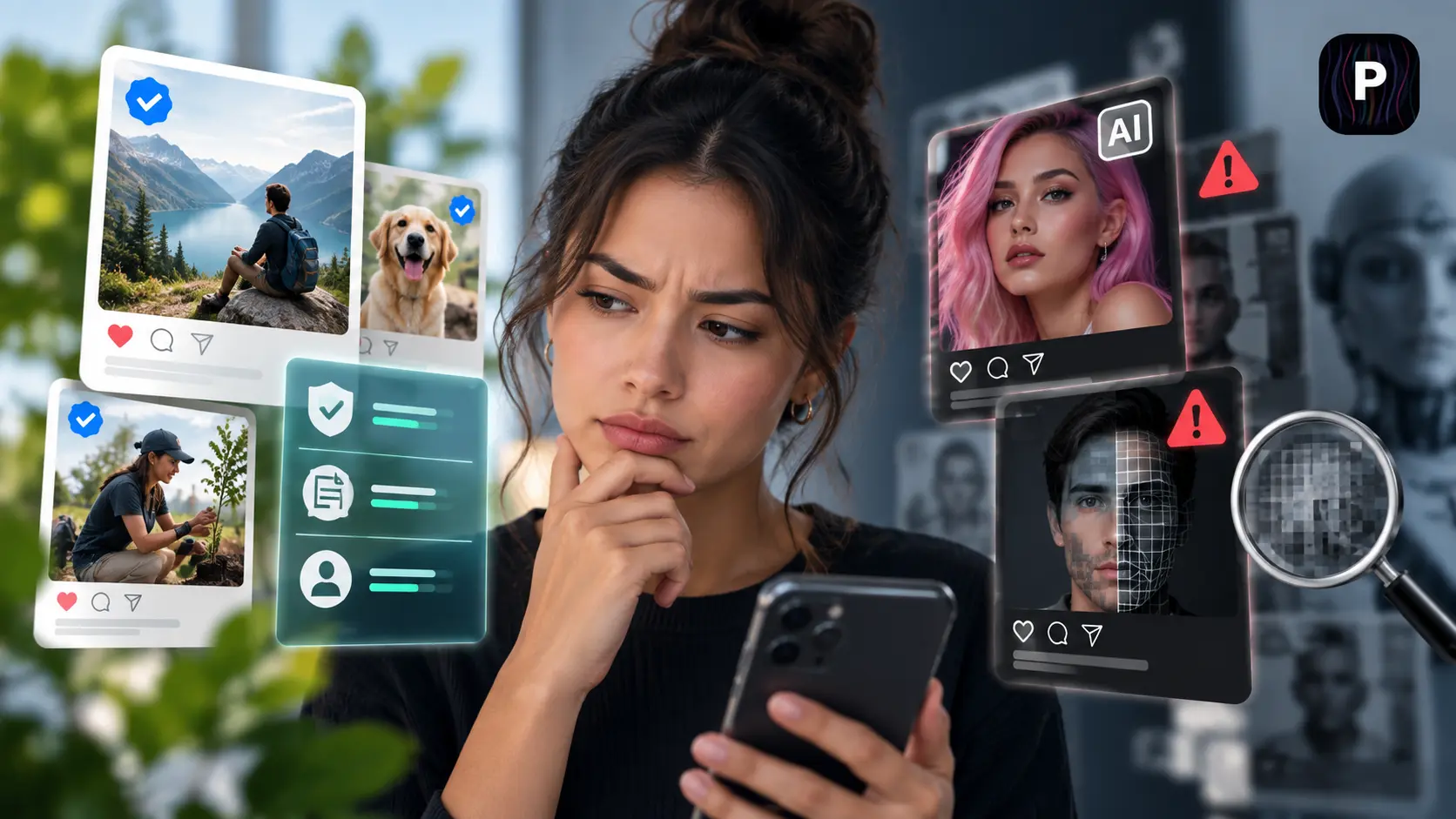
Explore why consumers are becoming more skeptical of social media content, how AI and misinformation affect brand credibility, and what businesses can do to make their content more trustworthy.
A polished social media post can attract attention.
But attention is not the same as trust.
Customers now encounter:
AI-generated images
Synthetic videos
Influencer promotions
Edited testimonials
Unverified claims
Fake-looking reviews
Misinformation
That makes a simple question more important:
“Can I believe this?”
Recent YouGov research found that 89% of UK adults think it is important for AI-generated content to be clearly identified, while 70% are concerned that there may not be enough rules or oversight around AI use. YouGov — What Does the Public Think of LLM-Generated Content?
A separate YouGov/Meltwater study covering seven markets found that 42% of UK consumers said they would trust a brand less if its content were AI-generated, compared with 34% in the U.S. Meltwater & YouGov — Trust in the Age of Generative AI
The better approach is:
Don't only make content look convincing. Give people reasons to believe it.
Why the Trust Gap Is Growing
People have always been skeptical of advertising.
But AI has made it harder to know what is real, what is edited, and what is completely synthetic.
A brand might publish an image that looks like a real product photograph.
A creator might publish a recommendation that looks spontaneous.
A customer testimonial might look genuine.
The audience may have no easy way to know how the content was produced.
Sprout Social's latest consumer research found that 52% of social media users are concerned about brands posting AI-generated content without disclosure, while 55% are more likely to trust brands committed to publishing human-created content. Sprout Social — Social Media Statistics and Consumer Data
This creates a new challenge:
The more content brands can produce, the more important credibility becomes.
Make AI Use Transparent
Using AI isn't automatically a trust problem.
Hiding it can be.
YouGov's 2026 UK research found that 89% of adults believe AI-generated content should be clearly identified. YouGov — Public Attitudes Toward LLM-Generated Content
The exact disclosure approach can depend on the platform, content type, and applicable rules, but the basic principle is straightforward:
Don't make customers guess how the content was produced.
For brands using AI, transparency can mean:
Clear AI labels when appropriate
Honest descriptions of synthetic visuals
Human review before publishing
No fabricated testimonials or experiences
No fake product demonstrations
AI can still help with:
Drafting
Editing
Creative variations
Translations
Production assistance
The key is making sure technology supports the brand rather than pretending to be something it isn't.
Show Evidence Instead of Making Bigger Claims
Trust grows when customers can check your claims.
Instead of:
“The most powerful product in its category.”
show:
Battery: 40 hours
Weight: 250g
Warranty: 2 years
Material: Aluminum
Instead of:
“Customers love it.”
show:
“4.8/5 from 2,400 verified reviews.”
Specific evidence gives the customer something concrete to evaluate.
TechCrunch reported in June 2026 on WordPress VIP research showing that 86% of U.S. consumers don't fully trust AI and still want to explore original sources, while 42% said AI-generated answers without clear attribution were less trustworthy than several other frustrating online experiences. TechCrunch — Consumers Still Want Original Sources in the AI Era
That has an important implication for brands:
Make it easy for customers to verify what you're saying.
IMAGE 2 — PROOF OVER CLAIMS
Put Real People and Experiences Into Your Content
Trust doesn't come only from facts.
It also comes from credible human experience.
Show:
Customers using the product
Employees explaining it
Founders discussing decisions
Real product testing
Behind-the-scenes processes
Unedited customer reactions
Sprout Social's 2026 data identifies human-generated content as the number-one thing social users want brands to prioritize, while its research also finds that consumers are more likely to trust brands that consistently publish human-created content. Sprout Social — Social Media Trends 2026
This doesn't mean every post needs a selfie.
It means customers should occasionally see:
The people, process, and experience behind the brand.
This also connects naturally with your existing article:
How to Create Social Media Content for Customers Who Want Real Experiences, Not Perfect Brands
IMAGE 3 — REAL EXPERIENCE
Make Product Information Easy to Verify
Trust can disappear quickly when basic information is unclear.
Customers want to know:
What exactly am I buying?
How much does it cost?
Who is it for?
When will it arrive?
Can I return it?
What does the product actually look like?
This is especially important as social platforms increasingly influence shopping journeys.
Sprout Social reports that 52% of Gen Z users are more likely to trust brand or product information found through social media than information from traditional search or AI chatbots, showing that social content itself can become an important source of product information. Sprout Social — Social Media Statistics
That means your social content should not force people to rely on vague claims.
Show:
Price
Specifications
Product demonstrations
Customer reviews
Shipping information
Return information
The more important the claim, the easier it should be to verify.
Be Consistent Across Social, Website, and Customer Service
Trust is damaged when different parts of a brand tell different stories.
Imagine:
Instagram: “Ships within 24 hours.”
Website: “Ships in 3–5 days.”
DM: “Usually ships next week.”
The problem isn't just logistics.
It's credibility.
Your:
Social posts
Product pages
Ads
DM responses
Reviews
Customer service
should communicate the same core facts.
This becomes even more important as shoppers use multiple sources to verify information.
A 2026 Semrush study of more than 1,000 U.S. consumers found that 86% verify AI-generated brand recommendations at least sometimes, with Google, brand websites, review sites, YouTube, friends/family, and social media all used as validation sources. Semrush — How AI Tools Influence the Modern Buyer Journey
The lesson:
Don't just try to be visible everywhere. Make sure the information matches everywhere.
IMAGE 4 — TRUST CONSISTENCY
Use Trust as a Creative Advantage
Trust doesn't need to be hidden in a legal page.
It can become part of your content.
For example:
Instead of:
“Premium materials.”
Show:
Close-up of the material + specification + manufacturing detail.
Instead of:
“Loved by thousands.”
Show:
Verified customer reviews + number of reviews.
Instead of:
“Our team cares.”
Show:
The team working on the product.
Instead of:
“AI-powered.”
Explain:
What AI does + what humans still control.
The result is content that gives customers evidence rather than pressure.
And that can be especially powerful when audiences are becoming more skeptical of synthetic content.
Build Trust Into Your Social Content System
Trust should not be a final review step.
It can be part of the creative process from the beginning.
For example:
Content idea
↓
Check the claim
↓
Find supporting evidence
↓
Choose real visual proof
↓
Create the creative
↓
Human review
↓
With The Post Engine, this can fit naturally into a content workflow where the same product or campaign is turned into different creatives while the underlying information stays consistent.
For example:
Product information
→ Product demonstration
→ Comparison creative
→ Customer proof
→ Educational carousel
The visual treatment can change, but the facts should remain aligned.
→How to Create Social Media Content That Turns Attention Into Brand Memory
→How to Create Social Media Content for AI-Powered Shopping Journeys
One focuses on memory; the other focuses on AI-assisted shopping. This article adds the missing layer:
Why customers need credible information before they trust what they see.
IMAGE 5 — TRUST-FIRST CONTENT SYSTEM
Frequently Asked Questions
Why are customers becoming more skeptical of social media content?
AI-generated media, misinformation, influencer advertising, edited visuals, and inconsistent information make it harder for people to determine what is genuine.
Does using AI automatically reduce brand trust?
No. Consumer reactions depend on how AI is used, the type of content, transparency, and the category. YouGov's 2026 research shows significant skepticism in some markets, while other audiences are more accepting. YouGov & Meltwater — Trust in the Age of Generative AI
Should brands disclose AI-generated content?
Transparency is increasingly expected. YouGov found 89% of UK adults consider it important for AI-generated content to be clearly identified. YouGov — LLM-Generated Content
What builds trust on social media?
Strong signals include:
Real customer experiences
Specific product information
Transparent claims
Human-created content
Visible evidence
Consistent information
Clear AI disclosure when appropriate
Can AI still be useful for social media marketing?
Yes. The issue is not simply whether AI is used. The important questions are where it is used, what it produces, whether the result is accurate, and whether a human has reviewed it. Sprout Social's 2026 research shows consumers can be comfortable with certain AI applications, especially when AI improves customer service rather than replacing the human relationship. Sprout Social — 2026 Social Media Trends
Final Takeaway
The social media trust problem isn't going away.
Customers are becoming better at asking:
“Is this real?”
“Who made this?”
“Can I verify it?”
“Can I trust this brand?”
The answer shouldn't come from louder marketing.
It should come from:
Transparency
Evidence
Real experiences
Specific information
Human oversight
Consistent facts
The process becomes:
Claim → Evidence → Transparency → Trust
The brands that stand out won't necessarily be the ones producing the most content.
They'll be the ones giving customers the strongest reasons to believe what they see.